Contractor vs Employee Classification: The IRS 20-Factor Playbook
Founder & CEO Insight — Enow A. Jovial
A worker paid $60,000 a year as a contractor costs $60,000 a year. Reclassified as an employee, the same worker costs $60,000 plus $4,590 of employer FICA — the cheapest part of the correction. The expensive parts are the taxes never withheld, the overtime never paid, and the penalties that attach to both. Classification compounds silently for years, then arrives all at once, in an audit letter.
This playbook runs the test the way the IRS runs it, prices the failure with one worker over three years, and gives the two exits the law provides — the VCSP and Section 530 relief. Every figure traces to a statute, a publication or a program page opened this cycle.
The test: control, in three categories
The IRS does not classify workers by job title, contract language or how the worker files their own return. Under the common-law rules, the whole relationship is examined — all information showing the degree of control and independence. The facts fall into three categories, and the IRS states the rule plainly: no "magic" number of factors makes a worker an employee, and no one factor stands alone. It applies the same way whether the hiring entity is an LLC, a C-Corp or a sole proprietorship.
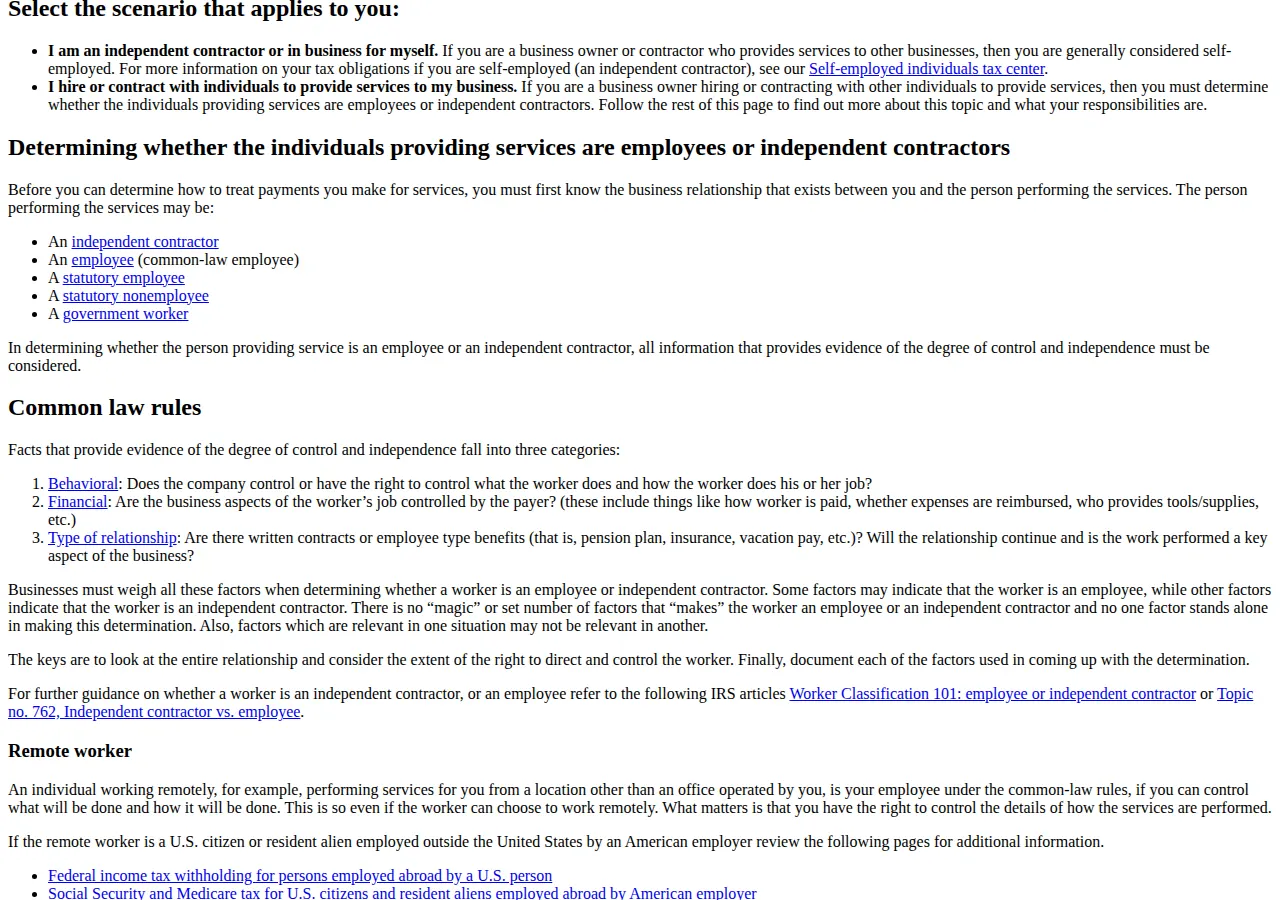
The twenty factors come from Revenue Ruling 87-41 (1987), issued after the IRS examined the cases and rulings on employment status. They are guides, not a scorecard; Publication 15-A (2026) groups them into the three categories below.
Behavioral control asks whether the business has the right to direct how the worker does the task. Instructions are the core evidence — when and where to work, what tools to use, what workers to hire, where to buy supplies, what a specified individual must do, and what order to follow. Training is the second strand: an employee may be trained to perform services in a particular manner, while contractors use their own methods. The key question, Publication 15-A stresses, is whether the business kept the right to control the details of performance — even with no instructions given, control may exist if the employer has that right.
Financial control asks whether the business controls the business aspects of the job: unreimbursed expenses — fixed ongoing costs counting most — investment in facilities or tools, whether the worker offers services to the market, the method of payment (an employee is generally paid by the hour, week or month; a contractor a flat fee or time and materials), and whether the worker can realise a profit or loss.
Type of relationship asks what the parties intended and built: written contracts; whether the business provides benefits such as insurance, a pension plan, vacation or sick pay; permanency — an indefinite engagement points to employment, a specific project to a contractor; and whether the services are a key aspect of the regular business — a law firm hiring an attorney presents that work as its own.
| Category | Points toward employee | Points toward contractor | Authority |
|---|---|---|---|
| Behavioral control | Detailed instructions; company training | Own methods; no training | Pub. 15-A (2026); Rev. Rul. 87-41 |
| Financial control | Hourly or monthly pay; expenses reimbursed | Flat fee or time and materials; own tools; profit or loss | Pub. 15-A (2026); Rev. Rul. 87-41 |
| Type of relationship | Benefits; indefinite term; key aspect | Contractor agreement; no benefits; project term | Pub. 15-A (2026); IRS classification page |
Count the factors honestly: one client, indefinite term, your tools, your hours, paid monthly, called a contractor — the profile auditors find.
The Department of Labor seesaw: which test applies today
The tax test above is the IRS test, and it has not changed. The wage test — the Fair Labor Standards Act test the Department enforces — has changed three times in five years. Track one test and the other catches you.
On January 10, 2024, the Department published a final rule, effective March 11, 2024, adopting a six-factor totality-of-the-circumstances economic reality test, codified at 29 CFR Part 795. On May 1, 2025, the Wage and Hour Division issued Field Assistance Bulletin No. 2025-1 and told investigators not to apply the 2024 rule in enforcement matters, directing them to use Fact Sheet 13 from July 2008, as further informed by Opinion Letter FLSA2019-6. The 2024 rule was not repealed: it remains in effect for private litigation. On February 27, 2026, the Department proposed rescinding it and replacing it with a five-factor test prioritising two core factors; the comment period closed April 28, 2026, and no final rule has published. Until one does, the position is split: the Department enforces the 2008 guidance, courts apply the 2024 rule, and a new rule is pending.
The state layer sits on top of both. California's Assembly Bill 5, codified at Labor Code Section 2775, applies the ABC test: a worker is an employee unless the hiring entity proves all three — free from its control and direction, work outside its usual course of business, and customarily engaged in an independently established trade of the same nature. Fail any one prong and the worker is an employee in California. Check the state where the worker sits. Our remote employee state income tax nexus playbook works the multi-state payroll side.
The price of getting it wrong: one worker, three years
Take a worker paid $60,000 a year as a contractor for three years, then reclassified — the arithmetic uses the rates in the statutes, not estimates.
The employment taxes
The employer share of Social Security and Medicare tax is 7.65% of wages — 6.2% Social Security plus 1.45% Medicare:
Over three years that is $13,770.00, before interest. The worker's own share — $4,590.00 a year — was never withheld, and neither was the income tax withholding. That is where Section 3509 comes in. The contractor, meanwhile, pays SECA tax — 15.3% on 92.35% of net earnings — instead of FICA, and cannot recover the employer's half later.
The Section 3509 reduced rates
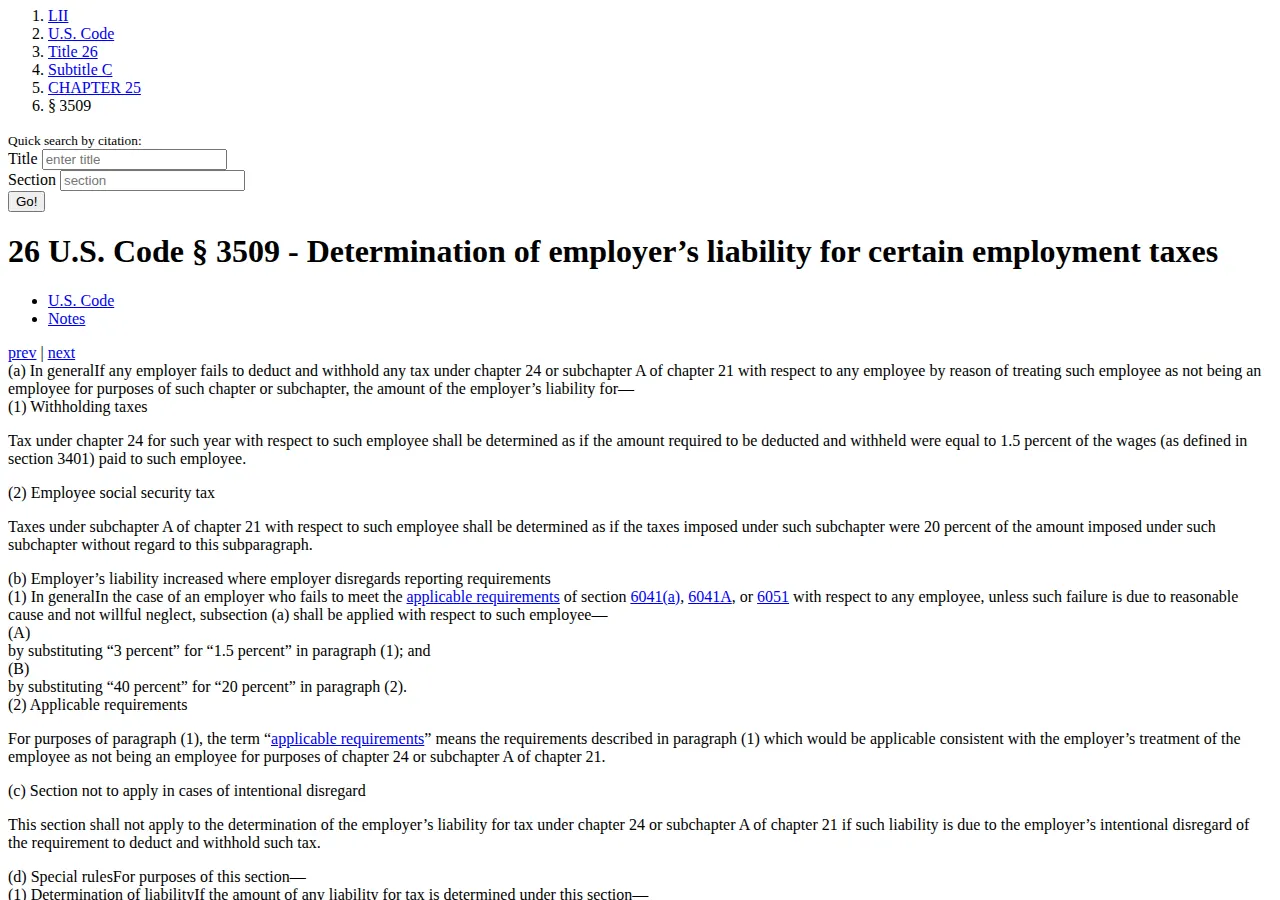
Section 3509 caps the employer's liability for the unwithheld employee-side taxes when the worker was treated as a non-employee. Under subsection (a), the withholding liability is determined as if 1.5% of the wages were required to be deducted, and the employee Social Security tax as if it were 20% of the amount otherwise imposed:
If the employer also failed the reporting requirements — no Form 1099 filed, for example — subsection (b) substitutes 3% for 1.5% and 40% for 20%, doubling the bill to $3,288.00 a year, or $9,864.00 over three years. Subsection (c) removes the relief entirely on intentional disregard of the requirement to deduct and withhold.
The wage bill
The tax bill is not the whole bill. Under the Fair Labor Standards Act, an employee paid as a contractor and never given overtime is owed back wages, and Section 216(b) adds an equal amount as liquidated damages — the award doubles. Example: a worker short $5 an hour, working 2,080 hours a year for three years:
That example uses a stated $5 shortfall; your number will differ, but the doubling does not. Liquidated damages are the statute's default, avoided only by showing good faith with reasonable grounds for believing the employer complied — a hard showing for a business that never ran the test.
The trust fund penalty
The sharpest edge is Section 6672: any person required to collect, truthfully account for and pay over tax who willfully fails to do so is liable to a penalty equal to the total amount evaded, or not collected, or not accounted for and paid over — a 100% penalty, assessed personally against the responsible person, the owner who signed the payroll decisions. Willfulness is not criminal intent; it means the person knew the taxes were due and paid someone else first.
The two exits the law provides
Exit one: the Voluntary Classification Settlement Program
The VCSP is the cheap exit, and it is voluntary — you take it before the audit, not after. It lets an employer reclassify workers prospectively as employees for future tax periods, paying 10% of the employment tax liability that would have been due on the workers' compensation for the most recent tax year, under the reduced rates of Section 3509(a). No interest, no penalties, and no employment-tax audit on the reclassified workers for prior years.
For the $60,000 worker, the VCSP payment is:
$164.40 — against a $13,770.00 employer FICA bill plus $1,644.00 a year of Section 3509 liability, plus penalties and interest. The conditions are real: the employer must have consistently treated the workers as non-employees, including filing all required Forms 1099 for the previous three years; must not be under employment-tax audit, or audit on the classification by the Labor Department or a state agency; and must apply on Form 8952 at least 120 days before it wants to begin treating the workers as employees. Miss the 1099 condition and the door is closed — which is why the 1099 matters every year, even for workers you are confident are contractors.
Exit two: Section 530 relief
Section 530 of the Revenue Act of 1978 — not a section of the Internal Revenue Code — relieves an employer from employment tax liability where the employer had a reasonable basis for the treatment. Publication 15-A states the conditions: a reasonable basis, all required federal information returns filed consistently with that treatment, and no worker in a substantially similar position treated as an employee for any period beginning after 1977. Relief does not determine the worker to be a contractor — the worker can still be determined an employee through an SS-8 — but it relieves the employment tax. The standard is met by a prior audit that did not disturb the treatment, a long-standing recognised practice of a significant segment of the industry, or reliance on a judicial precedent, published ruling or technical advice. A feeling that the industry does it this way is not a reasonable basis; a documented industry practice is.
The determination route: Form SS-8
When the facts are genuinely unclear, either party can file Form SS-8, Determination of Worker Status for Purposes of Federal Employment Taxes and Income Tax Withholding, and the IRS will review the facts and determine the worker's status — it may take at least six months. File it before the relationship hardens; it binds the tax treatment only, not the Labor Department's wage test or the state's ABC test.
Reclassify in four steps
- Run the three-category test on every worker, in writing — have a CPA review the file once a year — and keep the factor-by-factor record with the contract.
- Check the state test where the worker sits — California's ABC test can classify where the federal test does not.
- If a worker looks misclassified, apply for the VCSP on Form 8952 at least 120 days before the reclassification date, and file every 1099-NEC on time.
- If you have a reasonable basis — a prior audit, a documented industry practice, a published ruling — assemble the Section 530 file now, before the audit letter arrives.
Execution checklist
- [x] Run the three-category test on every worker, in writing — one paragraph per category, dated, kept with the contract.
- [x] Count the factors, not the labels — five or more pointing to employee status means reclassify or get advice.
- [x] Check the state test where the worker sits — California's ABC test can classify where the federal test does not.
- [x] File every 1099-NEC on time — collect the worker's SSN or EIN on Form W-9 before the first payment, since the form cannot be filed without it. It preserves the VCSP exit and keeps Section 3509 at 1.5% and 20% instead of 3% and 40%.
- [x] If a worker looks misclassified, apply for the VCSP first — Form 8952, at least 120 days before the reclassification date: $164.40 on a $60,000 worker.
- [x] If you have a reasonable basis, document it now — prior audit, industry practice, published ruling — before the audit letter arrives.
- [x] Price the correction with our tax estimator before deciding whether to fight or settle.
Classification is the cheapest compliance decision a business makes and the most expensive to get wrong. The test takes an afternoon. The correction, done voluntarily, takes $164.40 on a $60,000 worker; done after an audit, it takes the FICA, the withholding, the back wages, the liquidated damages and a personal 100% penalty. Run the test, write down the factors, file the 1099 — and reclassify before the letter arrives. Our quarterly payroll playbook covers filing once the worker is on payroll; our 1099-NEC guide covers the reporting that keeps the VCSP door open.