The three annual bills: one flat tax, one asset tax, one two-part fee
Delaware, Wyoming, and Nevada all sell the same product — a limited liability company — and all three charge you for it every year after formation. Delaware charges a flat $400 annual tax on every LLC, due June 1, with no annual report at all. Wyoming charges a license tax equal to the greater of $60 or $0.0002 per dollar of assets located and employed in Wyoming, due on the first day of your anniversary month. Nevada charges two fees that arrive together: a $150 annual list and a $200 state business license, $350 a year combined.
Why it matters: the state you pick taxes you every year, not once
Formation fees are one-time; annual compliance is recurring. An operator who forms in Delaware for the brand and forgets the June 1 tax owes $400 plus a $200 penalty plus 1.5 percent interest per month — $618 after three months late — and loses good standing until it is paid. An operator who forms in Nevada and files neither the annual list nor the business license owes $525 for that one missed year, and $825 if the charter is revoked and must be reinstated. An operator who forms in Wyoming and misses the anniversary-month report owes no flat late fee, but the company is dissolved if the report stays unfiled 60 days past due. The annual bill is also the only state cost that scales with the business in Wyoming: a holding company that parks $1,000,000 of equipment in Cheyenne pays $200 a year there, and one that parks $10,000,000 pays $2,000, while Delaware charges $400 either way.
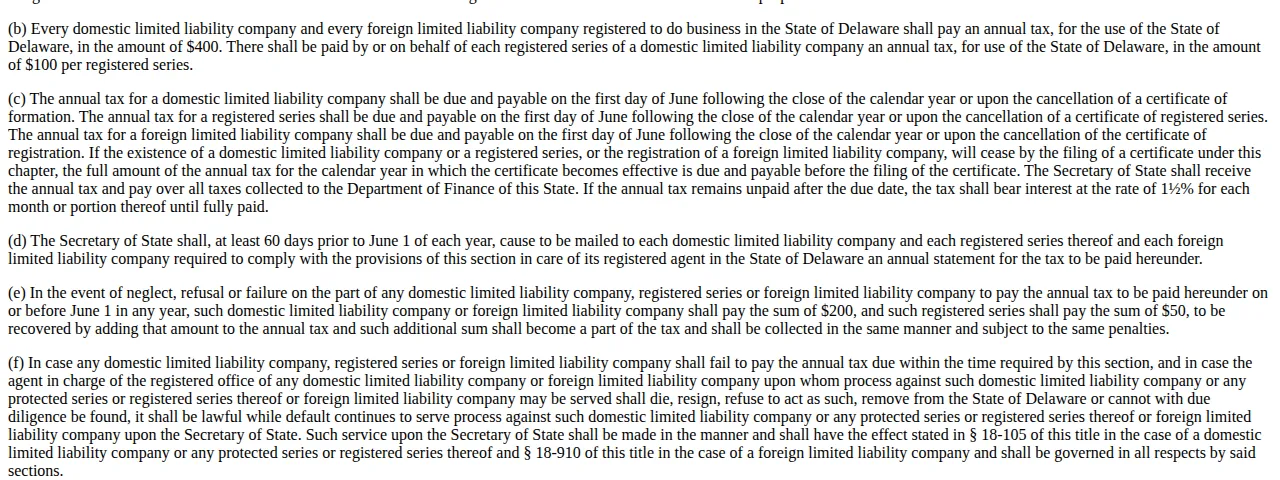
6 Del. C. section 18-1107(b): every domestic and foreign LLC pays an annual tax of $400, due June 1, with the full year's tax due before a certificate of cancellation is filed.
The fee schedules, read off the statute and the Secretary of State
All figures are the state-published charges read on 2026-11-05. Delaware's formation fee is from the Division of Corporations fee schedule revised August 1, 2026; the annual tax is from 6 Del. C. section 18-1107 as amended by House Bill 400, which raised it from $300 to $400 effective January 1, 2026, first payable June 1, 2027. Wyoming's figures are from the Secretary of State's FAQ. Nevada's are from the Nevada Revised Statutes.
| State charge | Delaware | Wyoming | Nevada |
|---|---|---|---|
| Formation filing | $110 certificate of formation | $100 articles of organization | $75 articles of organization (NRS 86.561(1)(a)) |
| Annual state charge | $400 annual tax, 6 Del. C. section 18-1107(b) | Greater of $60 or $0.0002 per dollar of Wyoming assets | $150 annual list (NRS 86.263(4)) + $200 business license (NRS 76.130(1)) = $350 |
| Due date | June 1, for the prior calendar year | First day of the anniversary month of formation | Last day of the anniversary month of formation |
| Late penalty | $200 plus 1.5% interest per month (section 18-1107(c), (e)) | No flat late fee; dissolved if unfiled 60 days past due | $75 list penalty (NRS 86.272(3)) + $100 license penalty (NRS 76.130(4)) |
Delaware's $110 formation fee is the Division's schedule figure — filing fee plus municipality fee for a one-page document. Delaware files no annual report, but the trade is that the $400 tax arrives as a single June 1 bill, with the only reminder the statement the Secretary of State mails to the registered agent at least 60 days before June 1 (section 18-1107(d)).
Wyoming's $60 is a floor, not a flat fee: $60 or two-tenths of one mill on the dollar ($0.0002) of assets located and employed in Wyoming, whichever is greater. An entity with $300,000 or less in Wyoming assets pays $60, because $300,000 multiplied by $0.0002 equals $60. File online and the processor adds a 2.4 percent card fee with a $1 minimum.
Nevada's two fees are filed together but governed by different statutes: the $150 annual list (NRS 86.263(4)) and the $200 state business license (NRS 76.130(1)). The statute sets the license fee at $500 for corporations under NRS chapters 78, 78A, or 78B — a trap for an LLC that converts and keeps budgeting $200.
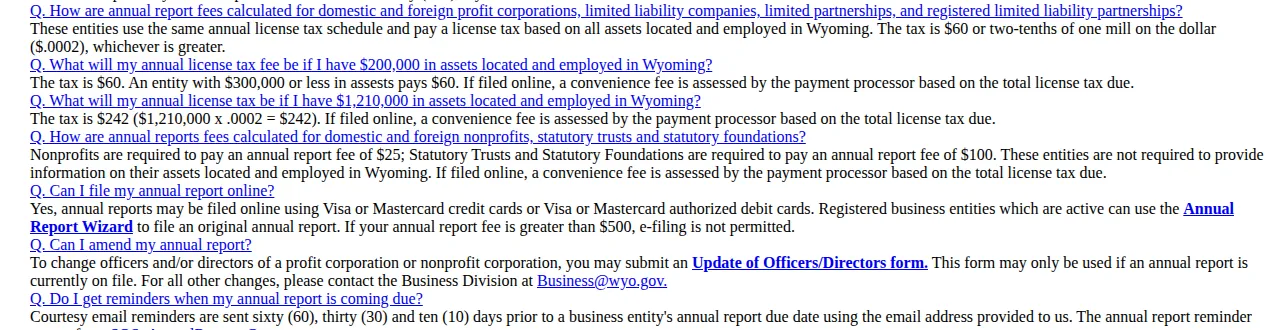
The Wyoming Secretary of State FAQ states the annual report license tax as $60 or two-tenths of one mill on the dollar ($0.0002) of assets located and employed in Wyoming, whichever is greater.
The five-year ledger
The honest comparison is formation plus five annual payments. The registered agent is excluded, because every state requires one and the agent's price is a market price, not a state fee.
| Horizon | Delaware | Wyoming (assets at or below $300,000) | Nevada |
|---|---|---|---|
| Year 1 | $110 + $400 = $510 | $100 + $60 = $160 | $75 + $150 + $200 = $425 |
| Three years | $110 + 3 × $400 = $1,310 | $100 + 3 × $60 = $280 | $425 + 2 × $350 = $1,125 |
| Five years | $110 + 5 × $400 = $2,110 | $100 + 5 × $60 = $400 | $425 + 4 × $350 = $1,825 |
| Five years, all-in with agent at $125/yr | $2,110 + $625 = $2,735 | $400 + $625 = $1,025 | $1,825 + $625 = $2,450 |
Over five years Delaware costs $1,710 more than Wyoming in state charges alone, and $285 more than Nevada. Nevada costs $1,425 more than Wyoming. The agent is the same $625 in all three states, so it does not change the ranking. An agent bought for $50 a year instead of $125 saves $375 over five years — more than the entire five-year Wyoming state bill. Delaware's $400 for the formation year is not due until June 1 of the following year.
The break-even lines: where Wyoming stops being cheapest
Wyoming's license tax rises with Wyoming assets, while Delaware's and Nevada's do not move. That produces two break-even points.
Wyoming ties Delaware when the license tax equals $400: $400 divided by $0.0002 equals $2,000,000 of Wyoming assets. Below that, Wyoming is cheaper; above it, Delaware's flat $400 wins. Wyoming ties Nevada when the tax equals $350: $350 divided by $0.0002 equals $1,750,000 of Wyoming assets. Below that, Wyoming is cheaper; above it, Nevada's flat $350 wins.
| Wyoming assets | Wyoming license tax per year | Cheapest state |
|---|---|---|
| $300,000 or less | $60 | Wyoming ($60 vs $350 Nevada, $400 Delaware) |
| $1,000,000 | $200 | Wyoming ($200 vs $350 Nevada, $400 Delaware) |
| $1,750,000 | $350 | Tie with Nevada; Wyoming still beats Delaware |
| $2,000,000 | $400 | Tie with Delaware; Nevada cheapest at $350 |
| $10,000,000 | $2,000 | Nevada ($350 vs $400 Delaware, $2,000 Wyoming) |
A holding company that moves a $10,000,000 equipment fleet into Wyoming pays $2,000 a year in license tax alone — five times Delaware's $400 and nearly six times Nevada's $350.
The late-payment ledger
Late payment is where the three states diverge hardest. Delaware charges money: a $200 penalty plus 1.5 percent interest per month. Nevada charges money and then takes the charter: a $75 penalty on the late list plus a $100 penalty on the late license, and the LLC that stays in default forfeits its right to transact business until it reinstates. Wyoming charges no money and takes the company: no flat late fee, but administrative dissolution if the report stays unfiled 60 days past due.
| Missed deadline | Delaware | Wyoming | Nevada |
|---|---|---|---|
| Paid 3 months late | $400 + $200 + (3 × $6.00) = $618 | $60, no flat fee | $150 + $75 + $200 + $100 = $525 |
| Never paid | Loss of good standing until paid, plus penalties and interest | Dissolved 60 days past due; re-formation required | Forfeiture of the right to transact business; $300 reinstatement |
Delaware's interest is 1.5 percent per month or portion thereof under section 18-1107(c), so even one day into the next month adds another $6.00 on a $400 tax. The $200 penalty under section 18-1107(e) is added to the tax, and the LLC loses good standing under section 18-1107(h) until the tax and penalties are paid.
Decision table
| Operator shape | Cheapest state over five years | Why | Watch out for |
|---|---|---|---|
| Consulting LLC, under $300,000 in Wyoming assets | Wyoming — $400 state, $1,025 all-in | $60 a year, the lowest charge | Anniversary-month deadline; dissolution 60 days past due |
| Holding company, $1,000,000 of Wyoming assets | Wyoming — $200 a year | Below Nevada's $350 and Delaware's $400 | Recompute the tax as assets move |
| Holding company, $10,000,000 of Wyoming assets | Nevada — $350 a year | Flat $350 beats Wyoming's $2,000 tax | Two fees, two statutes, two penalties |
| Venture-backed startup raising on Delaware documents | Delaware — $400 a year | Investors expect Delaware | $400 every June 1, no report to remind you |
| Operating business with a Nevada storefront | Nevada — $350 a year | The license is required anyway | The $500 corporation license rate if you convert |
Founder & CEO Insight — Enow A. Jovial
Who should NOT pick each state
Who should NOT pick Delaware: an operator whose only reason is the $110 formation fee, a single-member LLC with no investors and no acquisition plan, or a holding company whose assets will sit in Wyoming above $2,000,000. Delaware's $400 a year buys the brand, the Court of Chancery, and investor familiarity — if you need none of those, you pay $340 a year more than Wyoming for a label.
Who should NOT pick Wyoming: an operator who will not calendar an anniversary-month deadline, a company whose Wyoming asset base will cross $1,750,000 and stay there, or anyone who needs a warning before the state dissolves the company. Sixty days past due the company is dissolved.
Who should NOT pick Nevada: an operator who wants one fee and one deadline, a company that will convert to a corporation and forget the license jumps to $500, or anyone who files the annual list and assumes the license is covered.
File the year in five steps
- January: list the three due dates. Delaware June 1, Wyoming the first day of your anniversary month, Nevada the last day of it.
- February: value the Wyoming assets. Multiply the assets located and employed in Wyoming by $0.0002. Above $350, price Nevada; above $400, price Delaware.
- March: confirm the registered agent. The agent receives Delaware's tax statement and Nevada's renewal notice. A dead agent is how a $400 tax becomes a $618 cure.
- April: pay the earliest deadline first. Wyoming's anniversary-month report comes before Delaware's June 1 tax for most formation months.
- June: verify good standing in writing. Pull a certificate of good standing from each state of registration.
Execution checklist
- [x] Formation fee confirmed: Delaware $110, Wyoming $100, Nevada $75 — read the state schedule.
- [x] Annual charge computed: Wyoming max($60, $0.0002 × Wyoming assets); Delaware $400 flat; Nevada $150 + $200.
- [x] Five-year ledger run: Delaware $2,110, Wyoming $400, Nevada $1,825; Wyoming stops beating Nevada at $1,750,000 of Wyoming assets, Delaware at $2,000,000.
- [x] Late-payment cure priced: Delaware $618 after three months; Nevada $525, or $825 with reinstatement; Wyoming dissolved after 60 days.
- [x] Due dates calendared as payments: Delaware June 1, Wyoming first day of the anniversary month, Nevada last day of the anniversary month.
- [x] Registered agent confirmed current: the agent is the address the state mails to.
The cheapest state is the one whose annual charge fits your asset base and whose deadline you will meet. For a small LLC with under $300,000 in Wyoming assets, that is Wyoming at $60 a year. For a holding company above $1,750,000 in Wyoming assets, that is Nevada at $350 a year. For a venture-backed startup, that is Delaware at $400 a year — not because $400 is cheap, but because it buys the jurisdiction your investors priced in. Run the five-year ledger through the tax estimator before you commit. The LLC dissolution and tax clearance playbook covers winding the company up, including Delaware's $220 cancellation fee. The Delaware franchise tax calculation guide prices the C-corporation side, and the single-member LLC charging order guide compares the asset-protection statutes behind the three states.