Donor-Advised Fund vs Private Foundation: 2026 Giving Playbook
Founder & CEO Insight — Enow A. Jovial
Two vehicles move large charitable gifts in the United States. A donor-advised fund (DAF) is an account inside a public charity: you contribute, take the deduction that year, and recommend grants while the sponsor owns the money. A private foundation is a separate entity you control. The choice turns on four numbers — the deduction limit, the payout rule, the excise tax, and the annual cost — and on one question: how much control do you need?
1. The Two Vehicles, In One Paragraph Each
A donor-advised fund is a separately identified fund maintained by a section 501(c)(3) organization called a sponsoring organization — the IRS's definition. Once you contribute, the sponsor has legal control of the money. You keep advisory privileges — recommend, not direct — and the sponsor approves every grant.
A private foundation is a 501(c)(3) that is not a public charity — typically funded and controlled by one family or company. You or your board decide investments, pick grantees, hire staff, and sign the returns. That control is the product, and it creates the obligations: an annual Form 990-PF open to public inspection, a 5% minimum distribution, a 1.39% excise tax, and sections 4940 through 4966.
Donor-advised funds held $327.87 billion at the end of fiscal year 2024, with $90.57 billion contributed and $64.60 billion granted, per the DAFRC's Annual DAF Report 2025 (IRS Form 990 data). per the NPT 2024 DAF Report (PDF), grants and expenditures from private foundations totaled $114.11 billion in 2023.
2. The Deduction Limits: Where the DAF Wins on Paper
The deduction is the first place the two vehicles part ways — the gap is written into 26 U.S.C. § 170(b). A DAF sponsor is a public charity, so gifts to it take the public-charity limits; a foundation takes the lower limits Congress reserved for it. Every limit below is a percentage of AGI, and every excess carries forward five years.
| Gift | Donor-advised fund | Private foundation | Authority |
|---|---|---|---|
| Cash | 60% of AGI | 30% of AGI | § 170(b)(1)(G) / (B) |
| Appreciated property | 30% of AGI, FMV | 20% of AGI, basis | § 170(b)(1)(C) / (D); Pub. 526 |
Cash is the cleanest comparison: § 170(b)(1)(G) allows cash gifts to public charities up to 60% of the contribution base; § 170(b)(1)(B) caps gifts to private foundations at 30%. At $400,000 of AGI, a donor deducts $240,000 of cash through a DAF this year and $120,000 through a foundation. The remaining $80,000 carries forward up to five years.
Appreciated property is where the gap turns into a cliff. Long-term capital gain property given to a public charity is deductible at fair market value, capped at 30% of AGI under § 170(b)(1)(C). The same property given to a private nonoperating foundation is capped at 20% of AGI under § 170(b)(1)(D), and IRS Publication 526 adds the sharper rule: except for qualified appreciated stock — publicly traded shares with readily available quotations — it is deductible only at your cost basis. Private-company shares worth $100,000 on a $20,000 basis deduct at $100,000 through a DAF and $20,000 through a foundation.
3. The 5% Rule and the 1.39% Tax: The Foundation's Annual Bill
A private foundation pays for its control every year, in two charges the DAF never sees. The first is the distribution rule: § 4942(e) sets the minimum investment return at 5% of the fair market value of investment assets — everything not used directly in its exempt purpose, less acquisition debt. The foundation must pay out roughly that 5%, less taxes, as qualifying distributions. Section 4942(a) enforces it: undistributed income left over at the start of the second following year draws a 30% initial excise tax. A $1,000,000 foundation that distributes nothing owes roughly $50,000 of grants plus a $15,000 tax.
The second is the excise tax itself: § 4940(a) imposes 1.39% on a private foundation's net investment income — dividends, interest, rents, royalties, and capital gains, less related expenses. The IRS requires it on Form 990-PF, paid annually or quarterly when the total reaches $500.
A DAF has no federal payout rule; the DAFRC's 2025 report puts the aggregate payout rate at 25.2% for fiscal 2024, though sponsors impose their own activity policies — National Philanthropic Trust requires a grant at least once every three years.
4. What It Costs to Run Each One
Fidelity Charitable — the largest DAF sponsor — publishes its schedule on its own fee page, opened by our editorial team this cycle. The Giving Account has no minimum to open and a $50 minimum grant. The annual administrative fee is 0.60% or $100, whichever is greater, on the first $500,000; 0.30% on the next $500,000; 0.20% on the next $1,500,000; and 0.15% on the next $2,499,999. Investment expenses run 0.015% to 0.93%. Fidelity's own example: a $600,000 balance pays $3,300 a year.
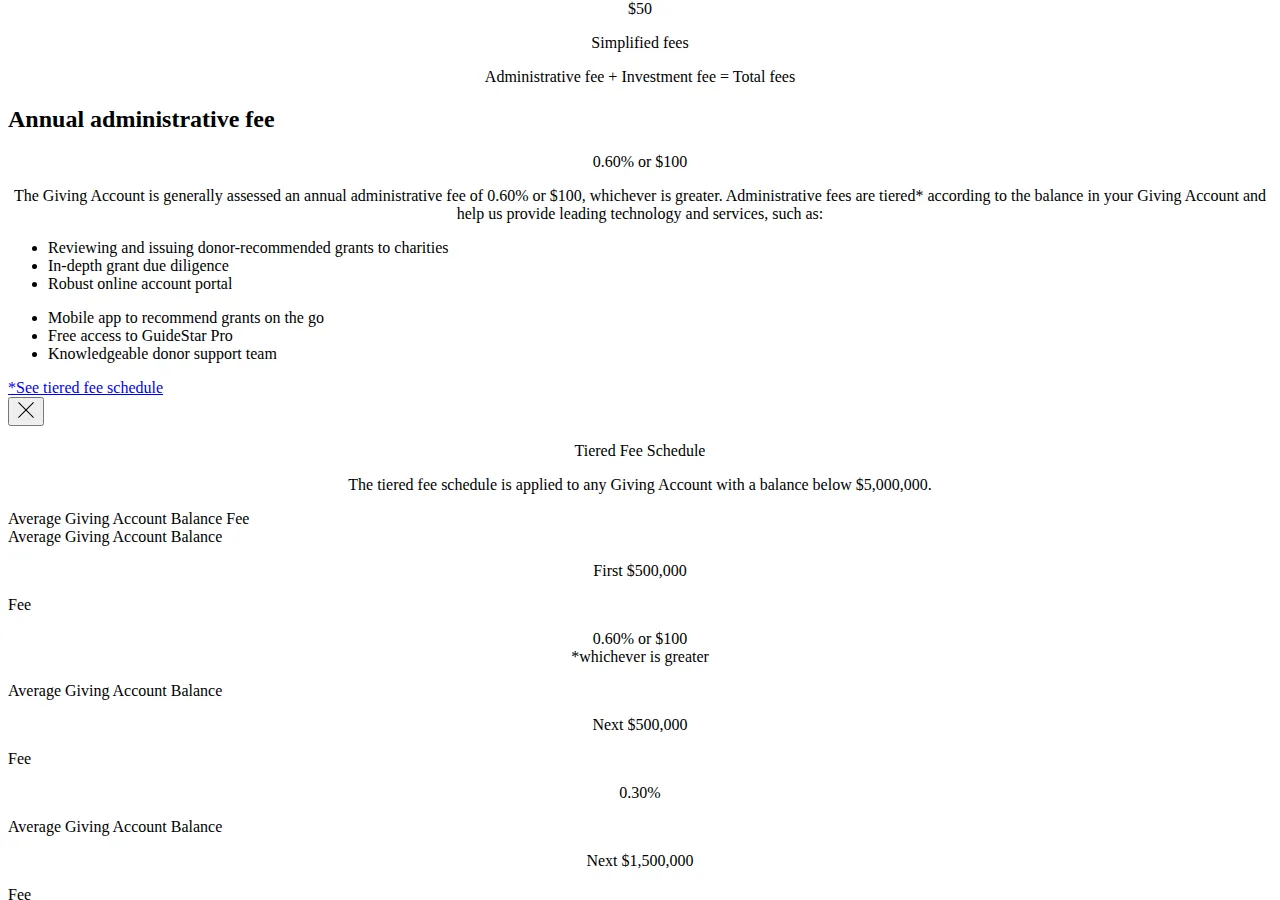
Vanguard Charitable requires a $25,000 initial contribution and $5,000 for each additional one, sets a $500 minimum grant, and charges the same 0.60% on the first $500,000, stepping down to 0.30% and lower at higher tiers — plus a $250 annual maintenance fee if the balance falls below $25,000. DAFgiving360, formerly Schwab Charitable, requires no minimum to open, sets a $50 minimum grant, and charges 0.60%. Both schedules come from independent 2026 reads — the sponsors' own fee pages blocked this network's requests — so treat these two as corroborated-secondary.
A private foundation's cost has no price list. The excise tax is computable — 1.39% of net investment income — but the rest is bespoke: formation and legal fees, annual accounting by a CPA, 990-PF preparation, board meetings, state registrations, and investment management. Below roughly $1 million in assets, those fixed costs consume a share of the endowment no DAF fee schedule approaches, which is why advisors commonly put the practical floor for a foundation between $250,000 and $1 million of initial funding.
5. The Worked Math: Three Gift Profiles, One Formula
Profiles use a stated $400,000 AGI and 35% rate.
Example: profile (a) — the $200,000 cash gift. Through a DAF, the 60% limit allows $240,000, so the full $200,000 is deductible now. Through a foundation, the 30% limit allows $120,000 now, and $80,000 carries forward five years.
For the gift-tax side of a large transfer, see our gift-tax annual exclusion playbook.
Scenario: profile (b) — the appreciated private shares. Shares worth $100,000, bought for $20,000 and held more than a year, in a private company. Through a DAF, the gift is deductible at fair market value — $120,000 of room — so the full $100,000 is deductible and the $80,000 of gain is never taxed. Through a foundation, the same shares deduct only at the $20,000 basis.
Publicly traded stock mostly closes the gap: qualified appreciated stock keeps FMV treatment at the foundation, capped at 20% of AGI — $80,000 now, $20,000 carried forward.
Case Study: profile (c) — the $1,000,000 foundation's annual bill. A $1,000,000 endowment at 6% produces $60,000 of net investment income.
The same $1,000,000 in a Fidelity DAF pays $4,500 a year in administrative fees, plus investment expenses, with no distribution or excise tax. The foundation pays $834 of excise tax, must grant $50,000, and carries the filing and governance costs on top. For the estate side of a gift this size, see our estate-tax exemption playbook.
6. Control, Anonymity, and What Each Vehicle Cannot Do
The DAF's price is control: you recommend, the sponsor decides. A grant recommendation can be declined; the sponsor's due diligence is the final word. You cannot direct investments beyond the sponsor's menu.
Grants go to qualified public charities only; verify the grantee's EIN first. A DAF cannot fulfil a personal pledge, buy gala tickets, pay for memberships with a non-deductible component, reimburse expenses, or grant to an individual. It cannot grant to a private nonoperating foundation, and no IRA qualified charitable distribution can go to a DAF. Section 4966 backs the boundary: a taxable distribution draws a 20% tax on the sponsor and 5% on any fund manager who knowingly agreed.
The foundation's price is exposure: the Form 990-PF lists contributors, grantees, trustees, grants, fees, and salaries, and anyone can read it. In exchange the foundation can hire family, run its own programs, and grant to individuals for scholarships or hardship under expenditure-responsibility rules. Anonymity is the DAF's exclusive feature — NPT states DAFs are the only vehicle allowing 100% anonymous grants, because the sponsor, not the donor, is legally making the distribution.
7. The Decision Table
| Decision factor | Donor-advised fund | Private foundation | Authority |
|---|---|---|---|
| Cash deduction limit | 60% of AGI | 30% of AGI | § 170(b)(1)(G) / (B) |
| Appreciated property | 30% of AGI, FMV | 20% of AGI, basis | § 170(b)(1)(C) / (D); Pub. 526 |
| Minimum annual payout | None (federal) | 5% of investment assets | § 4942(e); NPT |
| Excise tax on NII | None | 1.39% of net investment income | § 4940(a) |
| Minimum to open | $0 (Fidelity, DAFgiving360); $25k (Vanguard) | None; floor $250k–$1m | Sponsor fee pages |
| Minimum grant | $50 (Fidelity, DAFgiving360); $500 (Vanguard) | None | Sponsor fee pages |
| Control | Advisory only | Full board control | IRS DAF page |
| Anonymity | 100% anonymous grants possible | 990-PF is public record | NPT; IRS |
| Grants to individuals | No | Yes, with expenditure responsibility | § 4966 |
8. Who Should Avoid Each Vehicle
A donor-advised fund is the wrong vehicle for a family that wants the giving itself to be the institution — a named foundation — or for a donor who needs to grant to individuals or employ family. It is wrong for a donor whose gifts are mostly private-company shares or real estate — the basis rule takes $28,000 of tax saving off a $100,000 gift.
A private foundation is the wrong vehicle for a donor giving under $250,000, where the fixed costs of formation, accounting, and the 990-PF eat the endowment faster than any DAF fee. It is wrong for a donor who wants to give quietly — the 990-PF publishes every grant, trustee, and salary. It is wrong for a donor who will not meet the 5% distribution every year, because the 30% tax under § 4942(a) turns a missed deadline into a penalty. For the Schedule A mechanics, see our Schedule A itemized deductions playbook.
9. The Five-Step Workflow: Choose, Fund, and Run the Vehicle
Step 1: Price the gift before you pick the vehicle. Take the gift amount, the asset type, and your AGI, and apply the limits in section 2 — or run them through the tax estimator. A $200,000 cash gift at $400,000 AGI deducts in full through a DAF, only $120,000 now through a foundation.
Step 2: Pick the sponsor or file the foundation. For a DAF, open the account at the sponsor whose minimums fit: Fidelity Charitable or DAFgiving360 at $0, Vanguard at $25,000. For a foundation, incorporate and apply for exemption on Form 1023.
Step 3: Fund it in the high-income year. Contribute before December 31 of the deduction year. The DAF deduction lands in the contribution year. Keep the acknowledgement letter and Form 8283.
Step 4: Set the grant calendar — or the distribution deadline. For a DAF, name successor advisors and set a grant rhythm — NPT's policy is a grant at least once every three years. For a foundation, calendar the distributable amount.
Step 5: File, disclose, and review annually. A DAF donor files nothing. A foundation files Form 990-PF every year and pays the 1.39% excise tax.
10. Execution Checklist: Fund the Right Vehicle, Once
- [x] Step 1: Run the limit math — cash 60% vs 30%, property 30% at FMV vs 20% at basis.
- [x] Step 2: Match the asset to the vehicle — public stock keeps FMV treatment; private shares do not.
- [x] Step 3: Open the DAF or incorporate the foundation — $0 at Fidelity and DAFgiving360; $25,000 at Vanguard.
- [x] Step 4: Fund before December 31 — the deduction year is the contribution year.
- [x] Step 5: Calendar the 5% distribution and 1.39% excise tax — Form 990-PF, quarterly estimates at $500+.
- [x] Step 6: Keep the paper — acknowledgement, appraisal, Form 8283, and the 990-PF.
The DAF wins the arithmetic: a higher deduction, no payout rule, no excise tax, and a fee from $600 a year on $100,000. The foundation wins the one thing the DAF cannot sell — control.