Employee Retention Credit: IRS Moratorium, Claim or Withdraw Playbook
Founder & CEO Insight — Enow A. Jovial
A business holding an Employee Retention Credit claim holds a refund the IRS will pay, a refund it will disallow, or a liability dressed as an asset. No new claim can be filed: the windows closed April 15, 2024 for 2020 wages and April 15, 2025 for 2021, and the One, Big, Beautiful Bill Act barred the IRS from allowing or refunding third- and fourth-quarter 2021 claims filed after January 31, 2024. What remains is the decision: defend, withdraw, or answer the disallowance letter.
A 10-employee business at the $10,000 cap in each quarter of 2021 holds a $280,000 claim. Paid, it is $280,000 of cash; disallowed after payment, the worked cost here is $294,072.34 — more than the claim itself. The difference is whether the business can prove, quarter by quarter, that it met one of the two tests.
The decision in one table
| Your position | The move | Cost | Risk | Authority |
|---|---|---|---|---|
| Filed, unpaid, documented | Defend it | Time and records | Disallowance | IRC § 3134 |
| Filed, unpaid, eligibility weak | Withdraw the Form 941-X | Refund forgone | None — treated as never filed | IRS |
| Paid, eligibility weak | Repay voluntarily and amend | Repayment + interest | 20% penalty and audit | OBBBA § 70605 |
| Letter 105-C received | Protest or sue | Fees | Losing the suit right | IRC § 6532(a) |
| Q3/Q4 2021 filed after Jan. 31, 2024 | Accept disallowance | The claim | None — statutory bar | OBBBA § 70605 |
What the credit actually pays
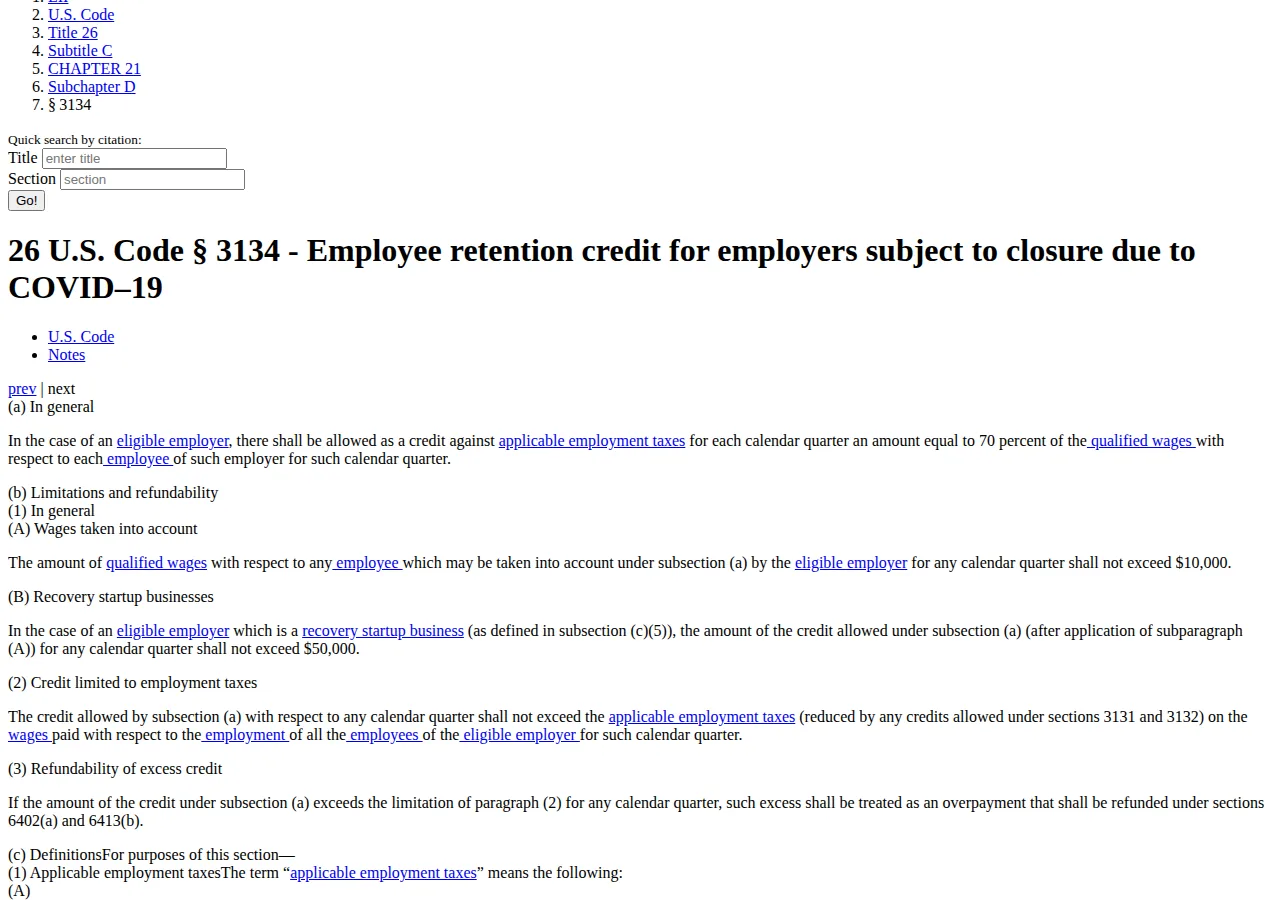
The Employee Retention Credit is a refundable payroll tax credit for employers that kept paying employees during COVID-19, covering qualified wages paid after March 12, 2020 and before January 1, 2022.
| Rule | 2020 wages | 2021 wages | Authority |
|---|---|---|---|
| Credit rate | 50% | 70% | CARES Act § 2301; IRC § 3134(a) |
| Qualified-wages cap | $10,000 per employee per year | $10,000 per employee per quarter | IRS chart |
| Maximum per employee | $5,000 | $28,000 over four quarters | IRS chart |
| Gross-receipts test | Below 50% of same quarter in 2019 | Below 80% of same quarter in 2019 | IRC § 3134(c)(2) |
| Large-employer threshold | 100 or fewer full-time employees in 2019 | 500 or fewer in 2019 | IRS chart |
Eligibility runs through one of two doors, and a business needs only one per quarter: the gross-receipts decline above, or the government-order test — operations fully or partially suspended by an order from an appropriate governmental authority limiting commerce, travel or group meetings because of COVID-19. The order must be a government order, not a recommendation.
The large-employer threshold changes what counts as qualified wages: below it, wages paid to every employee count; above it, only wages paid to employees not providing services count. Wages used for the credit cannot also be deducted — claiming the credit reduces the wage deduction by the same amount.
The worked math: a 10-employee claim at the cap
A 10-employee business at the $10,000 cap in every quarter of 2021, meeting the gross-receipts test in all four:
The same ten employees in 2020:
The qualified wages behind the 2021 claim are $400,000 — the deduction given up, and restored if disallowed.
The moratorium: what stopped, what did not
On September 14, 2023, the IRS announced an immediate moratorium on processing new ERC claims, through at least December 31, 2023. The agency had received about 3.6 million claims, and Commissioner Danny Werfel ordered the pause after tax professionals and media reports showed a substantial share were ineligible. It applied to claims received on or after September 14, 2023; earlier claims kept moving, and the processing goal stretched to 180 days.
The moratorium changed neither payouts on filed claims nor the filing deadlines. Processing resumed August 8, 2024 for claims filed through January 31, 2024, lowest-risk first, with 50,000+ refunds to pre-moratorium filers. The first disallowance wave: on December 6, 2023, the IRS mailed more than 20,000 Letter 105-C disallowances to entities that did not exist during the eligibility period or had no paid employees.
The 2026 status: what the IRS says, and what it has not said
As of the week ending October 3, 2026, the IRS reports approximately 13,000 remaining claims: about 750 under review, 2,300 pending payment or disallowance, 3,000 under audit, 5,400 awaiting review of disallowance responses, and 1,500 with Appeals.
In GAO-26-107456 (Feb. 2026), the GAO reported IRS officials told it the agency had closed all remaining claims, aside from those under examination or appeal, by Dec. 31, 2025 — about 41,000 in examination or appeal — but provided no documentation, no definition of "closed," and no public announcement as of Jan. 2026.
The 2025 rewrite: the One, Big, Beautiful Bill
The One, Big, Beautiful Bill Act (P.L. 119-21, signed July 4, 2025) rewrote the ERC rules for claims already filed. Section 70605 does four things:
First, the bar: for third- and fourth-quarter 2021 claims filed after January 31, 2024, the IRS may not allow or refund the credit — unless the refund was already paid before July 4, 2025. Fact Sheet 2025-07 confirms a claim counts as filed by January 31, 2024 only if postmarked and properly mailed, or submitted, by that date. A claim filed after that date is barred by statute — the merits cannot overcome a filing-date bar.
Second, the audit window: the period for the IRS to assess third- and fourth-quarter 2021 claims is now six years from filing, up from five — and the same six-year window now applies to claiming the wage deduction for a disallowed ERC.
Third, the penalty: the 20% penalty for an erroneous claim for refund or credit, previously limited to income tax, now applies to ERC claims.
Fourth, the promoters: due-diligence requirements, a $1,000 penalty for each failure, and a definition of promoter by the share of gross receipts earned from advising on ERC claims. Reliance on a promoter's advice is not a defense to repayment.
Disallowance: Letter 105-C and the two-year clock
A disallowed claim arrives as Letter 105-C, Notice of Claim Disallowance. The first wave targeted the clearest cases — entities that did not exist during the eligibility period, and entities with no paid employees. Later disallowances run through the IRS risk-scoring model: analytics flag a claim as high-risk and disallow it without an examination, then ask the taxpayer to substantiate it — disallowance first, proof second, as the Taxpayer Advocate has called it.
The clock starts on the letter date. Under IRC § 6532(a), a suit for recovery must be filed within two years of the mailing of the notice of disallowance, and requesting an appeal does not extend that period. The options are protest to Appeals, or suit in federal court. If Appeals is still pending as the two years run out, the business needs Form 907 before the period expires, or the right to sue is lost. The Taxpayer Advocate has reported 316 claims denied because the period had run.
Withdrawal: the clean exit for unpaid claims
For a claim that has not been paid, the IRS offers a withdrawal process. It covers a claim not yet paid, or a refund check received but not cashed or deposited. The business withdraws the entire adjusted employment tax return — Form 941-X, 943-X, 944-X or CT-1X — for the tax period that included the ERC claim. A withdrawn claim is treated as if it were never filed; there is no partial withdrawal.
Fax the withdrawal request to 855-738-7609, or mail it to the address in the adjusted-return instructions. If the business is under audit, submit it to the examiner instead. If a Letter 105-C has already arrived, the withdrawal route is closed — the response is a protest or a suit. Withdrawal does not shield against criminal exposure: the IRS states plainly it does not exempt the taxpayer from potential criminal investigation and prosecution.
For claims already paid, the IRS's two voluntary-disclosure windows — repay 80% by March 22, 2024, or 85% for 2021 periods by November 22, 2024 — are both closed; the remaining route is to amend and repay in full, with interest.
The cost of waiting vs withdrawing: the worked exposure
Example: take the $280,000 model claim, paid in full, then disallowed two years later. The IRS underpayment interest rate is 7% for the fourth quarter of 2026 under IRC § 6621, compounded daily. At 7% over two years:
A disallowed $280,000 claim costs $294,072.34 in cash — $14,072.34 more than the refund itself. Before the promoter's fee: if a promoter took a 20% contingency fee of $56,000 at payment and the business cannot recover it, the loss rises to $350,072.34. The 20% fee is a labelled modelling assumption — promoters' fees vary, and the IRS has said only that many charged a percentage fee.
For a claim already paid and still under review, the arithmetic points the other way. The expected value of waiting, where p is the probability of disallowance:
| Probability of disallowance (p) | Expected value of waiting |
|---|---|
| 25% | $206,481.91 |
| 75% | $59,445.74 |
| 95.21% | $0 — breakeven |
Waiting stays positive until disallowance probability passes 95.21%. A claim with records behind it is worth defending even at a 75% chance of losing: the upside is $280,000, the downside on a paid claim $14,072.34. Withdraw when the claim is nearly certainly dead — no employees, entity formed after the window, a Q3/Q4 2021 claim filed after January 31, 2024. An unpaid claim that is disallowed forfeits the refund itself — there is nothing to repay and no interest — so for an unpaid claim the waiting math is simpler: defend it unless it is barred or the facts are dead.
The decision framework: which bucket are you in
Five buckets: A — Defend: filed by Jan. 31, 2024 for Q3/Q4 2021, eligibility documented per quarter (IRC § 3134). B — Withdraw: any date, claim unpaid, evidence weak — withdraw the entire Form 941-X, fax 855-738-7609. C — Barred: Q3/Q4 2021 claim filed after January 31, 2024 — accept disallowance (OBBBA § 70605). D — Repay: paid, eligibility weak — amend and repay in full with interest (OBBBA § 70605; IRC § 6676). E — Protest or sue: Letter 105-C received, evidence exists — protest to Appeals, calendar the two-year deadline (IRC § 6532(a)).
Run the claim-or-withdraw operation in seven steps
- Pull the record: for each quarter, the filing date, the EIN used, the amount claimed, and whether the refund was paid, pending or disallowed.
- Test each quarter separately against IRC § 3134: gross receipts against the same quarter in 2019, or the specific government order and the operations it suspended.
- Check the filing-date bar: any Q3 or Q4 2021 claim filed after January 31, 2024 cannot be paid. Mark it barred.
- Price the exposure: repayment, 20% penalty, interest at 7%, less the restored wage deduction. Add any unrecoverable promoter fee.
- Decide per period — defend A, withdraw B, accept C, repay D, protest E — in writing.
- Execute: withdrawal by fax to 855-738-7609 or by mail; protest to Appeals; suit within two years of the Letter 105-C date.
- Fix the income tax return: a withdrawn or disallowed claim restores the wage deduction — on Form 1120 for a C-Corp, Form 1120-S for an S-Corp, Form 1065 for a multi-member LLC.
Execution checklist
- [x] Pull every Form 941-X: filing date, amount claimed, paid / pending / disallowed.
- [x] Test each quarter against IRC § 3134: gross-receipts decline or government-order suspension.
- [x] Check the Jan. 31, 2024 bar: any Q3/Q4 2021 claim filed after it cannot be paid — mark it barred.
- [x] Price the exposure: repayment, 20% penalty, interest at 7%, less the restored deduction.
- [x] Withdraw unpaid weak claims now: fax 855-738-7609 or mail.
- [x] Calendar every Letter 105-C date: two years to sue under IRC § 6532(a); get Form 907 signed if Appeals is pending.
- [x] Run the numbers through our tax estimator before committing to a defence.
The ERC was a $283 billion program, and its closing act is paperwork: a filing date, a letter, a fax number, a two-year clock. Our Form 941 filing playbook works the return the claim rides on, our CP2000 response playbook works the same protest clock on a different notice, and our Section 199A guide works the wage-deduction interaction that decides what a disallowance really costs. It is not a substitute for a CPA on the protest or the suit.