IRS Form 1099-SA HSA Distributions Playbook
A health savings account lets a worker pay medical bills with pre-tax dollars, and it stays tax-favored only while the money leaves for the right reasons. Every dollar that comes out of an HSA, an Archer MSA, or a Medicare Advantage MSA is reported on Form 1099-SA. The trustee files it, the account holder receives Copy B, and the Internal Revenue Service matches the box 1 total against Form 8889. The form never decides whether a distribution is taxable: it reports the gross amount and a code for why the money moved.
Founder & CEO Insight — Enow A. Jovial
What Form 1099-SA is
Form 1099-SA is the distribution return for three account types: a health savings account under 26 U.S.C. § 223, an Archer MSA under § 220, and a Medicare Advantage MSA under § 138. The trustee files a separate return for each plan type and reports every distribution, whether paid to a medical provider or to the account holder. There is no minimum threshold: the General Instructions put Form 1099-SA in the "all amounts" row. The 2026 Instructions, revised December 2026, govern 2026 information filed in early 2027. Form 5498-SA reports contributions, rollovers, and year-end fair market value, filed by May 31.
The section 223 machine
An HSA is a trust created in the United States exclusively to pay the qualified medical expenses of the beneficiary, spouse, and dependents (§ 223(d)). Only an eligible individual can contribute: a person covered by a high deductible health plan, with no other disqualifying coverage, not enrolled in Medicare, and not claimed as a dependent on another return. The 2026 limits are 4,400 dollars self-only and 8,750 dollars family (Revenue Procedure 2025-19). A high deductible health plan for 2026 needs a minimum deductible of 1,700 dollars self-only or 3,400 dollars family, and out-of-pocket expenses, excluding premiums, may not exceed 8,500 dollars self-only or 17,000 dollars family.
| Figure | 2025 | 2026 | Authority |
|---|---|---|---|
| Self-only limit | $4,300 | $4,400 | RP 2025-19 |
| Family limit | $8,550 | $8,750 | RP 2025-19 |
| Catch-up, age 55+ | $1,000 | $1,000 | § 223(b)(3) |
| Min. deductible, self-only | $1,650 | $1,700 | RP 2025-19 |
| Min. deductible, family | $3,300 | $3,400 | RP 2025-19 |
| Out-of-pocket max, self-only | $8,300 | $8,500 | RP 2025-19 |
| Out-of-pocket max, family | $16,600 | $17,000 | RP 2025-19 |
The five boxes
Box 1, gross distribution, carries the total distributed, including any earnings separately reported in box 2. The trustee is not required to determine the taxable amount. Three items stay out of box 1: a negative amount, excess employer contributions returned to the employer, and excess MA MSA contributions returned to the Secretary of Health and Human Services. Box 2, earnings on excess contributions, carries only the earnings distributed with excess contributions returned by the due date of the account holder tax return, using the net income method under Regulations § 1.408-11. The amount in box 2 is included in box 1, and the trustee enters code 2 in box 3.
Box 3 carries one distribution code from the six-code list below. Box 4, fair market value on date of death, is used only when the account holder dies. Box 5 is a checkbox for the plan type: HSA, Archer MSA, or MA MSA.
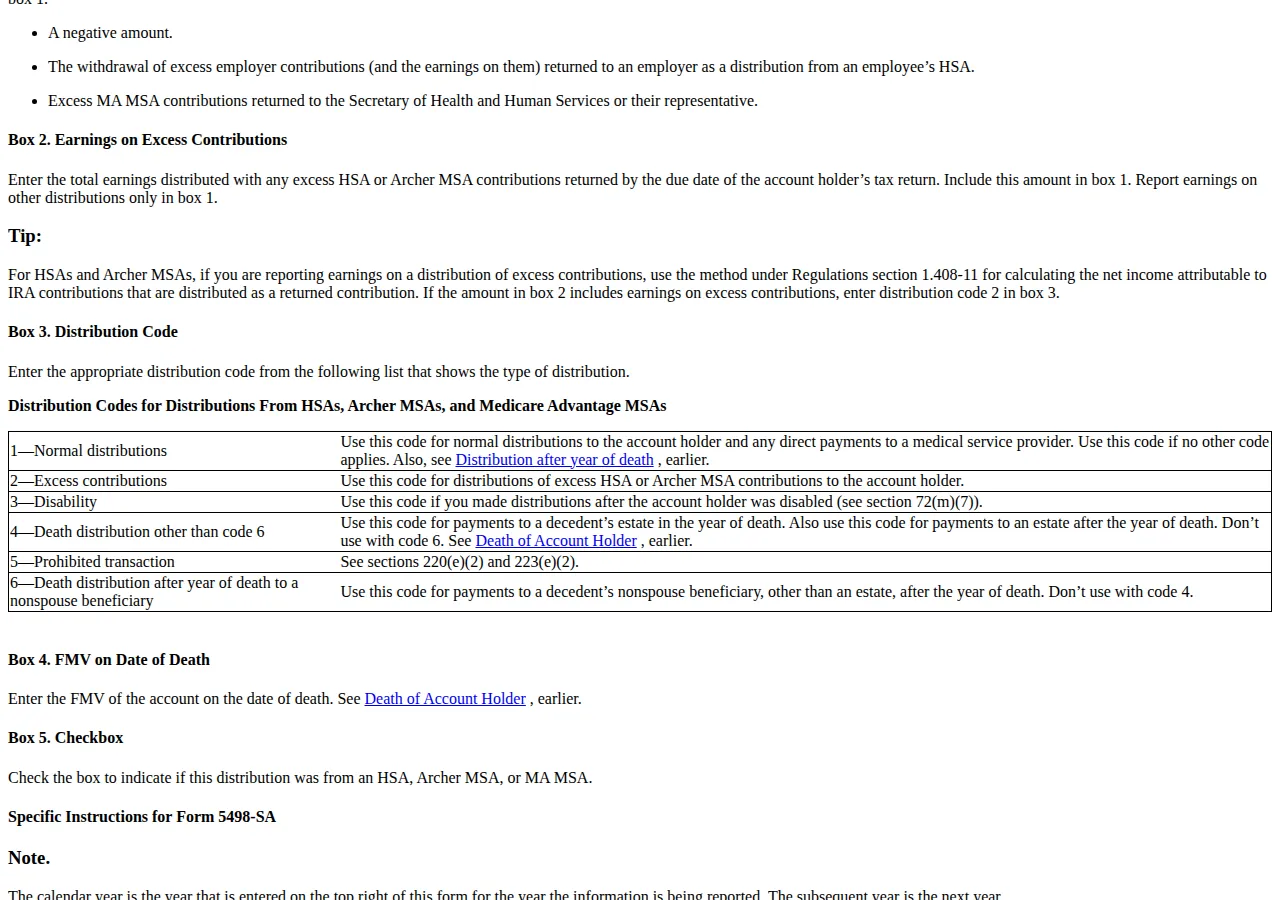
Distribution codes 1 through 6
The code in box 3 is the only place the form says why the money moved.
| Code | Meaning | When it applies | Authority |
|---|---|---|---|
| 1 | Normal distribution | Ordinary distributions; the default | 2026 Instructions |
| 2 | Excess contributions | Excess HSA or Archer MSA contributions | 2026 Instructions |
| 3 | Disability | Distributions after disability | § 72(m)(7) |
| 4 | Death distribution other than code 6 | Payments to a decedent estate | 2026 Instructions |
| 5 | Prohibited transaction | A disqualifying transaction | § 223(e)(2) |
| 6 | Death distribution after year of death to a nonspouse beneficiary | Payments to a living nonspouse beneficiary | 2026 Instructions |
Code 3 matters because a distribution after disability escapes the 20 percent tax.
Reporting the distribution on Form 8889
Form 8889 turns the 1099-SA total into a tax result: Part I reports contributions, Part II reports distributions, and Part III reports income and additional tax for failure to maintain high deductible health plan coverage. The 2026 Instructions for Form 8889 were not yet published when this article was written, so the form structure below follows the 2025 instructions and the 2026 dollar figures come from Revenue Procedure 2025-19 and Publication 969.
Line 14a takes the total distributions from all HSAs, the same total shown in box 1 of Form 1099-SA. Line 14b subtracts rollovers and excess contributions withdrawn by the due date of the return including extensions. Line 15 takes the distributions used to pay qualified medical expenses incurred after the HSA was established. Line 16, the taxable distribution, is line 14a minus lines 14b and 15. Lines 17a and 17b apply the additional 20 percent tax to the line 16 amount, unless an exception applies. Example: take a 2026 family-coverage account holder with a 9,000 dollar distribution: 6,200 dollars for qualified medical expenses, 2,800 dollars for a vacation.
The additional 20 percent tax runs on the taxable portion only.
The 2,800 dollars joins ordinary income, the 560 dollar additional tax goes on Schedule 2, and the 6,200 dollars for qualified medical expenses is excluded entirely.
Qualified medical expenses
Section 223(d)(2) defines qualified medical expenses as amounts paid for medical care under § 213(d) for the beneficiary, spouse, and dependents, only to the extent not compensated by insurance or otherwise. Publication 969 adds the practical edge: expenses for over-the-counter medicine, whether or not prescribed, and menstrual care products are considered medical care, so both count as qualified medical expenses. Insurance premiums generally do not qualify, with four exceptions: COBRA continuation coverage, qualified long-term care insurance, health coverage while receiving unemployment compensation, and Medicare premiums, subject to the age-65 rules in the Form 8889 instructions. A distribution used for a premium outside those four exceptions is taxable and subject to the 20 percent additional tax. The account holder, not the trustee, decides whether an expense qualifies. Keep every receipt: the 1099-SA reports the total, Form 8889 reports the qualified portion, and an audit tests the receipts behind line 15.
The 20 percent additional tax
Section 223(f)(4) adds the teeth: when a distribution is includible in gross income because it was not used for qualified medical expenses, the tax on the account beneficiary is increased by 20 percent of the amount included. The additional tax is figured on Form 8889, line 17b, and reported on Schedule 2.
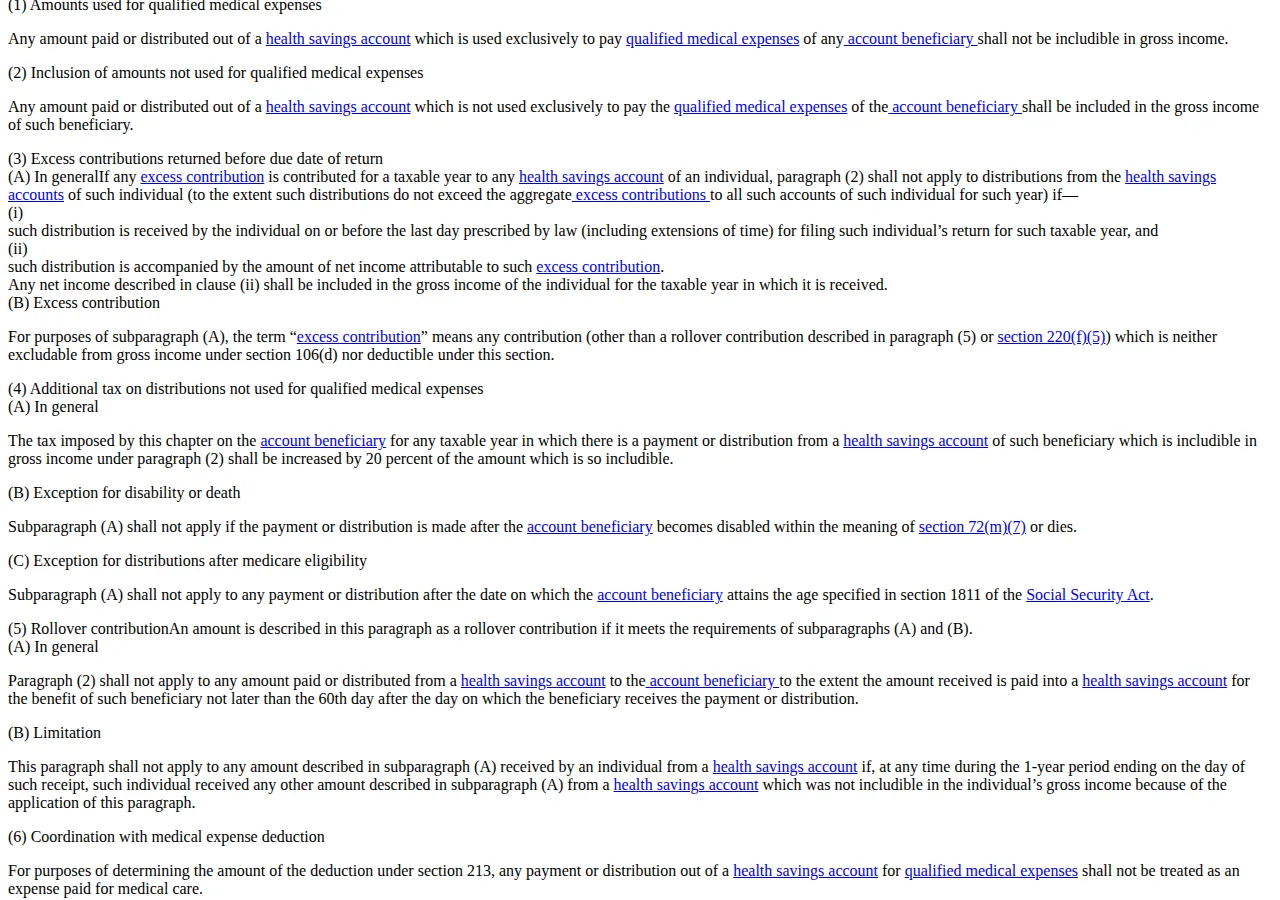 Three exceptions remove the additional tax, though the distribution stays includible in income: distributions made after the beneficiary dies, becomes disabled, or turns age 65. The account holder checks line 17a when any exception applies, and enters on line 17b only 20 percent of the line 16 amount that meets no exception. A separate 10 percent additional tax applies in Part III when the account holder fails the testing period under the last-month rule or after a qualified HSA funding distribution.
Form 1099-SA against Form 1099-R
The boundary between the two forms is the account type, not the dollar amount. Form 1099-R reports distributions from pensions, annuities, retirement or profit-sharing plans, IRAs, and insurance contracts; Form 1099-SA reports distributions only from an HSA, Archer MSA, or Medicare Advantage MSA. An IRA distribution that funds an HSA under § 408(d)(9) is reported by the IRA trustee on Form 1099-R and by the HSA trustee on Form 5498-SA, never on Form 1099-SA. The 1099-NEC playbook covers the payer side for service payments, and the 1099-DA playbook covers the broker side for digital asset sales. To price the tax behind a distribution, run the numbers through the tax estimator.
| Distribution | Form | Authority |
|---|---|---|
| HSA, Archer MSA, or MA MSA distribution | Form 1099-SA | § 223(h) |
| Pension, annuity, or IRA distribution | Form 1099-R | Pub. 1099 |
| IRA to HSA funding distribution | Form 1099-R; Form 5498-SA box 2 | § 408(d)(9) |
| Trustee-to-trustee HSA transfer | Neither form; not a distribution | 2026 Instructions |
Death of the account holder
When the beneficiary is the surviving spouse, the spouse becomes the account holder and the account continues as an HSA. When the beneficiary is not the surviving spouse, the account ceases to be an HSA on the date of death, and the fair market value on that date is reported in box 4. A distribution in the year of death takes the gross distribution in box 1, code 4 in box 3, and the fair market value on the date of death in box 4. A distribution after the year of death uses code 1 for the spouse, code 4 for the estate, and code 6 for a nonspouse. Box 4 then carries the fair market value on the date of death, reduced by payments for the decedent qualified medical expenses within one year after death. Form 8889 matches: a beneficiary other than the estate enters on line 15 the qualified medical expenses the decedent incurred before death and paid within one year after death.
Excess contributions, mistaken distributions, and rollovers
An excess contribution is a contribution above the § 223(b) limit. The account holder can withdraw the excess, with its earnings, by the due date of the return, and the earnings go in box 2 with code 2 in box 3. Leave the excess in the account and a 6 percent excise tax applies for each tax year it remains, figured on Form 5329. A mistaken distribution is different: when an amount left the HSA because of a mistake of fact due to reasonable cause, the account holder may repay it by the due date of the return, not counting extensions, following the first year the account holder knew or should have known. The repaid amount is not included in gross income, is not subject to the additional 20 percent tax, and the trustee does not report it on Form 1099-SA. The trustee is not required to accept the repayment, but when it does, it may rely on the account holder statement, under Notice 2004-50, Q&A 76. A rollover moves assets from one HSA to another HSA of the same beneficiary, tax-free, when completed within 60 days; an HSA can receive only one rollover contribution during a one-year period, reported on Form 5498-SA, box 4.
Deadlines, penalties, and corrections
For 2026 information, the trustee furnishes Copy B by February 1, 2027, and files on paper by March 1, 2027, or electronically by March 31, 2027 (January 31 and February 28 are Sundays, so section 7503 moves them to Monday). > [!TIP]
The penalty rule surprises filers who know the general information-return ladder. Sections 6721 and 6722 do not apply to Form 1099-SA at all, because Forms 1099-SA and 5498-SA are filed under §§ 220(h) and 223(h). The penalty that does apply is § 6693: 50 dollars per return, with no maximum, unless the failure is due to reasonable cause. The general § 6721 ladder runs 60 dollars per return when corrected within 30 days, 130 dollars when corrected on or before August 1, and 340 dollars after that. Those figures are not the 1099-SA penalty.
Identifiers and the paper trail
A United States individual gives a Social Security Number on Form W-9, a business entity gives an Employer Identification Number, and a resident alien who cannot obtain one gives an Individual Taxpayer Identification Number. An LLC that has not elected corporate treatment is reported under its owner rules, while an LLC that elected corporate treatment, an S-Corp, and a C-Corp are each reported as the corporation they elected. A CPA reviewing the file checks the taxpayer identification number against the name on the W-9, the entity classification against the books kept under GAAP, and the FICA and SECA treatment separately.
Execution checklist
- Confirm the account type and file a separate Form 1099-SA for each plan type.
- Collect a Form W-9 with an SSN, EIN, or ITIN, and run TIN matching.
- Enter the gross distribution in box 1 for every distribution.
- Put earnings on returned excess contributions in box 2, with code 2 in box 3.
- Choose the box 3 code from the six-code list.
- On death, enter the fair market value on the date of death in box 4.
- Do not report trustee-to-trustee transfers, repaid mistaken distributions, or returned excess employer contributions.
- Report rollovers on Form 5498-SA, box 4, within 60 days and one per year.
- Reconcile every Form 1099-SA to Form 8889, lines 14a through 17b.
- Furnish Copy B by February 1, 2027, file by March 1, 2027 on paper or March 31, 2027 electronically, file Form 5498-SA by May 31.
- Correct fast with the CORRECTED box checked and reasonable cause documented under § 6693.
- Keep every receipt behind Form 8889, line 15, with the expense date and the HSA establishment date.