IRS Form 706: The Estate Tax Return Filing Playbook
The return that settles the estate tax
Form 706 is the return on which the executor figures the federal estate tax imposed by chapter 11, on the entire taxable estate. For a 2026 death, the filing line is $15,000,000; below it, most estates never touch the form. Above it, the executor has nine months, a stack of schedules, and personal liability.
Who must file: the section 6018 test
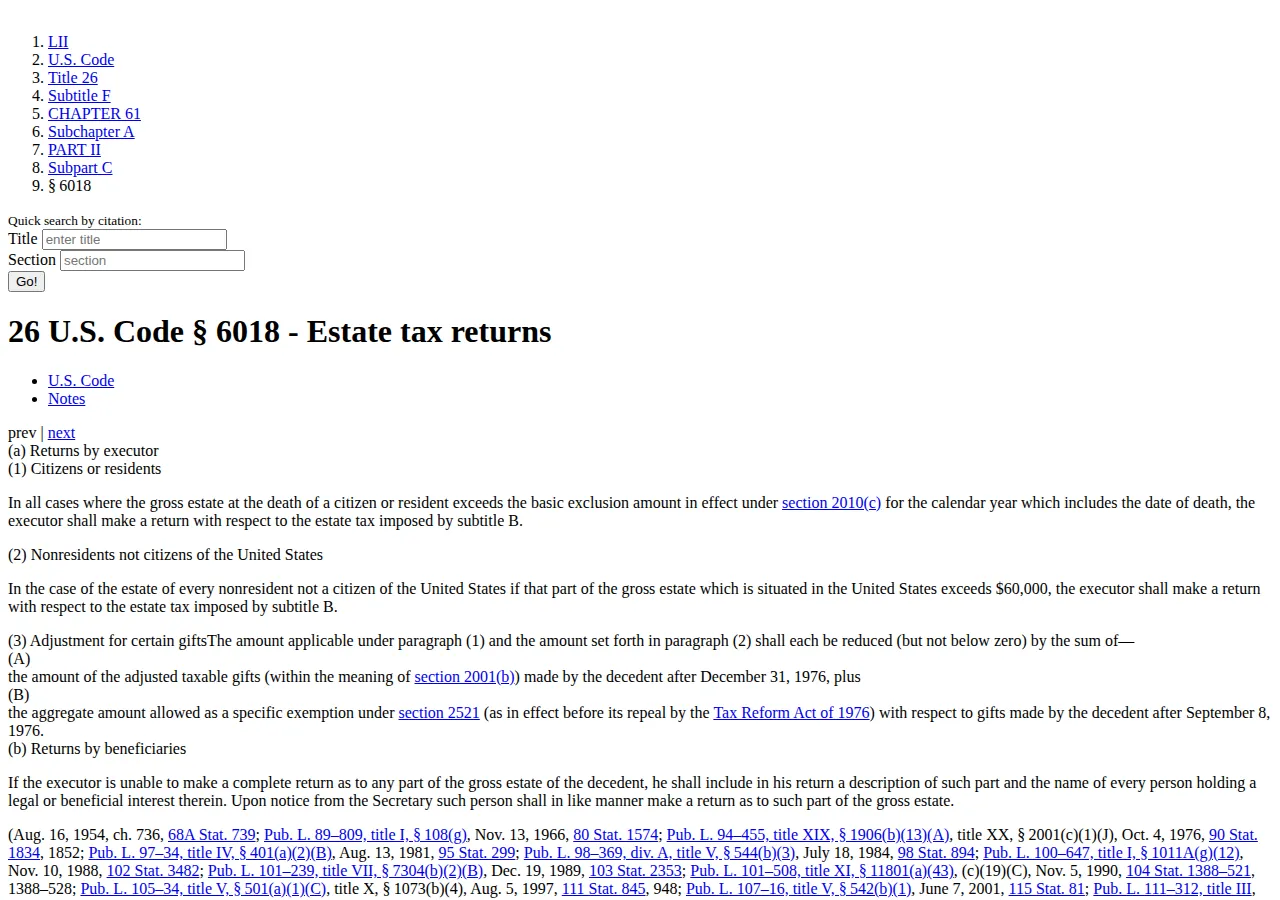
Section 6018(a)(1) states: where the gross estate at the death of a citizen or resident exceeds the basic exclusion amount under section 2010(c) for the year of death, the executor shall make a return. Section 6018(a)(3) cuts the threshold by adjusted taxable gifts after December 31, 1976, plus any specific exemption under old section 2521 for gifts after September 8, 1976. The Instructions for Form 706 (07/2026) apply the same test for 2026: file when the gross estate plus adjusted taxable gifts and specific exemption exceeds $15,000,000.
Three points catch executors out. First, the gross estate is valued at death and reaches foreign property, transfers without full consideration, annuities, joint property, life insurance payable to others, digital assets, and property under a general power of appointment. Second, adjusted taxable gifts count even though the gift tax was paid years ago — $4,000,000 of lifetime gifts leaves $11,000,000 of filing headroom. Third, filing and tax are different tests: an estate can owe no tax and still have to file. The gift tax and Form 709 playbook shows how lifetime gifts shrink the threshold.
An executor must file to elect portability, whatever the size of the gross estate. For a nonresident not a citizen of the United States, section 6018(a)(2) requires Form 706-NA when the United States part of the gross estate exceeds $60,000.
The math: from gross estate to tax due
Section 2001(b) computes the tax in three moves: tentative tax on the taxable estate plus adjusted taxable gifts, minus the gift tax payable on those gifts. Section 2001(c) tops out at 40 percent over $1,000,000, with a tentative tax of $345,800 at exactly $1,000,000. The section 2010 credit is the tentative tax on the applicable exclusion amount, wiping out the tax on the first $15,000,000 for a 2026 death.
Worked example — a 2026 death with no prior taxable gifts:
The short form gives the same answer: 40 percent of the $4,500,000 above the $15,000,000 exclusion. Check the arithmetic with our tax estimator.
The clock: nine months, then Form 4768
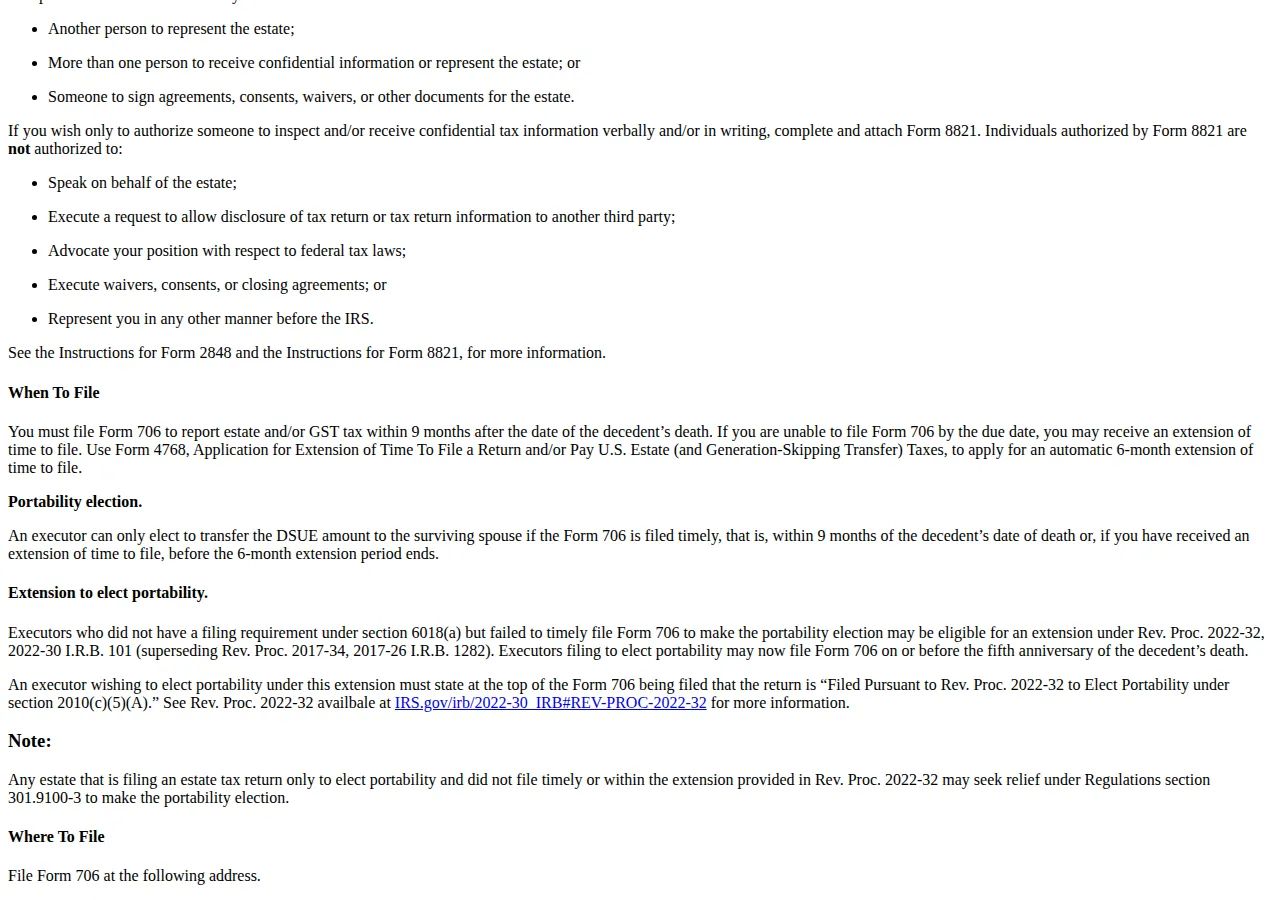
Section 6075(a) fixes the deadline: returns under section 6018(a) are due within 9 months after the date of the decedent's death, and the tax is due the same day. Miss the date without an extension and section 6651 penalties run, excused only on reasonable cause.
| Choice | What it does | Deadline | Authority |
|---|---|---|---|
| File Form 706 on time | Return and tax due | 9 months after death | Section 6075(a) |
| Form 4768, Part II — automatic extension | 6 more months to file, not to pay | File by the 9-month date | Section 6081 |
| Form 4768, Part III — extension to pay | More time to pay, for reasonable cause | 12 months; 10 years under section 6161(a)(2) | Section 6161 |
| Section 6166 installments | Business share in up to 10 installments over 14 years | Elect by the filing deadline, including extensions | Section 6166(a), (d) |
Form 4768 has two parts that do different jobs. Part II gives the automatic 6-month extension to file under section 6081 — file by the original due date and the return is due 15 months after death — plus a discretionary extension for good cause. Part III requests an extension of time to pay under section 6161, which requires reasonable cause.
The trap: the 6-month filing extension does not extend the time to pay. Tax unpaid at the 9-month mark draws interest under section 6601 from the payment due date. Pay the best estimate by the 9-month date, then file inside the extension.
Portability: the DSUE election on Part VI
Portability is the one election on Form 706 that can be worth millions to the surviving spouse, and the easiest to lose. Section 2010(c)(4) defines the deceased spousal unused exclusion amount as the lesser of the basic exclusion amount or the excess of the first spouse's applicable exclusion over the tentative-tax amount. Section 2010(c)(5)(A) sets the conditions: the DSUE may not be taken into account unless the executor files a return computing the amount and makes the election on that return. The election, once made, is irrevocable, and no election may be made after the time prescribed by law, including extensions — only a timely return can carry it.
Worked example — first spouse dies in 2026 with a taxable estate of $6,000,000 and no adjusted taxable gifts:
If the surviving spouse later dies with a taxable estate of $24,000,000, the tax is zero with the election; without it, the tax is 40 percent of the $9,000,000 above the spouse's $15,000,000 exclusion:
One timely return for an estate that owed no tax at all saves $3,600,000. The election is made in Part VI of Form 706; executors below the filing threshold who skip the return give away the DSUE. Our estate tax exemption and portability playbook works the $15,000,000 exclusion and portability mechanics; this guide covers the filing operation that makes the election stick.
Rev. Proc. 2022-32 lets an executor with no filing requirement under section 6018(a) who failed to file timely file Form 706 to elect portability on or before the fifth anniversary of the decedent's death, headed "Filed Pursuant to Rev. Proc. 2022-32 to Elect Portability under section 2010(c)(5)(A)." Past the fifth anniversary, only discretionary relief under Regulation section 301.9100-3 remains.
Valuation: date of death, the alternate date, and special use
The gross estate is valued at fair market value at death. Section 2032 gives one alternative: value all property as of six months after death, with property disposed of within that six months valued at the date of disposition. Section 2032(c) bars the election unless it will decrease both the gross estate and the sum of the estate tax and the generation-skipping transfer tax. The election is all or nothing and needs a timely return.
Worked example — listed stock worth $4,000,000 at death and $3,100,000 six months later, in an estate above the exclusion:
The alternate date also resets the income tax basis to the lower value — a 40 percent saving against a larger capital gain when the beneficiary sells.
Section 2032A offers a second route for a farm or closely held business: qualified real property used in the business may be valued at current use rather than best use. For a 2026 death, Rev. Proc. 2025-32 caps the aggregate decrease at $1,460,000 — $584,000 of tax at 40 percent — with strings: qualified heirs, a 10-year recapture period, and a written agreement from all interested parties.
Section 6166: paying the tax over fourteen years
A family business — an LLC, an S-Corp, or a C-Corp — can be worth more than the estate's liquid assets, and the tax on it can force a sale. Section 6166 is the statute's answer. Under section 6166(a)(1), if a closely held business interest in the gross estate exceeds 35 percent of the adjusted gross estate, the executor may elect to pay part or all of the section 2001 tax in 2 to 10 equal installments. Under section 6166(a)(3), the first installment is due no more than 5 years after the section 6151(a) payment date, each succeeding installment one year after the last — five years of interest-only payments, then ten installments, the last 14 years after the due date. Elect by the filing deadline, including extensions, by checking "Yes" on Part III, line 3 of Form 706.
The adjusted gross estate is the gross estate less the deductions under sections 2053 and 2054, per section 6166(b)(6). Only the tax attributable to the business interest may be deferred: section 6166(a)(2) caps it at the share of the tax in the same ratio as the business interest bears to the adjusted gross estate.
Worked example — the same estate, now holding a family business interest in an LLC:
Section 6166(f) requires interest on the unpaid portion for the first five years annually, and after that with each installment. Section 6601(j) sets the rate: 2 percent on the 2-percent portion, 45 percent of the section 6601(a) rate on the rest. The 2-percent portion is the lesser of the extended tax or the tentative tax on $1,000,000 plus the applicable exclusion amount, less the applicable credit:
Two cautions. First, the $1,000,000 figure in section 6601(j)(2) is inflation-adjusted under section 6601(j)(3) for deaths after 1998, so the true 2-percent portion for a 2026 death is larger than the $400,000 on the unadjusted base — pull the year's adjusted figure from the annual revenue procedure. Second, the deferral is not available for passive assets: section 6166(b)(9) strips out assets not used in carrying on a trade or business. A later deficiency is prorated to the installments under section 6166(e), except for negligence or fraud.
The executor's personal exposure
Section 2002 puts the tax on the executor: the chapter 11 tax shall be paid by the executor. An executor who distributes before the tax is settled can be personally liable for the shortfall. The estate needs its own EIN, and the return lists the decedent's SSN; most executors hire a CPA to prepare it. Section 2204(a) gives the way out: on written application the IRS notifies the executor of the tax, and on payment — other than any amount extended under sections 6161, 6163, or 6166 — and on furnishing any bond required for the extended amounts, the executor is discharged from personal liability for any later deficiency. File for discharge once filed, pay what is notified, and bond the deferred balance. Do not distribute the residue until the discharge is in hand.
Founder & CEO Insight — Enow A. Jovial
The execution checklist
- Step 1 — Fix the dates. Date of death plus 9 months for filing and payment; plus 15 months for the extended date.
- Step 2 — Run the section 6018 test. Gross estate plus adjusted taxable gifts plus the specific exemption; above $15,000,000, Form 706 is required.
- Step 3 — Document the executor. Will, court appointment, death certificate, the decedent's SSN, and the estate's EIN for the return.
- Step 4 — Inventory and value everything. Fair market value at death; commission appraisals early.
- Step 5 — Decide valuation elections. Test the section 2032 alternate date and the section 2032A special use value.
- Step 6 — Compute the tax and the DSUE. Section 2001 computation in Part II; portability in Part VI.
- Step 7 — File Form 4768 before the 9-month date if more time is needed. Filing only; pay the best estimate by the 9-month date.
- Step 8 — Test section 6166 before the payment date. Business interest above 35 percent of the adjusted gross estate means an election, a schedule, and a bond.
- Step 9 — File at the right address and keep proof. Kansas City, MO 64999, or 333 W. Pershing Road, Kansas City, MO 64108 for a private delivery service; keep the certified mail receipt.
- Step 10 — Apply for discharge under section 2204. Request the determination, pay the notified amount, bond any extended balance, hold the residue.