IRS Form 8862: Reclaim the Earned Income Credit After Disallowance
Founder & CEO Insight — Enow A. Jovial
The IRS denied your Earned Income Tax Credit and the refund never arrived. Skip the form and the claim is denied automatically.
1. What Form 8862 Is, and When the Law Demands It
Form 8862 is titled "Information To Claim Certain Credits After Disallowance." Part I names the tax year and credits; Part II the Earned Income Credit; Part III the Child Tax Credit, Additional Child Tax Credit, and Credit for Other Dependents; Part IV the American Opportunity Tax Credit. Complete only the parts matching the credits you claim, and attach the schedules — Schedule EIC for the EITC, Schedule 8812 for the child credits.
The trigger is 26 U.S.C. § 32(k)(2): once a credit is denied under the deficiency procedures, no credit is allowed for any later year unless the taxpayer provides the information the Secretary requires to demonstrate eligibility. Publication 596 states it plainly: if your EIC for any year after 1996 was denied or reduced for any reason other than a math or clerical error, attach a completed Form 8862 to your next return claiming the EIC.
Three carve-outs decide whether you file it. First, math or clerical error: if the IRS corrected your arithmetic or rejected a return for a wrong or missing Social Security number, Form 8862 is not required. Second, one-and-done: if you already filed Form 8862 in a later year, the credit was allowed, and it has not been reduced or disallowed again except for a math or clerical error, you do not file it again. Third, no-child: if you claim the EITC without a qualifying child and the only reason for the earlier disallowance was that a child on Schedule EIC was not your qualifying child, no Form 8862 is needed.
Line 1 takes the year you are claiming the credit, not the year it was disallowed: a 2024 disallowance answered on a 2026 return takes "2026."
2. The Two Bans: 2 Years for Recklessness, 10 Years for Fraud
Not every disallowance is equal. A claim denied because the IRS could not verify a child's residency is a paperwork failure; a claim denied because you claimed a child who never lived with you, knowing the rule, is a different event. Section 32(k)(1) draws the line.
| Finding | Ban length | Authority |
|---|---|---|
| Reckless or intentional disregard | 2 taxable years after the determination year | 26 U.S.C. § 32(k)(1)(B)(ii) |
| Fraud | 10 taxable years after the determination year | 26 U.S.C. § 32(k)(1)(B)(i) |
| Ordinary disallowance | No ban — recertify with Form 8862 | 26 U.S.C. § 32(k)(2) |
| Math or clerical error only | No ban, no Form 8862 | IRS Instructions for Form 8862 |
A "final determination" is the operative phrase: a notice of deficiency is not final until the 90-day Tax Court petition window closes without a petition, or the court rules. The instructions give the example: EIC claimed on a 2024 return filed March 2025, reckless finding, deficiency notice September 2025, no petition within 90 days, EIC denied December 2025, CP79A notice January 2026 barring the EIC for 2025 and 2026.
You do not file Form 8862 during a ban to claim the credit and expect payment. You file it to contest the ban, with documentation proving you were entitled to the credits for the ban year, or that the claim was not reckless or fraudulent — and you must mail the return, because the IRS rejects an e-filed return claiming a credit during a ban period. A notice disallowing the credit then arrives; follow its instructions, and the path runs to the U.S. Tax Court, the U.S. District Court, or the U.S. Court of Federal Claims.
3. The 2026 Numbers: What the Credit Is Worth Now
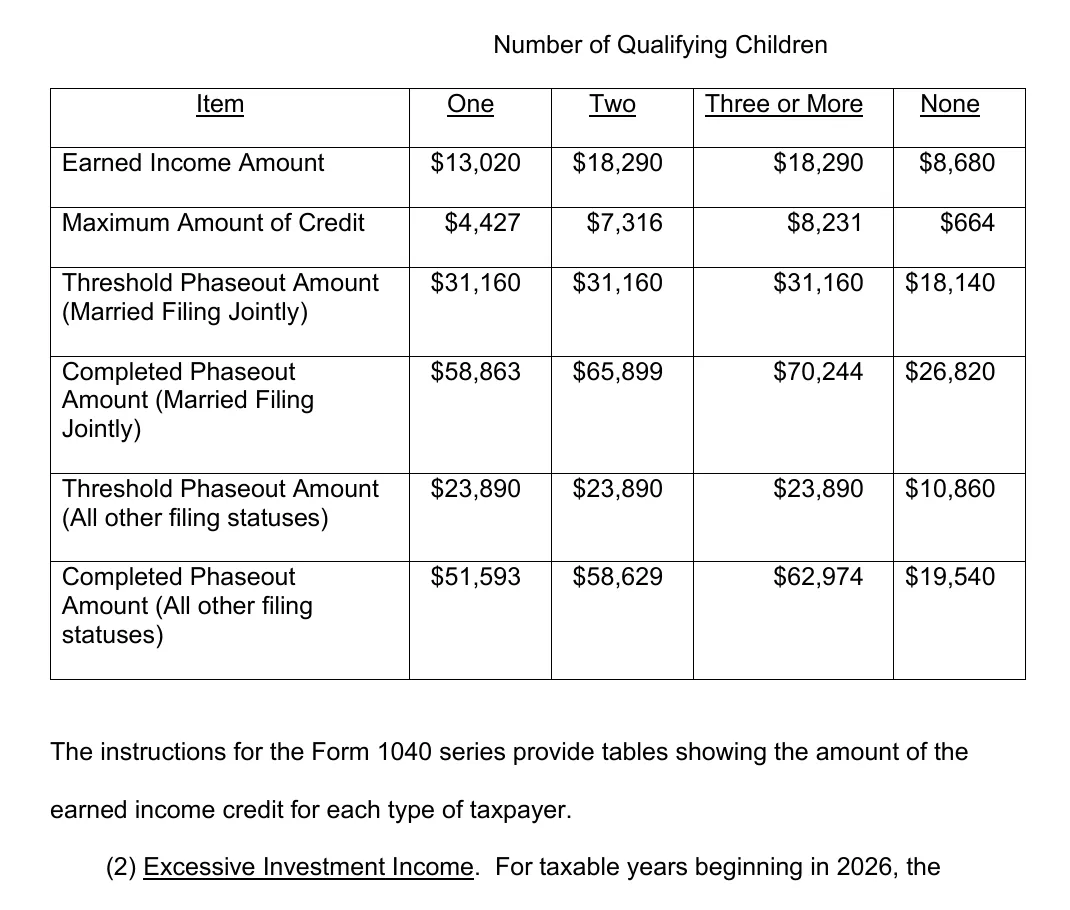
Under 26 U.S.C. § 32(a) and (b), the credit is a percentage of earned income up to the earned income amount, reduced by a phaseout percentage above the threshold. The percentages are fixed — 34% with one child, 40% with two, 45% with three or more, 7.65% with none — and the dollar amounts move with inflation. Revenue Procedure 2025-32, section 4.06, sets the 2026 figures, for returns filed in early 2027.
| Qualifying children | Earned income for max credit | Maximum credit | Phaseout starts (single) | Credit ends (single) | Phaseout starts (joint) | Credit ends (joint) |
|---|---|---|---|---|---|---|
| None | $8,680 | $664 | $10,860 | $19,540 | $18,140 | $26,820 |
| 1 | $13,020 | $4,427 | $23,890 | $51,593 | $31,160 | $58,863 |
| 2 | $18,290 | $7,316 | $23,890 | $58,629 | $31,160 | $65,899 |
| 3 or more | $18,290 | $8,231 | $23,890 | $62,974 | $31,160 | $70,244 |
Earned income and adjusted gross income must each sit below the completed phaseout amount for your filing status and family size; the higher of the two controls.
The third test is the cliff. Under 26 U.S.C. § 32(i)(1), no credit is allowed if disqualified income — interest, dividends, tax-exempt interest, net capital gains and rents — exceeds the statutory $10,000 base, carried by inflation to $12,200 for 2026. Cross it by one dollar and the whole credit disappears, whatever your wages are.
4. The Qualifying-Child Tests: Where Most Disallowances Start
Most EITC disallowances are qualifying-child failures, and the tests are mechanical enough to check before filing. Section 32(c)(3) points to the section 152(c) definition; the Form 8862 instructions list the four tests on line 6.
Relationship: the child must be your son, daughter, stepchild, foster child, brother, sister, stepbrother, stepsister, half brother, half sister, or a descendant of any of them — a grandchild, niece, or nephew. An adopted child, including one lawfully placed for adoption, is always treated as your own child.
Age: under 19 at the end of the year and younger than you (or your spouse on a joint return); or under 24, a full-time student, and younger than you; or any age if permanently and totally disabled.
Residency: the child must have lived with you in the United States for more than half the year; temporary absences (school, vacation, business, medical care, military service, juvenile detention) count as time lived with you. Half the year or less fails even if you paid most of the child's living expenses, and the IRS may ask for school and child care records showing the child's address.
Joint return: the child must not file a joint return, unless only to claim a refund of withheld tax or estimated tax paid.
The no-child route has its own gates. Under section 32(c)(1)(A)(ii), a filer without a qualifying child must have lived in the United States for more than half the year, be at least 25 but under 65 at year-end (either spouse on a joint return), and not be the qualifying child or dependent of another taxpayer. Married filers must file jointly, with a narrow separated-spouse exception in section 32(d)(2).
Every person on the claim needs a valid SSN — issued before the return's due date including extensions, and not issued solely for a federally funded benefit without work authorization. An ITIN does not work for the EIC. Beginning in 2025, a valid SSN is also required for the CTC or ACTC; on a joint return only one spouse needs it.
5. EITC vs. Child Tax Credit: Two Credits, One Return, Different Rules
The EITC and the Child Tax Credit share a household and a form, but they are different instruments. The EITC is fully refundable: it pays out even when the filer owes no income tax. The Child Tax Credit is primarily nonrefundable: it reduces tax to zero and stops there. Its refundable slice is the Additional Child Tax Credit, claimed on Schedule 8812.
For 2026 the Child Tax Credit is worth up to $2,200 per qualifying child under age 17, with up to $1,700 per child refundable as the ACTC, per Revenue Procedure 2025-32, section 3.05, and the IRS Child Tax Credit page. The ACTC requires at least $2,500 of earned income and pays 15% of earned income above $2,500, capped at $1,700. The CTC phases out by $50 for each $1,000 or fraction of modified AGI above $200,000, or $400,000 on a joint return, under 26 U.S.C. § 24(b).
The interaction matters most at low incomes. A filer with no income tax liability gets nothing from the nonrefundable CTC, but can still receive the full EITC plus the ACTC slice. Both credits can be disallowed in the same examination, and one Form 8862 covers both — check each credit's box on line 2 and complete Parts II and III.
Both credits share the refund clock: by law the IRS must wait until mid-February to issue refunds on returns claiming the EITC or the ACTC, and the hold applies to the entire refund.
6. The Worked Math: Three Filers, Three Outcomes
The credit rises at the credit percentage to the earned income amount, holds at the maximum, then falls at the phaseout percentage to zero at the completed phaseout amount. The IRS tables use $50 income bands, so a return may show a few dollars more or less.
Example: a single parent with two children and $18,290 of earned income. At 40% for two children, $18,290 is exactly the 2026 earned income amount, so the credit reaches its maximum:
Scenario: the same parent, now with $40,000 of adjusted gross income. Past the $23,890 single phaseout threshold, the 21.06% phaseout percentage applies to the excess:
Case study: a single parent with one child, $13,500 of earned income, no income tax liability. The EITC reaches its one-child maximum: 34% × $13,020 = $4,426.80, rounded by the IRS table to the published $4,427 maximum. The child credit side is refundable only through the ACTC:
The $1,650 is below the $1,700 per-child ACTC cap, so the full $1,650 is refundable. Combined with the $4,427 EITC, this filer receives $6,077 as a refund with zero income tax liability. Check the same numbers through the tax estimator before filing; a mismatch of more than a few dollars means an input is wrong.
7. The Five-Step Recertification Workflow
Step 1: Read the notice and name the reason. Find the notice that reduced or disallowed the credit — the CP79/CP79A series for bans, the notice of deficiency for an examination adjustment. Note the tax year, the credit, the reason, and whether recklessness or fraud was found.
Step 2: Check the ban before you check the credit. Count the ban years from the determination year — 2 for recklessness, 10 for fraud — and confirm the current tax year is outside the ban before claiming. Inside the ban and appealing, prepare the documentation that defeats the finding and plan to mail the return.
Step 3: Re-prove eligibility from scratch. Run the four qualifying-child tests, or the no-child age and residency tests, against the current year — not the disallowed year. Gather the proof: school and child care records showing the child's address, birth certificates, Social Security cards. Check investment income against the $12,200 limit and both income measures against the phaseout table.
Step 4: Complete Form 8862 and the credit schedules. Enter the claim year on line 1, check each credit on line 2, answer Part II for the EITC and Part III for the child credits, attach Schedules EIC and 8812 — plus Schedule 3-A for 2026 claims. An unanswered line is a denied claim.
Step 5: File, then keep the proof. E-file with Form 8862 attached unless you are appealing a ban, in which case mail it. Keep the filed return, the acceptance notice, and the proof file together for three years.
8. Execution Checklist: Reclaim the Credit Without Losing It Twice
- [x] Step 1: Name the disallowance reason — notice, tax year, credit, recklessness or fraud found.
- [x] Step 2: Count the ban — 2 years for recklessness, 10 for fraud, from the determination year; confirm the claim year is clear.
- [x] Step 3: Re-prove the child tests — relationship, age, residency over half the year in the United States, joint-return test; school and child care records on file.
- [x] Step 4: Check the money gates — investment income at or below $12,200; earned income and AGI below the completed phaseout amount.
- [x] Step 5: File Form 8862 with the schedules — claim year on line 1, every credit checked on line 2, Schedules EIC and 8812 attached, Schedule 3-A for 2026; mail the return if appealing a ban.
- [x] Step 6: Plan around the refund hold — no EITC or ACTC refund before mid-February; keep the proof file for three years.
The credit is worth up to $8,231 for 2026, and the form that restores it is one page. Answer the reason the IRS gave, prove the tests with documents, and file the form with the return — not after it. For credits beside the EITC on the same return, see our Schedule 3 additional credits playbook, and if the disallowance reaches back to a filed return, the amended return playbook covers the correction.