IRS Form W-4 Employee Withholding Certificate Playbook: Every Step, the 2020 Redesign, and the Math Your Paycheck Depends On
Form W-4, the Employee's Withholding Certificate, decides how much federal income tax leaves every paycheck. The employee fills it in, the employer keeps it on file, and payroll software turns its five steps into a per-paycheck amount. Get it right and April brings a small bill or none; get it wrong and April brings a bill plus a possible penalty.
Who this guide is for
This guide is for the employee starting a new job; the founder or payroll operator who collects W-4s; and the household with two incomes, a side business, or investment income.
The 2020 redesign: allowances are gone
Before 2020, Form W-4 ran on withholding allowances. An employee claimed a number, and each allowance reduced the wages subject to withholding by a fixed amount. The Tax Cuts and Jobs Act of 2017 eliminated personal exemptions, so the IRS rebuilt the form. The 2020 redesign replaced allowances with direct dollar entries, and the current 2026 form keeps that five-step structure.

The statute behind the form: 26 U.S.C. section 3402
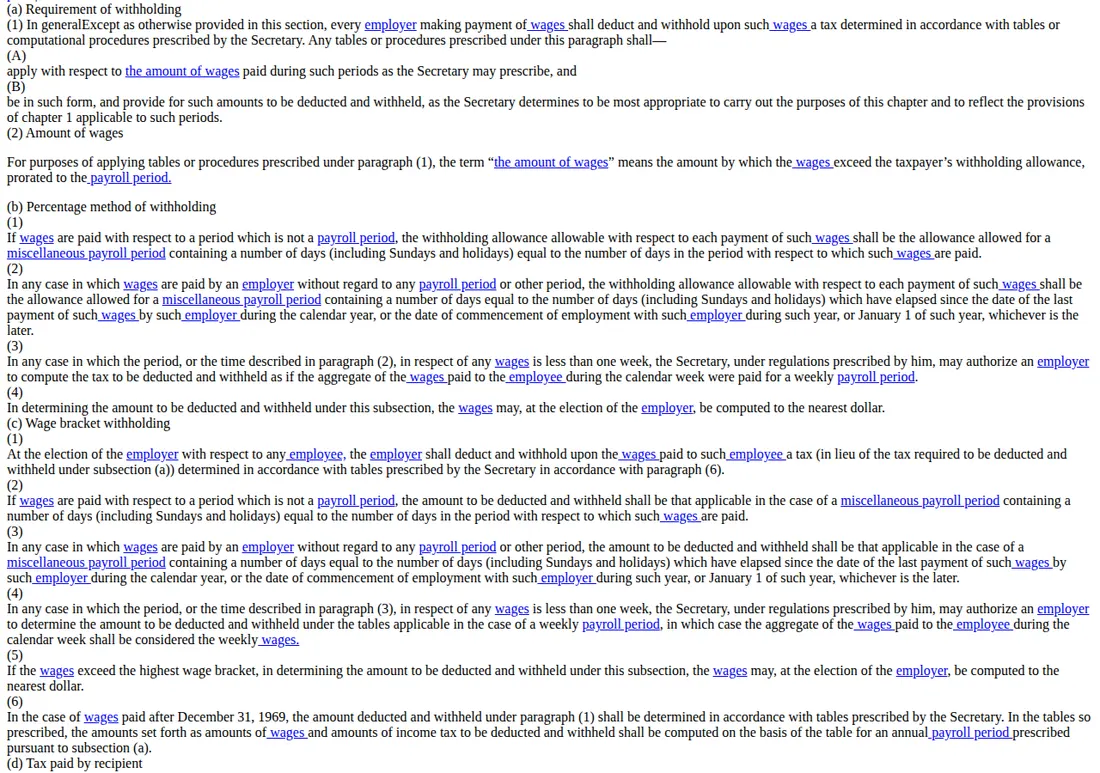
Form W-4 is the certificate Congress authorized in 26 U.S.C. section 3402, titled "Income tax collected at source." Section 3402(a)(1) states that every employer making payment of wages shall deduct and withhold upon such wages. The employer does not choose whether to withhold. Section 3402(f) governs the certificate: the employee furnishes it, the employer applies it, and it stays in effect until replaced. Section 3402(n) creates the exemption for an employee with no income tax liability in either year. The form cites its own authority on page 4: sections 3402(f)(2) and 6109 require the information, and an incomplete form is treated as single with no other entries.
Step 1: personal information and filing status
Step 1 collects identity facts and the one choice that moves withholding most. The employee enters name, address, and Social Security number, then checks one filing status: Single or Married filing separately; Married filing jointly or Qualifying surviving spouse; or Head of household, for an unmarried employee who pays more than half the costs of keeping up a home for a qualifying individual. Filing status selects the standard deduction and the tax-rate table Publication 15-T applies. The 2026 Deductions Worksheet on page 4 lists the standard deduction amounts: $16,100 for single or married filing separately, $32,200 for married filing jointly or qualifying surviving spouse, and $24,150 for head of household.
Step 2: multiple jobs or a working spouse
Step 2 applies when the employee holds more than one job at a time, or is married filing jointly and the spouse also works. Each employer withholds as if its job were the worker's only income, so two jobs treated separately will under-withhold. The form offers three fixes. Option (a) is the IRS Tax Withholding Estimator at irs.gov/W4App, the most accurate choice and the only option for self-employment income. Option (b) is the Multiple Jobs Worksheet on page 3, with the result entered in Step 4(c). Option (c) is a checkbox, available only when there are two jobs total, which halves the standard deduction and the tax brackets for each job. One rule governs all three: complete Steps 3 through 4(b) on only one Form W-4, ideally the highest-paying job's, and leave those steps blank on the others.
The Multiple Jobs Worksheet, worked with real table values
Line 1 takes a value from the table on page 5, with the higher-paying job's wages as the row and the lower-paying job's as the column. Line 2 repeats the lookup for a third job. Line 3 is the pay periods per year for the highest-paying job. Line 4 divides the annual amount by the pay periods, and that figure goes into Step 4(c) on the highest-paying job's W-4. Take a single filer paid biweekly, with a $50,000 job and a $35,000 job. On the Single table, the row for $40,000 to $59,999 and the column for $30,000 to $39,999 intersect at $5,080. Divided by 26 pay periods, the Step 4(c) entry is:
The employee writes $195.38 in Step 4(c) on the $50,000 job's W-4 and leaves Step 4(c) blank on the other form.
Step 3: dependent and other credits
Step 3 converts credits into a smaller withholding amount. It applies only when total income will be $200,000 or less, or $400,000 or less for married filing jointly. For each qualifying child under age 17, the employee multiplies by $2,200. For each other dependent, by $500. A single parent with two qualifying children under 17 enters:
That $4,400 is an annual credit, worth $169.23 per biweekly check.
Step 4: other adjustments
Step 4(a) is other income not from jobs — interest, dividends, and retirement income. Entering it here means tax on that income is withheld from the paycheck, so estimated payments on it are usually unnecessary. Step 4(b) is deductions, taken from the Deductions Worksheet on page 4. The 2026 worksheet added One Big Beautiful Bill Act deductions: qualified tips up to $25,000 (income under $150,000; $300,000 joint), qualified overtime up to $12,500 ($25,000 joint) on the half portion of time-and-a-half pay, and vehicle loan interest up to $10,000 (income under $100,000; $200,000 joint). Seniors 65 or older add $6,000 each (income under $75,000; $150,000 joint). The worksheet result, line 15, goes into Step 4(b) and reduces withholding. Step 4(c) is extra withholding per pay period — the catch-all fix for under-withholding from any source. To withhold $1,300 more over the year on a biweekly schedule, enter $50.00, because $1,300 divided by 26 is $50.00.
A full worked example: one paycheck, every line visible
Maya is single, paid biweekly, earns $78,000 a year, and has two qualifying children under 17. She completes Step 1 as single, skips Step 2, enters $4,400 in Step 3, and leaves Step 4 blank. Her gross pay per period is $78,000 divided by 26, or $3,000.00. Federal income tax withholding comes from Publication 15-T, applied to her filing status, her $4,400 Step 3 credit, and the $16,100 standard deduction. FICA is fixed by statute: Social Security tax is 6.2 percent of wages up to the 2026 wage base of $184,500, and Medicare tax is 1.45 percent with no wage base limit, per Publication 15 (2026). For Maya:
Her FICA burden is $5,967.00 a year, or $229.50 per paycheck, matched dollar for dollar by her employer. The maximum Social Security tax in 2026 is 6.2 percent of $184,500, or $11,439.00; wages above that owe no further Social Security tax.
Exempt status: the two conditions, both required
An employee may claim exemption for 2026 only by meeting both conditions: no federal income tax liability in 2025, and none expected in 2026. The form defines the first condition precisely — total tax on line 24 of the 2025 Form 1040 or 1040-SR was zero, or less than the sum of lines 27a, 28, 29, and 30. The employee checks the Exempt box and completes only Steps 1(a), 1(b), and 5. No income tax is withheld, and the worker may owe taxes and penalties at filing time if the expectation proves wrong. The claim expires every year: a new Form W-4 is due by February 16, 2027 to keep exempt status for 2027.
When no W-4 is on file
An employee who never submits a W-4 is withheld as if single with no other entries — the form and Publication 15 state this default. For a married worker with children, that default over-withholds. For a single worker with a second job, it under-withholds. Either way, get a signed form on file before the first paycheck. An unsigned W-4 is not valid — the employee must sign it, under penalties of perjury.
Employer duties: what the business must do
Collect a signed W-4 from every new hire before the first paycheck. Apply it through Publication 15-T — the employer does not calculate tax by hand, and does not decide whether the employee's entries are correct. Retain the signed W-4 at least four years after the due date of the last return it was based on, under 26 CFR 31.6001-5. Send the form to the IRS only when the IRS asks for it.
- [x] Collect at hire: a signed W-4 from every employee before the first payroll run.
- [x] Apply through Publication 15-T: use the percentage or wage bracket method; never invent a figure.
- [x] Default correctly: withhold as single with no other entries when no valid W-4 is on file.
- [x] Apply replacements on time: a new W-4 takes effect by the first payroll period ending on or after the 30th day after receipt.
- [x] Retain four years: keep the signed form at least four years after the due date of the last return it was based on.
- [x] Honor the lock-in letter: when the IRS sends Letter 2800C setting a maximum filing status and withholding amount, it overrides the employee's form until the IRS releases it.
The form's vocabulary: the worker's SSN, the employer's EIN, and withheld tax remitted by ACH. The duties hold whether the employer is an LLC, an S-Corp, or a C-Corp.
The employer must not fill out the form or give tax advice on which boxes to check, but may explain each step and point the worker to the estimator.
Founder & CEO Insight — Enow A. Jovial
Backup withholding: the 24 percent rule that does not touch wages
Backup withholding applies to reportable payments — interest, dividends, rents, and nonemployee compensation reported on Forms 1099 — not to wages. It is governed by IRC section 3406, not section 3402, and it is triggered when a payee fails to furnish a taxpayer identification number, furnishes an obviously incorrect one, or is flagged for underreporting. The payee's form is Form W-9, not Form W-4. The rate is a flat 24 percent of the gross payment, per Publication 7951. Backup withholding is a tax, not a penalty, and the payor reports it on Form 945. An employee with a valid W-4 never faces backup withholding on wages, while a contractor with no W-9 on file faces 24 percent on every reportable payment from the first one.
| Decision | Choose this | Avoid this | Authority |
|---|---|---|---|
| One job, no dependents, no other income | Steps 1 and 5 only | Filling Steps 2–4 with zeros | Form W-4 (2026), p. 1 |
| Two jobs or working spouse | Estimator, worksheet, or Step 2(c) checkbox | Leaving Step 2 blank; claiming credits twice | Form W-4 (2026), pp. 1–3 |
| No tax liability last year and none expected | Exempt checkbox; new form by Feb 16, 2027 | Claiming exempt without checking line 24 | 26 U.S.C. § 3402(n); Form W-4 (2026), p. 2 |
| No W-4 on file | Withhold as single, no adjustments | Withholding nothing, or guessing a status | Form W-4 (2026), p. 4; IRS Pub. 15 (2026) |
| Contractor or payee with no TIN | Form W-9; 24% backup withholding | Using a W-4 for a nonemployee | 26 U.S.C. § 3406; IRS Pub. 7951 |
| False or baseless W-4 entries | Correct the form at once | Inflating credits or claiming exempt without both conditions | 26 U.S.C. § 6682 ($500 penalty) |
FAQ
Do I need a new W-4 every year?
No, unless something changes or you claimed exempt. A W-4 stays in effect until you furnish a new one. Exempt claims expire every year — a new form is due by February 16, 2027 for a 2026 claim.
What happens if I never give my employer a W-4?
Your employer withholds as if you were single with no other entries. That default is in the form's Privacy Act notice and Publication 15. It usually over-withholds for married workers with children and under-withholds for workers with a second job.
Does the W-4 control Social Security and Medicare withholding?
No. Social Security tax is 6.2 percent of wages up to the 2026 wage base of $184,500, and Medicare tax is 1.45 percent with no wage base limit. Both are fixed by Publication 15 (2026). The W-4 controls federal income tax withholding only.
Is backup withholding the same as the withholding on my paycheck?
No. Backup withholding is a flat 24 percent under IRC section 3406 on reportable payments when the payee has not furnished a correct taxpayer identification number. It never applies to wages covered by a W-4. The payee's form is the W-9, and the payor reports the withheld amount on Form 945.
Sources
Payroll side: Form 941 quarterly filing playbook and Form W-2 wage reporting playbook. Payroll costs: Gusto vs Rippling vs QuickBooks payroll costs. Take-home: profit calculator.