Merchant Cash Advance vs Business Loan: The Cost Playbook for Owners Who Sign Before They Calculate
Maria runs a restaurant in Houston. A slow February leaves her short on a $50,000 equipment invoice. An online funder approves her in four hours: $50,000 today, repaid as 15 percent of daily card sales until $65,000 is collected. No monthly payment, no stated interest rate, no APR — just a "factor rate" of 1.30. Eighty-seven business days later she has repaid $65,000. The same $50,000 as a term loan at 10 percent over 24 months would have cost $5,373.91 in interest — the advance cost $15,000 in about four months. This playbook prices that gap.
Founder & CEO Insight — Enow A. Jovial
The decision in one table
| Your position | The move | Cost on $50,000 | Authority |
|---|---|---|---|
| Cash in 24–48 hours; card sales $10,000+/month | Merchant cash advance | $10,000–$25,000 in 3–5 months | OnDeck 1.2–1.5 |
| Can wait 30–90 days | SBA 7(a) term loan | $2,750–$5,374 over 12–24 months | SBA 7(a) terms |
| Need a revolving cushion | Business line of credit vs term loan vs invoice factoring | Interest only on what you draw | Line-of-credit playbook |
| No estimated APR shown | Walk away in New York or Florida | Disclosure is the law | N.Y. §§ 801–812; Fla. §§ 559.961–559.9615 |
What a merchant cash advance is — and what it is not
A merchant cash advance, usually shortened to MCA, is not a loan. It is a purchase of a share of the business's future receivables: the funder pays a lump sum today and buys the right to collect a fixed percentage of daily or weekly card sales — the holdback, also called the retrieval rate — until a fixed purchased amount is collected. OnDeck, one of the largest providers, states it plainly: advances are not loans, so they carry no APR or interest rate — only a factor rate, typically 1.2 to 1.5. A 1.2 rate means repaying the advance plus 20 percent; 1.5 means plus 50 percent. On a $50,000 advance, that is $60,000 or $75,000 to repay. Collection is a percentage of card transactions, or fixed bank withdrawals. The funder is paid first, out of card batches, before the business sees the money.
The classification matters. The federal Truth in Lending Act does not apply to a commercial purchase of receivables, so the headline number is a multiplier, not a rate. There is no fixed term — the advance ends when the purchased amount is collected — and the funder's remedies are lien-based, which is why the UCC filing and confession of judgment appear in the paperwork.
The paperwork, in the language your accountant speaks
Your CPA will ask for the EIN on the funding application, because the funder underwrites the entity, not the owner: an LLC, an S-Corp, or a C-Corp each files differently, and the advance sits on GAAP books as a purchase of receivables, not debt. The SBA 7(a) application asks for the same EIN but prices the money as a loan with an APR and a fixed monthly payment. The UCC-1 filing puts the world on notice, and ACH debits pull on calendar days, weekends included, while a holdback pulls only on days with sales. Twelve acronyms, one file: EIN, LLC, S-Corp, C-Corp, FICA, CPA, GAAP, UCC, SBA, APR, MCA, ACH. If any of them is unfamiliar, pause before signing.
The factor-rate math: three numbers, no surprises
Every advance reduces to three numbers: funded amount, factor rate, purchased amount — funded times factor.
Maria's numbers: $50,000 at a 1.30 factor gives a purchased amount of $65,000 and a cost of $15,000. Typical factor rates run 1.1x to 1.5x; OnDeck's own range is 1.2 to 1.5. At $50,000 the cost runs $10,000 at 1.20, $15,000 at 1.30, $20,000 at 1.40, and $25,000 at 1.50. One trap: some funders deduct origination fees, so the business receives less while the purchased amount is still computed on the gross figure.
The holdback math: how fast the money leaves
The factor rate sets how much the funder collects; the holdback sets how fast.
Maria processes $5,000 of card sales a day. At 15 percent the daily remittance is $750, and the term is $65,000 divided by $750 — 86.7 business days, about 4.1 months. Typical holdbacks run 10 to 20 percent. At $3,000 a day, the same 15 percent remits $450 and the term stretches to 144.4 business days — same $15,000 cost, nearly double the calendar.
The APR-equivalent: two honest methods, one warning
A factor rate is not an APR, and no single formula converts one into the other, because an advance has no fixed term. Our editorial analysis found two defensible methods. The simple method divides the cost by the advance and annualizes it: 30 percent over 0.344 years, about 87 percent.
The stricter method treats the advance as an installment loan and solves for the monthly internal rate of return. Maria repays about $15,750 a month for 4.13 months against $50,000 received; the monthly rate equating those payments to $50,000 is about 11.10 percent, compounding to about 254 percent a year. Both methods are honest; neither is the "true" APR. Independent 2026 comparisons put effective MCA APRs at 40 to 350 percent. At 1.20: 63 percent simple, 153 percent IRR. At 1.40: 108 and 366 percent. A busy month that clears the advance in 60 days does not save money — the cost is fixed — it raises the effective rate.
Fixed ACH withdrawals and the stacking trap
Many advances use a fixed daily ACH debit instead — say $700 a day regardless of sales. At $700 a day, Maria's $65,000 clears in 92.9 business days, about 4.4 months. Same arithmetic; different risk. A holdback falls to $450 when sales fall to $3,000; a fixed $700 ACH still pulls $700 — 23 percent of a $3,000 day, not 14 percent of a $5,000 day. A second $40,000 advance at 1.35 with its own $600 daily ACH means $1,300 a day leaves before the business pays anyone. Stacking is the fastest route from a tight month to a frozen account.
The term loan anchor: the same $50,000 at 10 percent
The SBA 7(a) program is the honest anchor: the cheapest regulated money most small businesses can reach. The SBA's program page states the terms: maximum loan $5 million, guarantee 85 percent up to $150,000 and 75 percent above, variable rates capped at base plus 3.0 to 6.5 percent by size, maturities up to 10 years for working capital, 25 for real estate. The SBA 7(a) versus SBA 504 loan playbook works the two programs side by side on a $500,000 loan. At 10 percent, a $50,000 term loan over 24 months costs $2,307.25 a month, $55,373.91 in total ($5,373.91 interest); over 12 months, $4,395.79 a month, $52,749.53 in total ($2,749.53 interest). The standard amortization formula:
Against the term loan, the advance costs nearly three times the interest and demands nearly seven times the monthly cash. It wins only on speed — 24 to 48 hours against 30 to 90 days — worth $9,626 only when the alternative is losing the business. Run any balance through the business loan calculator before signing.
The break-even table: what factor rate would match a 10 percent loan?
At what factor rate does an advance cost the same as a 10 percent term loan? The answer is startlingly low: 1.021 at four months ($12,761.50 a month); 1.029 at six ($8,578.07); 1.042 at nine ($5,789.60); 1.055 at twelve ($4,395.79). No provider quotes a 1.02 factor rate — OnDeck's range starts at 1.2. An advance can never compete on price; it competes on speed and underwriting — no minimum credit score at most providers, as little as three months in business, approval on card volume rather than tax returns.
New York: the disclosure law that forces the APR onto paper
New York forced the true cost of an advance onto a single page. The Commercial Finance Disclosure Law, N.Y. Financial Services Law sections 801 to 812, requires providers of offers of $2.5 million or less to give a standardized written disclosure when the offer is extended — including, for sales-based financing, an estimated annual percentage rate computed from projected sales volume. The Department adopted 23 NYCRR Part 600 on February 1, 2023; compliance became mandatory on August 1, 2023.
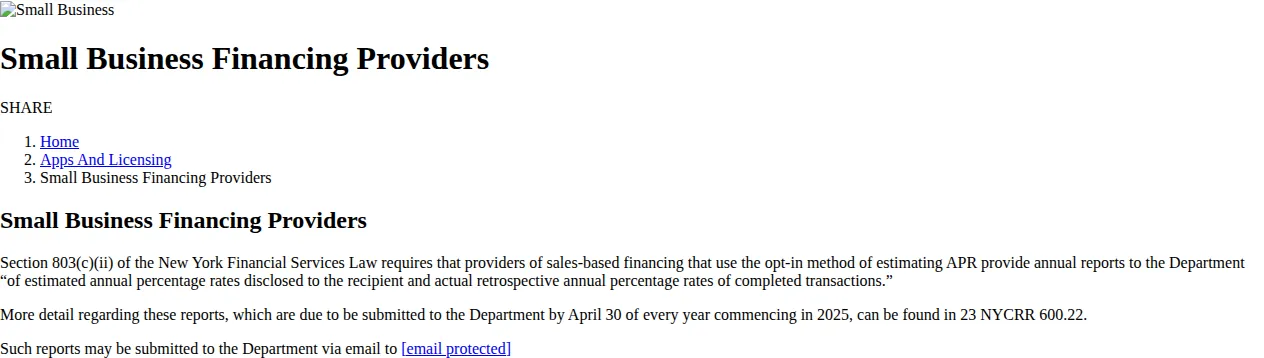
Financial Services Law section 803(c)(ii) requires providers using the opt-in APR estimation method to file annual reports with the Department of estimated APRs disclosed and actual retrospective APRs of completed transactions, due by April 30 of every year starting in 2025, under 23 NYCRR 600.22 — the provision shown above. A New York offer without an estimated APR is not a bargain, it is a violation. Compare the disclosure against the 254 percent this playbook computed for a 1.30 factor.
Florida: dollar cost, no APR, and a ban on broker advance fees
Florida took a different path. The Florida Commercial Financing Disclosure Law, created by CS/HB 1353 in 2023 as Florida Statutes sections 559.961 through 559.9615, applies to transactions of $500,000 or less consummated on or after January 1, 2024. A provider closing more than five such deals in twelve months must disclose in writing, at or before consummation, the funds provided, the amount disbursed if less, the total to be paid, and the total dollar cost, with the manner, frequency, and amount of each payment. Unlike New York, Florida requires the total dollar cost, not an APR. The law also bars a broker from collecting an advance fee before a deal is placed.
The confession of judgment: the clause that skips the courtroom
Buried in most MCA agreements is a confession of judgment — a signed affidavit letting the funder enter a court judgment without a lawsuit, notice, or hearing, the moment it claims a default. In New York, CPLR 3218 allows a judgment by confession without an action, on an affidavit stating the sum, authorizing entry, and stating the defendant's county of residence. Between 2014 and 2018, funders filed more than 25,000 confessions of judgment in New York courts. New York amended CPLR 3218 effective August 30, 2019: a confession may now be filed only in the county where the debtor resided when the affidavit was executed, or where the debtor resides at filing. The amendment closed the out-of-state pipeline but left New York businesses fully exposed. The FTC banned confessions of judgment in consumer credit in 1985 under 16 CFR 444.2 — but that ban covers consumer credit only, not a commercial advance. Read the confession clause before signing.
UCC Article 9: the lien behind the advance
Most MCA agreements grant the funder a security interest in the business's receivables, often all its assets, governed by UCC Article 9. Section 9-203 makes a security interest enforceable only when value has been given, the debtor has rights in the collateral, and the debtor has authenticated a security agreement describing it. Section 9-308 provides that a security interest is perfected when it has attached and the perfection step is taken; Section 9-310 makes filing a UCC-1 financing statement that step for most collateral. The funder files the UCC-1 at funding, putting other lenders on notice and giving the funder priority over later creditors. On default, Section 9-609 lets a secured party take possession of collateral without judicial process if it can be done without breach of the peace — for receivables, directing the processor to route card batches to the funder. Before signing, search the UCC records and read the collateral description: the broader grant can block a future bank loan.
The pre-signing checklist
An advance fits exactly one situation: strong, verifiable card sales, a cash need that cannot wait 30 days, and a clear repayment source inside ninety days. It is the wrong tool for falling sales, for a business already carrying an advance, for a business with no card sales, and for any need a 7(a) loan could meet if the owner applied thirty days earlier. The ACH versus FedNow versus wire payment rails guide explains why a fixed ACH debit clears on calendar days while a holdback follows card batches.
- [x] Factor rate in writing: funded amount, factor rate, purchased amount, fee question answered — gross or net.
- [x] Holdback versus fixed ACH: the daily dollar figure at last month's sales and at the worst month's.
- [x] APR-equivalent computed both ways, on your own sales figures, not the funder's projection.
- [x] Disclosure received: the New York APR disclosure or the Florida dollar-cost disclosure, signed and kept, before the money moves.
- [x] Confession of judgment located: the clause found, the county named, the CPLR 3218 residency rule checked.
- [x] UCC filing understood: collateral description read, existing UCC-1 filings searched, effect on a future bank loan weighed.
- [x] Stacking tested: no second advance while the first collects, unless both debits together pass the worst-month test.
- [x] The 7(a) alternative priced: the term-loan payment computed and compared, application filed first if there is time.
Maria's advance bought her an oven and cost her $15,000 in four months. The same advance, signed in a falling February with a fixed ACH and a second advance stacked behind it, would have frozen the account. Price the advance like a loan, read it like a lien.