PayPal vs Venmo vs Cash App: 2026 Payment App Fees Playbook
Founder & CEO Insight — Enow A. Jovial
PayPal, Venmo and Cash App all move money between people for free — and all three charge for the same three things: speed, card funding, and selling. The differences sit in the caps, the fixed fees, and the business rates.
1. The Fee Snapshot
Every figure here comes from the vendor's own fee page, read this cycle — except the PayPal personal and Cash App figures, which are corroborated-secondary: PayPal's consumer page sat behind a bot wall and Cash App's fee article returns a 404, so those numbers are confirmed in independent 2026 reads citing the vendors' pages (see the sources list).
| Fee | PayPal | Venmo | Cash App |
|---|---|---|---|
| Send to a friend, balance / bank / debit | Free | Free | Free |
| Send to a friend, credit card | 2.90% + $0.30 | 3.00% | 3% |
| Standard transfer to bank (1–3 days) | Free | Free | Free |
| Instant transfer | 1.75%, min $0.25, max $25 | 1.75%, min $0.25, max $25 | 0.5%–1.75%, min $0.25, no cap |
| Receive on a business profile | 3.49% + $0.49 (Checkout) | 1.9% + $0.10 | 2.6% + $0.15 |
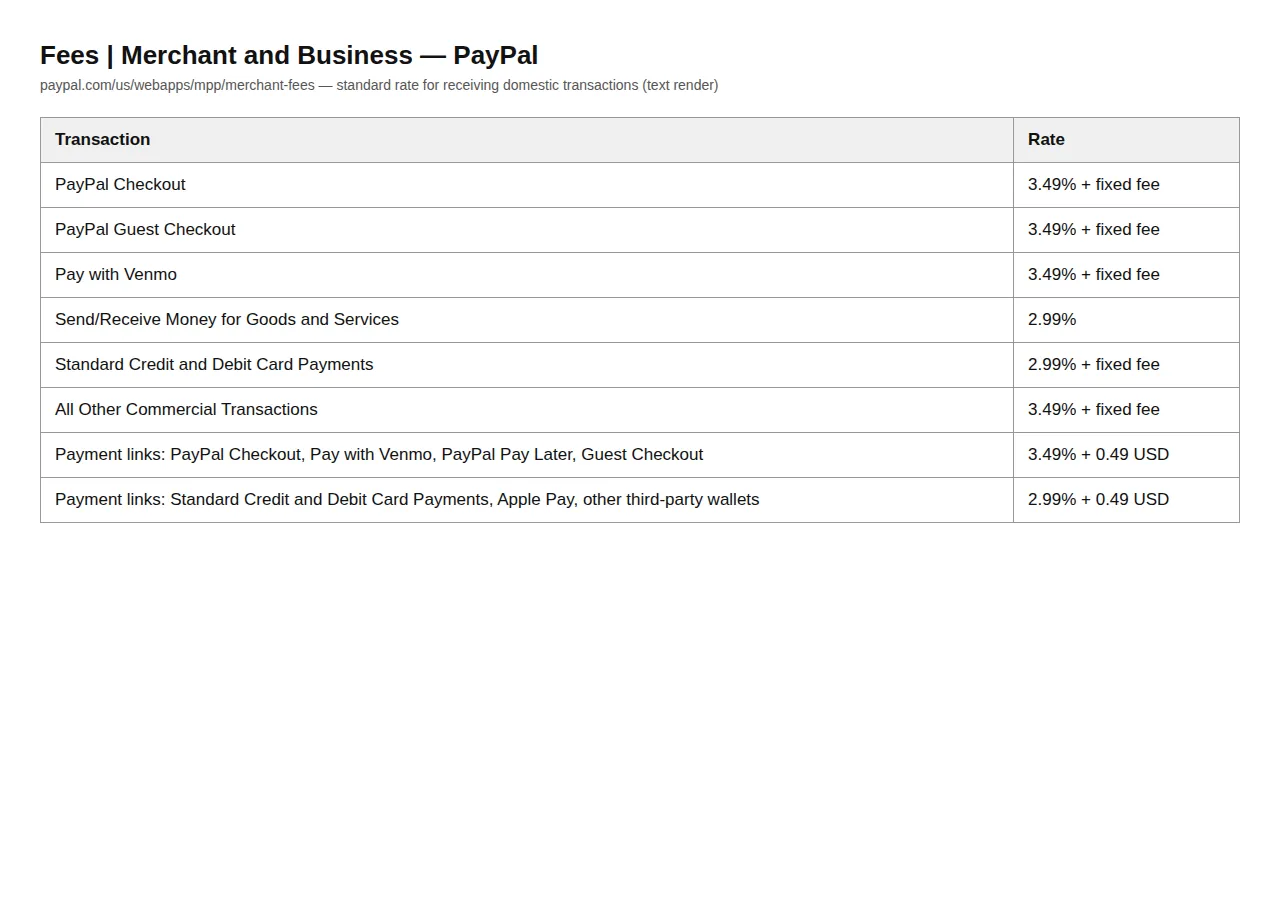
Cash App caveat: two 2026 reads report the current terms ceiling as 2.5%, not 1.75%. This playbook uses 1.75% as the planning rate; Cash App shows your exact fee before you confirm.
2. Sending Money to People: Free Until You Add a Card
The free tier is identical: pay from your balance, a bank account or a debit card and the send costs nothing. The fee appears when the funding source changes to a credit card, because the card network charges the app and the app passes the cost to you.
Example: a $200 payment to a friend, funded by credit card. Venmo charges 3.00%, which is $6.00. Cash App charges 3%, also $6.00. PayPal charges 2.90% plus $0.30, which is $5.80 + $0.30 = $6.10.
Case Study: the $300 crossover. Set the two card fees equal: 0.03T = 0.029T + 0.30 gives 0.001T = 0.30, so T = $300.00. Below $300 a card-funded send is cheaper on Venmo or Cash App; above $300 it is cheaper on PayPal. At $1,000 the gap is seventy cents — not a reason to switch apps, but a reason to stop funding large sends with a card.
Paying a contractor through these apps does not replace payroll: FICA withholding and SECA obligations still apply, so keep the receipt and let your CPA classify it.
3. Instant vs Standard: The Cap Is the Whole Story
Standard transfers are free on all three apps and take one to three business days over the ACH rails. Instant transfers arrive in minutes and cost a percentage — and the percentage is where the apps split. PayPal and Venmo charge 1.75% with a $0.25 minimum and a $25 maximum. Cash App charges 0.5% to 1.75% with a $0.25 minimum and no published maximum.
| Monthly cash-out | PayPal / Venmo | Cash App at 1.75% | Standard |
|---|---|---|---|
| $500 | $8.75 | $8.75 | $0.00 |
| $2,000 | $25.00 (capped) | $35.00 | $0.00 |
| $10,000 | $25.00 (capped) | $175.00 | $0.00 |
Example: one instant cash-out a month. At $500 the fee is $8.75 everywhere. At $2,000 the cap binds on PayPal and Venmo ($25.00) while Cash App charges $35.00. At $10,000 it is $25.00 against $175.00.
The cap threshold is the most useful number here: on PayPal and Venmo, every dollar above $1,428.57 moves free. One instant cash-out a month at $2,000 costs $300.00 a year on PayPal or Venmo and $420.00 on Cash App; at $10,000 a month it is $300.00 against $2,100.00. No volume makes instant transfer pay for itself, because the standard transfer is free. Instant is worth 1.75% only when having the money two days early is worth more than the fee.
4. Receiving Money for Goods and Services
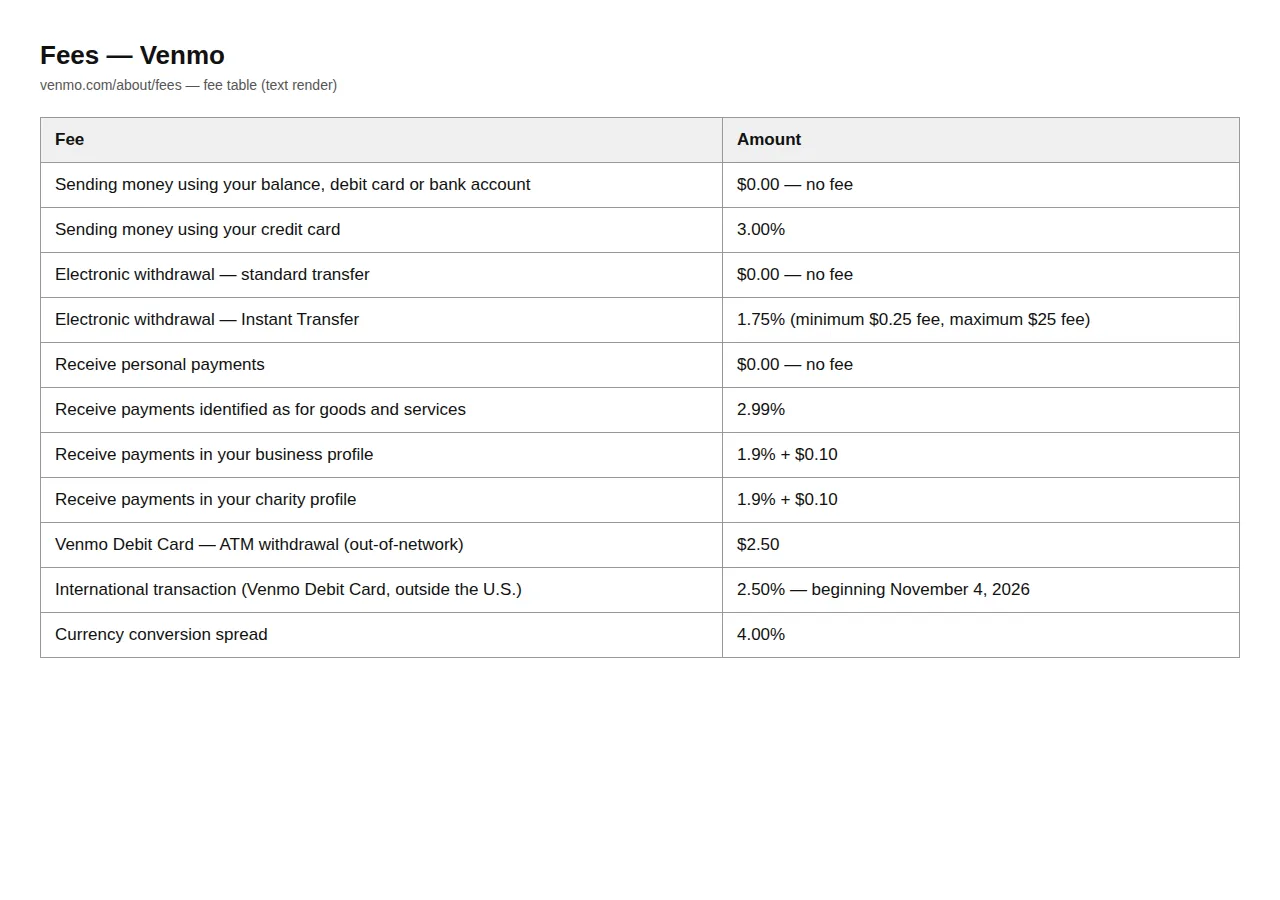
Receiving a personal payment costs nothing. The fee starts when the sender marks the payment as for goods and services — or when it lands in a business profile. PayPal charges 2.99% on goods-and-services payments with no fixed fee, and Venmo charges the same 2.99% on personal-account goods-and-services payments. The business profiles are where the apps diverge.
| Receiving route | Rate | $500/mo | $2,000/mo | $10,000/mo |
|---|---|---|---|---|
| PayPal goods and services | 2.99% | $14.95 | $59.80 | $299.00 |
| Venmo business profile | 1.9% + $0.10 | $10.50 | $42.00 | $210.00 |
| Cash App for Business | 2.6% + $0.15 | $14.50 | $58.00 | $290.00 |
Business figures assume a $50 ticket (10, 40, 200 transactions a month). A $50 ticket on Venmo business costs $1.05 against $1.50 on PayPal goods and services — $0.45 saved per sale; on Cash App for Business it costs $1.45. At $10,000 a month Venmo business saves $89.00 a month ($1,068.00 a year); Cash App for Business saves $9.00 a month ($108.00 a year). But compare percentage and fixed fee together: on a $5 sale Venmo business charges $0.20 (3.9%) — worse than PayPal's flat 2.99% ($0.15).
5. The Business-Profile Crossovers
The crossover is the ticket size where two fee structures cost the same. Our editorial analysis found three of them.
Example: Venmo business vs PayPal goods and services. Set 0.0299T = 0.019T + 0.10: 0.0109T = 0.10, so T = $9.17. Any ticket above $9.17 is cheaper on a Venmo business profile; below it, PayPal goods and services wins.
Example: Cash App business vs PayPal goods and services. Set 0.0299T = 0.026T + 0.15: 0.0039T = 0.15, so T = $38.46. Below $38.46, PayPal goods and services is cheaper; above it, Cash App for Business wins.
Case Study: Venmo business vs Cash App business. Set 0.019T + 0.10 = 0.026T + 0.15: −0.007T = 0.05 has no positive solution. Venmo business charges a lower percentage and a lower fixed fee, so it is cheaper at every ticket size — by $0.40 on a $50 sale. Whether you are a sole proprietor, an LLC, an S-Corp or a C-Corp, business money belongs in a business profile — never a personal one. Export transactions to CSV monthly and record the fees under GAAP.
6. The Stacked Cost: Receiving Plus Instant Cash-Out
Most sellers pay twice: once to receive the money, once to move it to the bank fast. Stacking both fees at $2,000 a month with $50 tickets shows how the ranking changes.
| Path at $2,000/mo | Receive fee | Instant cash-out | Total / month |
|---|---|---|---|
| PayPal G&S + instant | $59.80 | $25.00 | $84.80 |
| Venmo business + instant | $42.00 | $25.00 | $67.00 |
| Cash App business + instant | $58.00 | $33.99 | $91.99 |
| Venmo business + standard | $42.00 | $0.00 | $42.00 |
The PayPal row: $2,000.00 less the $59.80 receiving fee leaves $1,940.20, and 1.75% of that is $33.95 — above the $25.00 cap, so the instant fee is $25.00. The Cash App row is the only one with no cap: 1.75% of the $1,942.00 net balance is $33.99. The gap between the cheapest stacked path (Venmo business with a free standard cash-out, $504.00 a year) and the most expensive (Cash App business with instant cash-out, $1,103.88 a year) is $599.88 a year on the same $24,000 of sales.
For the card-processor comparison, see our Stripe vs Square vs PayPal playbook. Run your own totals through the Business Profit Margin Calculator.
7. Cross-Border Payments and Checkout
PayPal Checkout costs 3.49% plus $0.49, against 2.99% for goods and services — a premium of $0.99 on a $100 sale, or $355.20 a year at $2,000 a month with $50 tickets. Cross-border payments stack two more charges: PayPal adds 1.50% on international commercial transactions, plus a conversion spread — 4.00% for goods or services, 3.00% otherwise. On a $1,000 commercial payment the two together are $55.00, or 5.50% before the receiving fee; Venmo's spread is also 4.00%. A personal payment abroad on PayPal costs 5% with a $0.99 minimum and a $4.99 maximum, so a $1,000 send costs $4.99. Cash App stopped sending money abroad on May 1, 2026. For the full cross-border comparison, see our Wise vs Airwallex vs Payoneer playbook. An IBAN or SWIFT wire can beat a 5.50% surcharge above $5,000. PayPal's Payouts API charges 2%, or $0.25 flat per payout.
8. The 1099-K and Backup Withholding
The tax rules are the same on all three apps because they come from the same statute. Under 26 U.S.C. § 6050W(e), a platform must file Form 1099-K for a payee only when both tests are met in the same year: gross reportable payments above $20,000 and more than 200 transactions. The One, Big, Beautiful Bill retroactively restored that threshold, confirmed by the IRS in news release IR-2025-107 (October 23, 2025).
Example: $25,000 across 150 transactions draws no 1099-K (the count test fails); $21,000 across 250 does; and $15,000 on PayPal plus $15,000 on Venmo draws none, because the test is per platform. See our IRS Form 1099-K playbook for the full guide.
Backup withholding is the sharper edge: if a platform cannot verify your taxpayer identification number — your SSN, EIN or ITIN — § 3406 requires it to withhold 24% of reportable payments. On a $5,000 payment that is $1,200.00 held back until the TIN is verified. Give the platform a correct TIN at setup, match the legal name to it, and reconcile the 1099-K gross figure every January.
9. Disputes, Debit Cards and the Rest of the Bill
A sale that ends in a chargeback costs more than the sale: PayPal charges a $20.00 chargeback fee, a $15.00 standard dispute fee, and a $30.00 high-volume dispute fee on top of the reversed amount. One $100 sale lost to a chargeback costs $120.00. Venmo personal goods-and-services payments carry Purchase Protection, but Venmo's fee page lists no fixed dispute fee for personal accounts, so this playbook prints none. Only goods-and-services payments carry protection: a friends-and-family payment sent by mistake has no buyer protection on any of the three apps. The debit cards are cheap to hold: the Venmo Debit Card costs nothing to get, in-network ATM withdrawals through MoneyPass are free, and out-of-network withdrawals cost $2.50 — the same $2.50 Cash App charges. Venmo adds a 2.50% foreign transaction fee outside the US, effective November 4, 2026.
10. The Decision Table
| Your situation | Cheapest route | Why | Authority |
|---|---|---|---|
| Paying a friend, any amount | Any app, balance / bank / debit | $0.00 on all three | Vendor fee pages |
| Paying a friend by card under $300 | Venmo or Cash App | 3.00% wins | Vendor fee pages |
| Cashing out $2,000+ instantly | PayPal or Venmo | $25 cap vs no cap | Vendor fee pages |
| Selling, tickets above $9.17 | Venmo business profile | 1.9% + $0.10 wins | Venmo fees page |
| Selling, tickets $38.46 and up | Cash App for Business | 2.6% + $0.15 wins | Cash App help |
| Selling, tickets under $9.17 | PayPal goods and services | No fixed fee wins | PayPal merchant fees |
11. Execution Checklist
- [x] Step 1: Split personal and business money. Open a business profile where your buyers already are — Venmo business at 1.9% + $0.10 for most sellers.
- [x] Step 2: Turn off instant cash-out as the default. Use the free standard transfer and reserve instant for the week a deadline makes 1.75% cheaper than being late.
- [x] Step 3: Stop funding sends with a credit card. Link a bank account or debit card so personal sends cost $0.00.
- [x] Step 4: Give every platform your correct TIN — SSN, EIN or ITIN — so § 3406 never withholds 24% of your receipts.
- [x] Step 5: Track the 1099-K tests monthly. Log gross receipts and transaction counts per platform in a CSV export, and flag the month you cross $20,000 or 200 transactions.
- [x] Step 6: Re-price the stack every quarter. Re-run the worked examples with your own volume and ticket size.
The cheapest app is not a brand — it is a combination: the right funding source, the right receiving profile, the right ticket size, and the free transfer rail. Price the whole path once and set the defaults.