Revocable Living Trust vs Irrevocable Trust: the $15,000,000 Exclusion, the Step-Up You Keep or Lose, and the 60-Month Medicaid Clock
Margaret is 68, widowed, and owns a house worth $900,000 that she bought for $200,000, a brokerage account worth $800,000 with a $500,000 cost basis, and $300,000 in cash. Her neighbor says put everything in a revocable living trust. Her elder-law attorney says put $400,000 in an irrevocable trust instead. Both are right: the revocable trust keeps her in control and the step-up her children need; the irrevocable trust gives up control to start a 60-month Medicaid clock.
What each trust actually does
A revocable living trust is a set of instructions you write while alive, fund by retitling assets into the trust's name, and keep the power to change or revoke. You are typically trustee and beneficiary during your life; a successor trustee takes over on incapacity or death. You keep every practical power: sell the house, move the account, spend the cash, rewrite the beneficiaries.
An irrevocable trust is the same container with the exit removed. Once you sign it and transfer assets in, you generally cannot amend it, revoke it, or take the assets back. The trustee — who should not be you — manages the assets for the beneficiaries. Because you gave the assets away, the law treats them as gone.
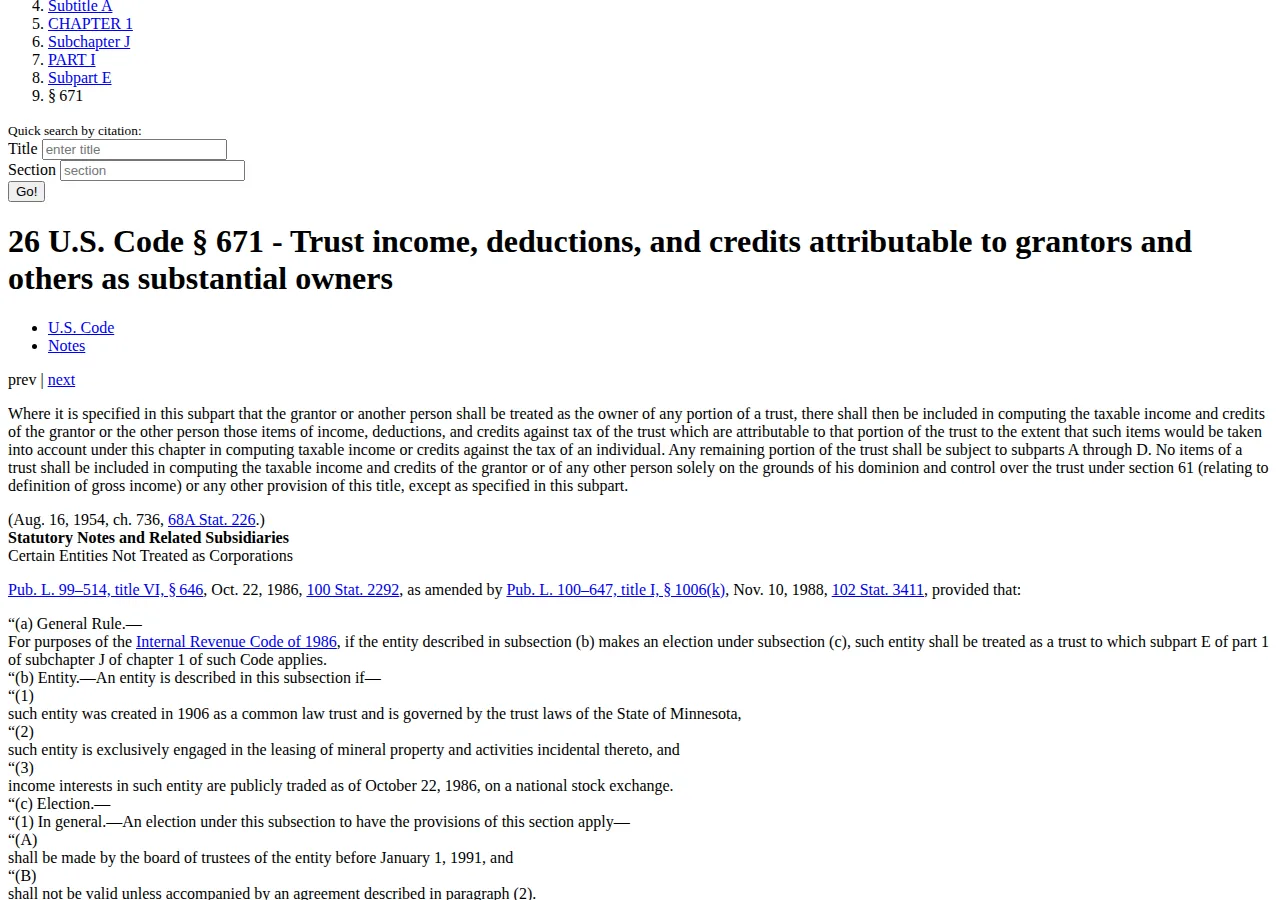
The tax difference follows from 26 U.S.C. § 671: the trust's items of income, deductions, and credits attributable to a portion the grantor owns are included in computing the grantor's taxable income. A revocable trust is a grantor trust because you kept the power to revoke it, so its income lands on your own return while you live. An irrevocable trust that is not a grantor trust is a separate taxpayer: it obtains its own taxpayer identification number and files Form 1041 if it has gross income of $600 or more.
The decision table
| Question | Revocable living trust | Irrevocable trust | Authority |
|---|---|---|---|
| Income tax while you live? | You, on your own return | The trust, on Form 1041, from $600 of gross income | 26 U.S.C. § 671 |
| In your taxable estate? | Yes — you kept the income and the power to revoke | No, if the gift was complete | 26 U.S.C. §§ 2036, 2038 |
| Step-up in basis? | Yes — fair market value at death | Generally no — heirs inherit your basis | 26 U.S.C. § 1014 |
| Creditor protection? | None | Yes, once the transfer is complete | State fraudulent-transfer law |
| Counts for Medicaid? | Yes — assets are still yours | Yes — 60 months after transfer | 42 U.S.C. § 1396p(c)(1) |
Why the revocable trust leaves your estate tax unchanged
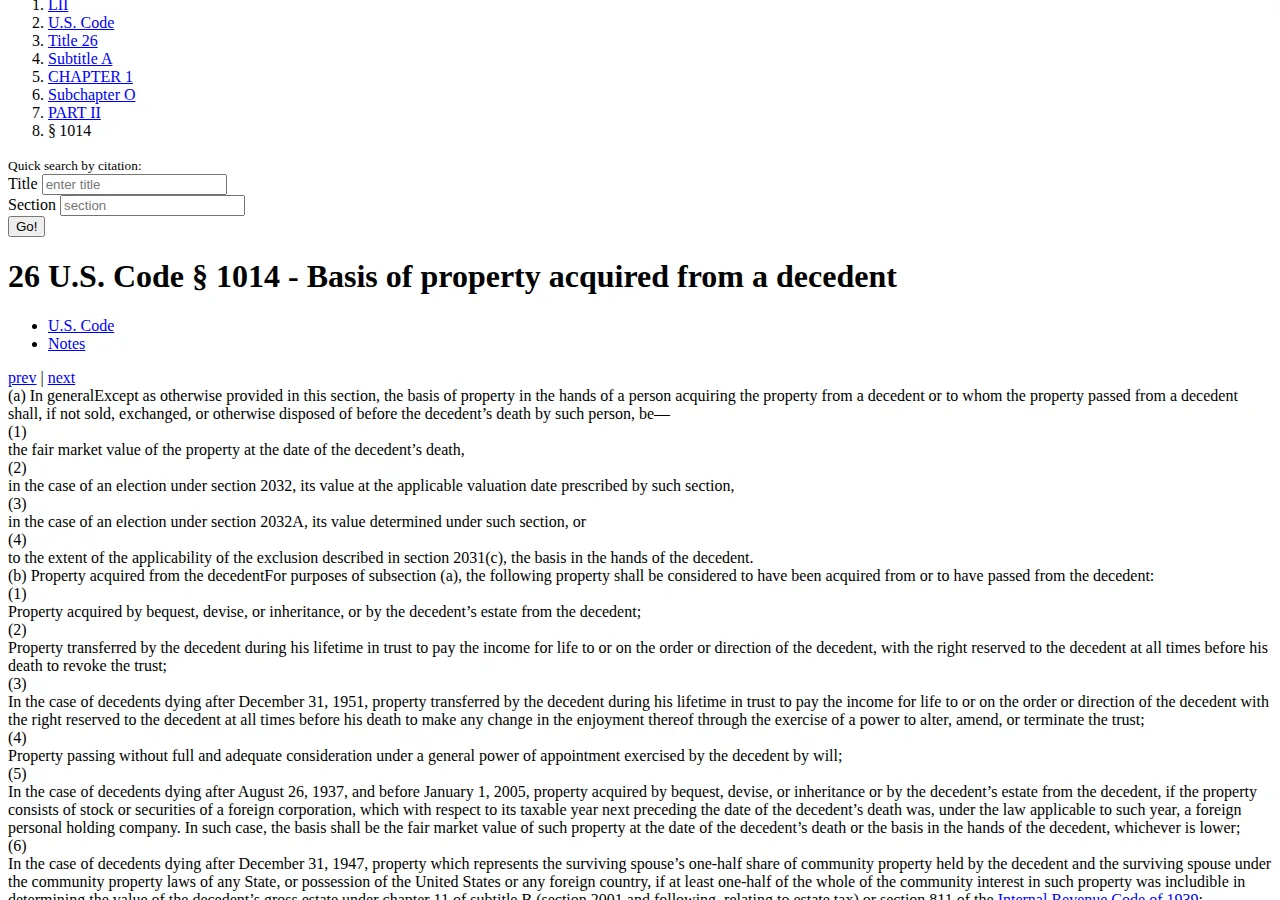
Section 2036 pulls property back into the gross estate when the decedent kept for life the possession or enjoyment of, or the right to the income from, the property — or the right to designate who shall possess or enjoy it. Section 2038 does the same when the decedent kept the power to alter, amend, revoke, or terminate. A revocable living trust trips both. That inclusion buys the step-up: section 1014 gives your heirs a basis equal to the fair market value of the property at the date of your death.
Worked example: Margaret's $2,000,000 estate
Margaret's estate is $2,000,000. The basic exclusion amount for 2026 is $15,000,000, so she owes no federal estate tax under either trust. What the revocable trust buys her is the step-up:
If her children inherit through the revocable trust and sell at death-date values, the $1,000,000 of appreciation is never taxed — $150,000 of capital-gains tax at the 15 percent rate under 26 U.S.C. § 1(h)(1)(C) never arises. Had the same assets gone to a completed-gift irrevocable trust, her children would inherit her $200,000 and $500,000 bases instead, and the $1,000,000 gain would be taxed when they sell. Below $15,000,000, the irrevocable trust does not save estate tax.
Worked example: the $18,000,000 estate — where the gift alone does not save tax
The calculation flips above the exclusion, but not the way most guides tell it. Take an $18,000,000 estate with a $12,000,000 cost basis — $6,000,000 of appreciation. Under a revocable trust the estate tax is 40 percent of the $3,000,000 above the $15,000,000 exclusion:
That is the tentative tax on the $18,000,000 estate ($7,145,800 under the § 2001(c) table) minus the unified credit on the $15,000,000 exclusion ($5,945,800). The exclusion works through the credit, not as a deduction from the estate: applying the table to the $3,000,000 excess instead gives $1,145,800, understating the tax by $54,200. The heirs get a full step-up to $18,000,000, so a sale at death-date values produces no capital gain.
Now gift $15,000,000 to an irrevocable trust in 2026. The first $19,000 is covered by the annual exclusion — a trust gift needs Crummey withdrawal powers to qualify as a present interest — so $14,981,000 counts against the lifetime exclusion and no gift tax is due. But the donor's remaining exclusion is $19,000, not zero. The retained $3,000,000 at death is taxed on the $2,981,000 above that remainder, and the gifted $15,000,000 carries over its $10,000,000 basis:
Total cost of the irrevocable route: $1,942,400 against the revocable route's $1,200,000. On static values the irrevocable trust LOSES $742,400 — the step-up surrendered on the pre-gift appreciation costs more than the estate tax saved. The retained $3,000,000 still gets its step-up at death, but that does not rescue the comparison.
The gift earns its keep only when the gifted assets appreciate after the gift, because post-gift growth escapes the estate entirely. Suppose the gifted $15,000,000 grows to $20,000,000 by death and the retained $3,000,000 grows to $4,000,000. Under the revocable trust the estate is $24,000,000 and the tax is 40 percent of $9,000,000 — $3,600,000, with no capital gain thanks to the step-up. Under the irrevocable trust the estate tax is 40 percent of $3,981,000 — $1,592,400 — and the capital-gains tax is $10,000,000 × 15 percent — $1,500,000 — for a total of $3,092,400. The irrevocable route now saves $507,600 — the $5,000,000 of post-gift appreciation escaping the 40 percent estate tax, net of the step-up surrendered on the pre-gift appreciation. Run the same two-sided arithmetic on your own numbers through the profit calculator before you sign — the break-even moves with your basis and your growth, not your balance.
The gift is reported on Form 709. The estate-tax guide on the OBBBA $15,000,000 exemption and portability rules covers how a surviving spouse can inherit unused exclusion.
The Medicaid clock: 60 months, and it starts before you need it
The irrevocable trust's other job is Medicaid planning, and it runs on a clock that punishes late starts. Under 42 U.S.C. § 1396p(c)(1)(B)(i), the look-back date for a transfer from a trust — or any other disposal of assets made on or after February 8, 2006 — is 60 months before the individual applies for medical assistance. Transfers inside that window create a penalty period: the total uncompensated value transferred, divided by the average monthly cost to a private patient of nursing facility services in the state.
Worked example: Margaret moves $400,000 into an irrevocable trust on November 8, 2021; sixty months later is November 8, 2026 — a Sunday. If she applies for Medicaid on Monday, November 9, 2026, the transfer is outside the look-back and creates no penalty. If instead she transfers $300,000 only 30 months before applying, the penalty is $300,000 divided by the state's average private-pay cost — at an assumed $10,000 a month, 30 months of ineligibility. The $10,000 divisor is an assumption; the statute leaves it to the state.
Funding the trust: the step everyone skips
A trust that holds no assets does nothing. Funding — retitling assets into the trust's name — is where most plans fail.
- Step 1 — List every asset with its title: deeds, brokerage and bank accounts, business interests, life insurance, retirement accounts. Retirement accounts stay outside the trust during your life — retitling an IRA triggers tax — so name the trust as beneficiary instead.
- Step 2 — Retitle the real estate: record a new deed from yourself as an individual to yourself as trustee, and confirm the title insurer and mortgage lender accept the transfer.
- Step 3 — Retitle the accounts: open trust accounts at each institution and transfer the holdings in kind — do not sell and rebuy, which realizes the gain the step-up would have erased.
- Step 4 — Update beneficiary designations: life insurance and retirement accounts pass by designation, not by the trust document, unless the designation names the trust.
- Step 5 — Sign the pour-over will: it catches the stragglers and names the guardians for minor children.
- [x] Deeds recorded in the trust's name
- [x] Accounts retitled in kind
- [x] Beneficiary designations updated to name the trust
- [x] Pour-over will signed, guardians named
- [x] Successor trustee named
- [x] Form 709 filed for any completed gift
- [x] Irrevocable trust funded last
- [x] Funding memo filed
What it costs over three years
Trust & Will's Trust Plan — revocable living trust, pour-over will, HIPAA authorization, living will, power of attorney — starts at $499, with membership at $49 a year; an attorney-led plan starts at $1,499. A published Georgia firm's flat fee for an irrevocable trust is $6,500, with annual Form 1041 preparation at $300 to $800 a year.
At the low end the irrevocable trust costs $7,400 over three years against $646 for the online revocable plan — a $6,754 gap — and $5,901 more than the $1,499 attorney-led plan.
The filing detail that decides the audit trail
While the grantor lives and the trust is revocable, its income is reported on the grantor's own return under section 671, using the grantor's Social Security number — no separate trust return, no separate Employer Identification Number, no Form 1041. When the grantor dies, the trust becomes irrevocable, obtains its own taxpayer identification number, and files Form 1041 if it has gross income of $600 or more. The estate files Form 706 within 9 months after the date of death if a return is required, and the personal representative applies for the estate's EIN. A CPA reviewing the plan checks three numbers: the grantor's Social Security number on the revocable trust's accounts during life, the trust's own EIN on the Form 1041 after death, and the Form 709 for any completed gift. An LLC, S-Corp, or C-Corp interest inside the trust is retitled like any other asset — the entity's EIN does not change, but the ownership line on the operating agreement does.
When the revocable trust is the wrong tool
The revocable trust is the wrong tool in three situations. First, when the estate is over the $15,000,000 exclusion and the assets you would gift will appreciate substantially after the gift — only post-gift growth escapes the estate tax. Second, when Medicaid is a realistic need within five years — the clock only runs on completed transfers. Third, when creditors are a live risk: a business owner facing a lawsuit, a professional with malpractice exposure, or a guarantor on a loan needs assets outside the estate.
The choice is not which trust is better — it is which problem you are solving. If the problem is probate, incapacity, and privacy, the revocable living trust solves it for $499 to $1,499, keeps the step-up, and costs nothing in estate tax below $15,000,000. If the problem is estate tax over the exclusion on assets that will keep growing, creditor exposure, or Medicaid within five years, only the irrevocable trust solves it — at $6,500 to $8,900 over three years. The gift-tax annual exclusion guide covers how the $19,000 annual exclusion interacts with larger completed gifts, and the primary residence exclusion guide covers the $250,000/$500,000 exclusion that can shelter the home's gain even when the trust does not.
Founder & CEO Insight — Enow A. Jovial