Section 351 Tax-Free Incorporation: The Founder's Playbook for Moving Assets Into a Corporation
Founder & CEO Insight — Enow A. Jovial
Maya has run her software consultancy as a sole proprietorship for six years. She owns equipment worth $400,000 with an adjusted basis of $150,000, and a patent she built herself worth $300,000 with a basis of $0 — she expensed the development costs as she went. She transfers both assets to NewCo Inc., a C-Corp, for all 1,000 shares. Total value transferred: $700,000. Total built-in gain: $550,000. Tax due on the day of the transfer: $0.
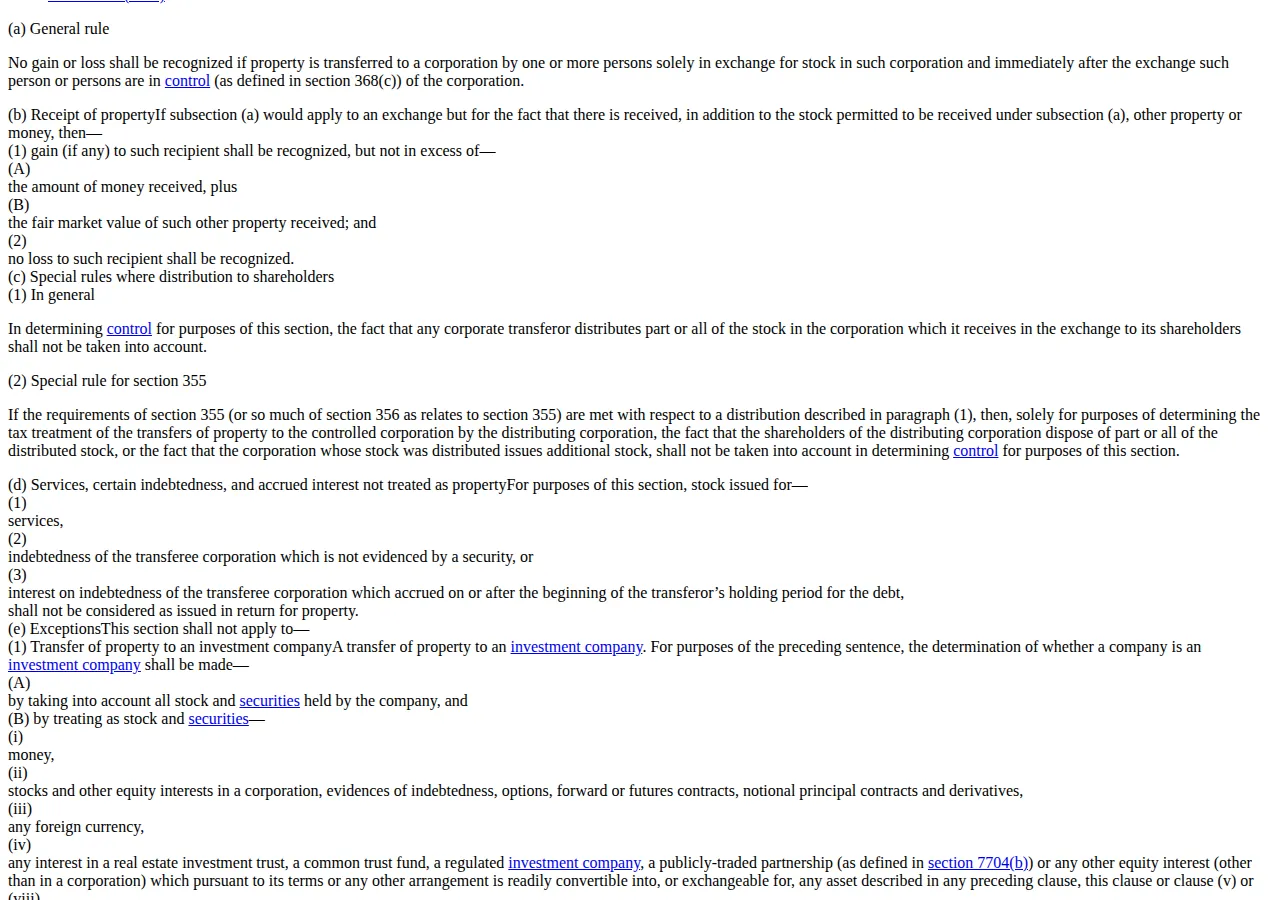
That zero is Section 351 at work — the most valuable sentence in the incorporation tax code: "No gain or loss shall be recognized if property is transferred to a corporation by one or more persons solely in exchange for stock in such corporation and immediately after the exchange such person or persons are in control (as defined in section 368(c)) of the corporation." The rest of this playbook is the price of that zero — four worked examples: the clean transfer, the boot case, the mortgage trap, and the failed control test.
The decision in one table
| Your position | The move | Tax result | Authority |
|---|---|---|---|
| Property for stock, transferors hold 80%+ after | Transfer under § 351 | $0 gain recognized; $550,000 deferred | IRC § 351(a); § 368(c) |
| Same transfer plus $50,000 cash boot | Expect boot gain | $50,000 gain recognized; $11,900 tax | IRC § 351(b) |
| Corporation assumes a mortgage above basis | Expect § 357(c) gain | $100,000 gain on a $300,000 mortgage over a $200,000 basis | IRC § 357(c) |
| Services only, no property contributed | No § 351 treatment | Ordinary compensation income; shares count against control | IRC § 351(d) |
| Transfer to an investment company | § 351 does not apply | Full gain recognized on the transfer | IRC § 351(e)(1) |
The three conditions, and what each one costs
Section 351 has three conditions, and all three must hold. Miss one and the whole transfer is taxable — there is no partial credit.
First, property must be transferred. Money counts; equipment, patents, real estate, customer lists, and accounts receivable count. Services do not: Section 351(d) provides that stock issued for services, for indebtedness of the transferee not evidenced by a security, or for interest accrued on or after the beginning of the transferor's holding period for the debt, is not considered issued in return for property. A person who contributes only services is not a transferor at all. An LLC that has elected to be taxed as a corporation counts as a corporation for this purpose.
Second, the consideration must be stock — not cash, not a note, not a promise. If the transferor receives stock plus something else, the stock part can still qualify and the something else is boot, taxed under Section 351(b) and priced in the next section. Nonqualified preferred stock is treated as other property under Section 351(g), so a founder who takes preferred stock with a mandatory redemption feature has taken boot, not stock.
Third, the transferor group must be in control immediately after the exchange. Control, defined by Section 368(c), has two prongs: at least 80 percent of the total combined voting power of all classes entitled to vote, and at least 80 percent of the total number of shares of all other classes. A group that holds 90 percent of the vote but only 70 percent of the nonvoting preferred has failed the test.
The 80 percent test, worked: one share is the whole ballgame
Maya's clean case passes at 100 percent: she is the sole transferor and the sole shareholder. Now change one fact. Suppose Maya transfers her $700,000 of assets for 700 shares, and Dev — who contributed no property, only a promise to work as chief technology officer — receives 300 shares for his services. Dev is not a transferor under Section 351(d). His 300 shares are compensation for services — ordinary income under Section 83, and payroll taxes including FICA apply if he is an employee. Maya holds 700 of 1,000 shares: 70 percent. The control test fails. Section 351 does not apply at all, and Maya recognizes the full $550,000 of built-in gain on the day of the transfer.
At the 2026 top long-term rate the bill is exact. Maya is a single filer already above the 20 percent threshold — Revenue Procedure 2025-32 puts the 20 percent rate above $545,500 of taxable income for a single filer in 2026, with 0 percent up to $49,450 and 15 percent in between — and the 3.8 percent net investment income tax applies above $200,000. Her rate is 23.8 percent.
One share the other way — Maya at 800, Dev at 200 — and the test passes at exactly 80 percent and the tax is $0. The control test is a cliff, not a slope.
The "immediately after" language is also a trap with a documented answer. A binding agreement to sell the stock to a third party right after the exchange means the transferor is treated as never having held it — the Intermountain Lumber rule — and control fails. But Revenue Ruling 2003-51 draws the line: a binding commitment to a nontaxable disposition, such as contributing the stock onward in a tax-free reorganization, does not necessarily break control. A binding commitment to a taxable sale destroys it. The distinction is the character of the disposition, not the existence of the agreement.

Boot: the $50,000 that costs $50,000
Section 351(b) is short and expensive. If subsection (a) would apply but for the fact that the transferor receives other property or money in addition to the permitted stock, gain is recognized, but not in excess of the amount of money received plus the fair market value of other property received. No loss is ever recognized on a boot exchange.
Maya's boot case: she transfers the same $700,000 of assets with a $150,000 basis, receives 950 shares plus $50,000 in cash. Realized gain is $550,000. Recognized gain is the lesser of realized gain and boot: $50,000.
The remaining $500,000 of gain stays deferred. Boot is taxed dollar for dollar up to the realized gain — a founder who takes $50,000 cash out of the incorporation pays tax on exactly $50,000, no more and no less.
Basis: where the deferred gain lives
Deferral is not forgiveness. The $550,000 Maya did not pay tax on has to live somewhere, and Sections 358 and 362 put it in two places at once.
The transferor's stock basis under Section 358(a)(1) starts with the basis of the property exchanged, decreases by money and other property received, and increases by gain recognized on the exchange. In Maya's clean case: $150,000 of basis, minus $0 of boot, plus $0 of gain recognized — her 1,000 shares carry a $150,000 basis. The stock is worth $700,000. The $550,000 of built-in gain now sits in the stock and will be taxed when she sells it. The corporation's books record the assets at fair value under GAAP; the tax basis is the carryover figure in the formula above. The difference is a deferred tax item on the books, not an error.
The corporation's basis under Section 362(a) is the same as the transferor's, increased by the gain the transferor recognized. NewCo takes the equipment and the patent at a $150,000 combined basis, and recognizes the built-in gain when it later sells the equipment.
In the boot case the two bases move together and the arithmetic closes. Maya's stock basis is $150,000 minus $50,000 of boot plus $50,000 of gain recognized: $150,000. NewCo's asset basis is $150,000 plus $50,000 of gain recognized: $200,000. The remaining built-in gain is $500,000 in the stock ($650,000 of stock value minus $150,000 of basis) and $500,000 in the assets ($700,000 of value minus $200,000 of basis). Recognized $50,000 plus deferred $500,000 equals the original $550,000.
Liabilities: the mortgage that creates gain out of nothing
Section 357(a) is generous: when a corporation assumes a liability of the transferor as part of the consideration, the assumption is generally not treated as money or other property, and it does not prevent the exchange from qualifying under Section 351. A founder can move a mortgaged building into the corporation without the mortgage counting as boot.
Section 357(c) is the exception that matters. If the sum of the liabilities assumed exceeds the total adjusted basis of the property transferred, the excess is treated as gain from the sale or exchange of a capital asset or of property that is not a capital asset, as the case may be. Maya transfers a building worth $900,000 with a $200,000 basis, subject to a $300,000 mortgage NewCo assumes. The excess is $100,000, and it is recognized gain even though Maya received no cash at all.
Her stock basis is $200,000 minus $300,000 of liabilities plus $100,000 of gain recognized: $0. NewCo's basis in the building is $200,000 plus $100,000: $300,000. The stock is worth $600,000 — the $900,000 building minus the $300,000 mortgage — against a $0 basis, so $600,000 of gain remains deferred. Recognized $100,000 plus deferred $600,000 equals the $700,000 of built-in gain.
Section 357(b) adds a purpose test: if the principal purpose of the assumption was to avoid federal income tax, or it had no bona fide business purpose, the entire liability assumed is treated as money received. Borrowing against an asset the week before incorporation and handing the debt to the corporation is the fact pattern that triggers it — and the taxpayer bears the burden of proof by a clear preponderance of the evidence.
What is not property, and what is not eligible
Section 351(d) already removed services from the definition of property. Section 351(e)(1) removes transfers to an investment company: if the corporation's assets are mostly stocks, securities, money, and similar liquid assets, the transfer is taxable in full. A founder cannot use Section 351 to move a stock portfolio into a corporation tax-free.
Founders confuse Section 351 with Section 368. Section 351 is an incorporation: property moves into a corporation for stock, and the transferors control the corporation after. Section 368 covers reorganizations: mergers, stock-for-stock acquisitions, and recapitalizations under a plan of reorganization. Forming a new corporation is Section 351; selling your corporation to a larger one is Section 368.
The execution checklist
- List every asset to be transferred with its fair market value and adjusted basis, and compute the total built-in gain before any document is drafted.
- Identify every transferor and what each contributes; anyone contributing services only is not a transferor and their shares count against control.
- Count the shares: the transferor group must hold at least 80 percent of the voting power and at least 80 percent of every other class immediately after the exchange.
- List every liability the corporation will assume and compare the total against the total basis; if liabilities exceed basis, pay the excess down or contribute offsetting cash before the transfer.
- Decide on boot before signing: any cash or nonqualified preferred stock is taxed dollar for dollar up to the realized gain.
- Record the Section 358 stock basis and the Section 362 corporation asset basis in the corporate books on day one — both numbers are the audit trail for every later sale.
- File the incorporation, apply for the corporation's EIN, issue the stock, and keep the transfer documents, the valuation support, and the basis computation with the corporate records — and have your CPA review the basis computation before you file.
Section 351 rewards the founder who treats incorporation as a tax event with a zero rate, not as a non-event. The zero is real and survives audit — but only when the control test, the boot rule, the basis math, and the liability rule are all satisfied on the same day, in the same documents, with the same numbers. Maya's $550,000 deferral cost her a morning of arithmetic; the $130,900 version costs the same morning plus the tax. Carry the rest of the formation decision through our Section 1031 exchange playbook, our Section 199A QBI playbook, and our Form 1065 playbook, and run the numbers through our tax estimator before you sign.
Section 351 defers the gain; a foreign trust can still tax it — see the Form 3520 playbook.