Section 469 Passive Activity Loss Rules: The Complete Playbook
A rental property can lose money every year while its owner deducts none of that loss. Under Section 469, losses from activities you merely own stay suspended until passive income absorbs them, a narrow allowance applies, or you sell the whole activity.
1. The disallowance machine
Section 469(a) disallows the passive activity loss and credit for the year for an individual, estate, trust, closely held C corporation, or personal service corporation. Under Section 469(c)(1), a passive activity is any trade or business activity in which the taxpayer does not materially participate, and Section 469(c)(2) adds the catch: the term includes any rental activity, regardless of hours spent.
The rule limits the loss, not the income: passive income is fully taxable in the year it arrives, while passive losses wait. And it sits third in a queue: Publication 925 states that at-risk rules apply before the passive rules, and basis limits before both.
2. The seven material participation tests
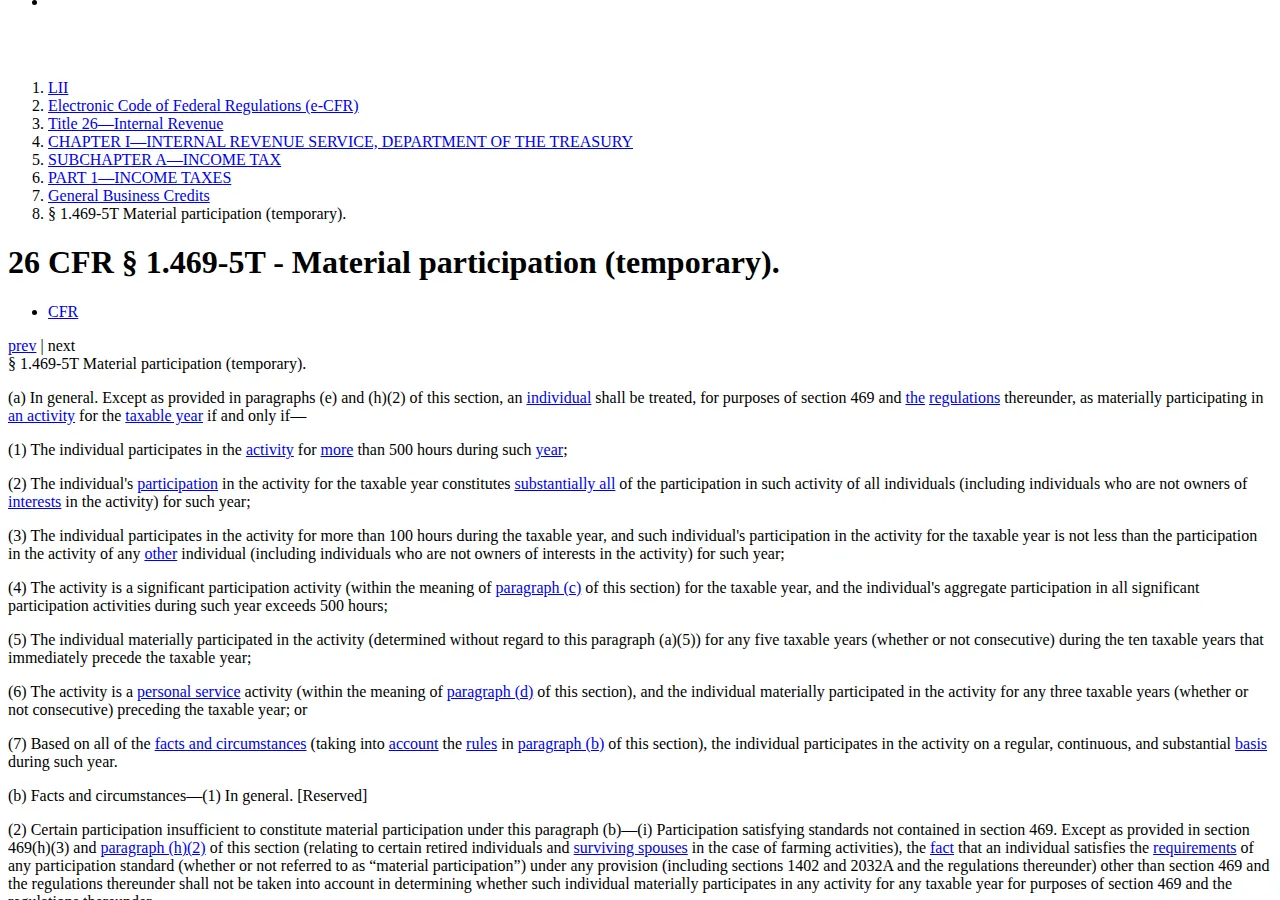
Material participation is the escape hatch for trade or business activities; rental activities are passive by statute even when the owner materially participates, unless the §469(c)(7) real estate professional exception in section 5 applies. Treas. Reg. Section 1.469-5T(a) lists seven tests; meeting any one means the taxpayer materially participated.
| Test | What it requires | Authority |
|---|---|---|
| 1. 500-hour test | More than 500 hours in the activity during the year | 1.469-5T(a)(1) |
| 2. Substantially all | Substantially all participation of all individuals | 1.469-5T(a)(2) |
| 3. 100-hour test | More than 100 hours, and not less than any other individual | 1.469-5T(a)(3) |
| 4. Significant participation | Significant participation activity; aggregate hours over 500 | 1.469-5T(a)(4) |
| 5. 5-of-10 test | Material participation for any 5 of the 10 preceding tax years | 1.469-5T(a)(5) |
| 6. Personal service | Personal service activity; material participation for any 3 preceding years | 1.469-5T(a)(6) |
| 7. Facts and circumstances | Regular, continuous, and substantial participation | 1.469-5T(a)(7) |
Test 1 is the workhorse: 500 hours, counting a spouse's work. Test 4 rescues owners of several small businesses: combined hours over 500 across activities where the owner spent more than 100 hours each makes the owner a material participant in every one.
3. Active participation is not material participation
Material participation decides whether a trade or business activity is passive. Active participation is a lower standard that unlocks only one thing: the 25,000-dollar special allowance for rental real estate in Section 4. A taxpayer actively participates by making management decisions in a significant and bona fide sense: approving new tenants, deciding rental terms, and approving expenditures.
Only individuals can actively participate, and the taxpayer's interest, including a spouse's interest, must be at least 10 percent by value of all interests in the activity throughout the year. A 5 percent limited partner cannot use the allowance at all.
4. The 25,000-dollar allowance and its phaseout
Section 469(i) gives individuals a limited escape valve: if a natural person actively participated in a rental real estate activity, up to 25,000 dollars of passive activity loss can offset nonpassive income such as wages. The allowance is 12,500 dollars for a married individual filing separately who lived apart from the spouse all year.
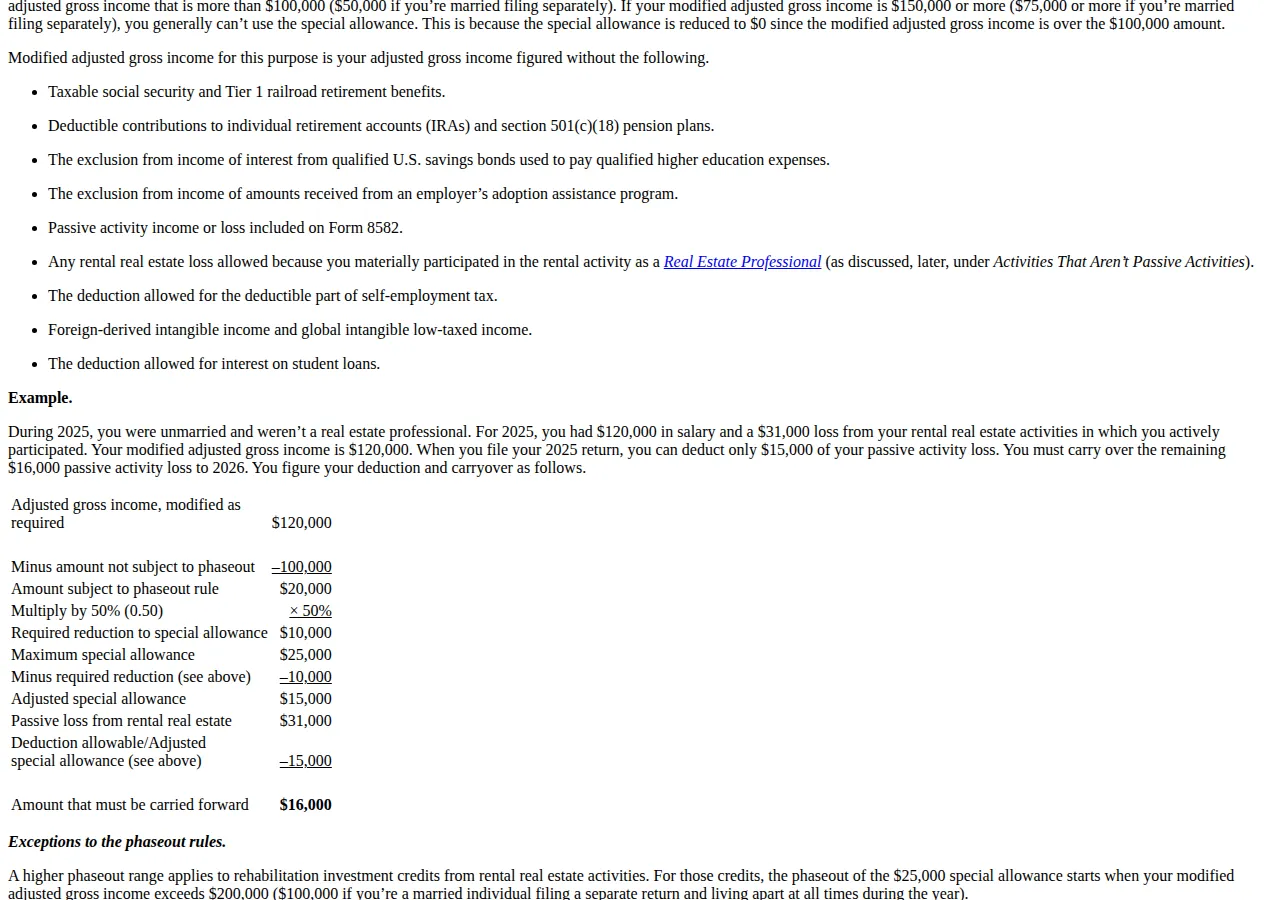
Section 469(i)(3) reduces the 25,000-dollar amount, but not below zero, by 50 percent of the amount by which adjusted gross income exceeds 100,000 dollars. Publication 925 states the result plainly: if modified adjusted gross income is 150,000 dollars or more, the taxpayer generally cannot use the special allowance at all.
That is the IRS's own worked example from Publication 925: an unmarried taxpayer with 120,000 dollars of salary and a 31,000-dollar loss deducts 15,000 dollars and carries 16,000 dollars forward.
5. The real estate professional exception
Section 469(c)(7) is the only route by which a rental real estate activity stops being passive. It applies when more than half of the taxpayer's personal services in all trades or businesses were performed in real property trades or businesses in which the taxpayer materially participated, and the taxpayer performed more than 750 hours of services in those businesses during the year. Employee services do not count unless the taxpayer was a 5 percent owner of the employer.
Qualifying does not automatically make every rental nonpassive. Section 469(c)(7)(A) treats each interest in rental real estate as a separate activity, unless the taxpayer elects to treat all interests as one activity under Treas. Reg. Section 1.469-9(g). For the Schedule E reporting mechanics once the activity is nonpassive, see our IRS Form 1040 Schedule E rental income playbook.
6. Suspended losses and the ratable allocation
Section 469(b) carries the disallowed loss forward: any loss disallowed under subsection (a) is treated as a deduction allocable to the same activity in the next taxable year, with no expiration date. It waits until the activity produces passive income, until the 25,000-dollar allowance reaches it, until the activity becomes nonpassive, or until disposition releases it.
When several activities lose money in the same year, Publication 925 applies a ratable allocation: each activity's disallowed share equals the total disallowed loss multiplied by that activity's loss divided by the sum of all activities' losses. The IRS example: Terry holds three passive activities with losses of 9,000 dollars in A and 16,000 dollars in B, and a 4,000-dollar gain in C, for a net loss of 21,000 dollars disallowed in full.
7. Disposition: the release of suspended losses
Section 469(g)(1) is the exit door. If a taxpayer disposes of their entire interest in a passive activity in a fully taxable transaction, the excess of the activity's loss for the year over net income or gain from all other passive activities is treated as a loss that is not from a passive activity, deductible against any income in the year of sale. The disposition must be of the entire interest, and the buyer must not be related to the seller.
Three dispositions do not open the door. A gift does not release the losses: Publication 925 states that unused losses allocable to a gifted interest cannot be deducted in any tax year, and instead the basis of the transferred interest is increased by those losses. A disposition by death releases losses only to the extent they exceed the step-up in basis; Publication 925 gives the arithmetic, an 8,000-dollar suspended loss against a 6,000-dollar basis increase leaves a 2,000-dollar deduction. A partial disposition releases nothing on its own. Only a disposition of substantially all of an activity can be treated as a complete disposition of the part disposed of, and only if you can prove with reasonable certainty the prior-year unallowed losses and the current-year income or loss allocable to that part.
Publication 925's Carter example: Carter sells an entire 5 percent limited partnership interest for 30,000 dollars against a 42,000-dollar basis, producing a 12,000-dollar capital loss, of which only 3,000 dollars is deductible in the year, leaving a 9,000-dollar carryover, while the 2,000 dollars of suspended ordinary passive deductions are allowed in full, for a total current deductible loss of 5,000 dollars.
8. Worked example: Maya's duplex across three years
Maya is single, earns 130,000 dollars in wages, actively participates in a duplex she owns outright. Year 1: the duplex produces a 31,000-dollar rental loss. Maya's MAGI is 130,000 dollars, so the allowance is 10,000 dollars and the rest waits.
Year 2: Maya takes a sabbatical and MAGI drops to 90,000 dollars. The duplex loses 8,000 dollars. The loss pool is the 21,000 dollars suspended from year 1 plus the 8,000-dollar current loss.
Year 3: Maya sells her entire interest to an unrelated buyer in a fully taxable sale at exactly her adjusted basis. The duplex loses 5,000 dollars in the final partial year. The activity's loss is the 5,000-dollar current loss plus the 4,000 dollars suspended from year 2, and with no net income from other passive activities, the whole 9,000 dollars is treated as a nonpassive loss under Section 469(g)(1).
9. Form 8582: where the tracking happens
Form 8582, Passive Activity Loss Limitations, is where noncorporate taxpayers figure the passive activity loss for the year and apply prior-year unallowed losses; unallowed losses carry forward until allowed against passive income, the special allowance, or a sale of the entire interest to an unrelated party.
Most taxpayers with only rental real estate losses never see the form. The instructions provide an exception when actively participated rental real estate was the only passive activity, there are no prior-year unallowed losses or credits, the total rental loss is not more than 25,000 dollars, and MAGI is not more than 100,000 dollars.

Form 8582 itself carries an identifying number: the filer's SSN for an individual, the EIN for an estate or trust. A CPA reviewing the return checks that number against the Form 1040 or Form 1041 the form rides on, and ties the suspended-loss balance on Form 8582 to Schedule E and to the K-1 from each partnership, LLC, or S corporation interest. A loss the K-1 reports but Form 8582 never carries is a loss the return silently drops. The CPA also checks the SSN or EIN on each K-1 against the return it feeds, so a mismatched identifying number is caught before filing.
Founder & CEO Insight — Enow A. Jovial
>
10. Section 469 versus Section 199A: the boundary
Section 199A and Section 469 answer different questions, and confusing them is the fastest way to overstate a deduction. Section 199A allows a deduction of up to 20 percent of qualified business income, defined as the net amount of qualified items for that business. Section 469 decides whether a loss is allowed at all in the year, and a loss it disallows is not a qualified item of deduction for that year, because it never enters the computation of taxable income.
Passing the Section 199A tests does not rescue a passive loss, and failing them does not make an otherwise allowable loss passive. A rental enterprise that qualifies as a Section 199A trade or business can still produce a fully suspended loss under Section 469 when the owner is not a real estate professional and MAGI exceeds 150,000 dollars. For the deduction side, including the specified service trade or business phaseout, see our Section 199A QBI deduction SSTB phaseout playbook. To test the numbers, run them through our tax estimator.
11. Who this playbook is for, and the execution checklist
This playbook is for individual owners of rental real estate and partnership or S corporation interests who file Schedule E, carry a suspended loss balance, or are weighing the real estate professional exception. It is not for C corporations, which use Form 8810; not for publicly traded partnership interests; and not for anyone whose loss already failed at basis or at-risk.
- Pull the prior-year Form 8582 and write down the suspended loss balance for each activity.
- Test material participation against all seven tests, activity by activity, and keep the proof.
- Compute MAGI for the phaseout using the Publication 925 definition, not ordinary AGI.
- Apply the 25,000-dollar allowance only to actively participated rental real estate losses.
- Confirm real estate professional status: more than 50 percent of personal services and more than 750 hours.
- Before selling, confirm the sale is of the entire interest, fully taxable, and to an unrelated buyer.