Generation-Skipping Transfer Tax: The $15 Million GST Exemption Playbook
Helen is 71 and her granddaughter Maya is 19. Helen wants $2,000,000 to reach Maya without stopping at her daughter's generation, so she writes the check directly to Maya. No gift tax is due — the lifetime exclusion covers it — and no GST tax is due either, because her unused GST exemption applies automatically. Change one fact: Helen's $15,000,000 exemption is already spent on an earlier dynasty trust, and she puts the same $2,000,000 into a trust for Maya and her future children. The trust is a different transfer, and the tax on Maya's children can reach 40 percent of every distribution.
Founder & CEO Insight — Enow A. Jovial
The decision in one table
| Your position | The move | GST result | Authority |
|---|---|---|---|
| Direct gift to a grandchild, within your unused exemption | Give outright | Inclusion ratio 0; no GST tax | 26 U.S.C. § 2632(b) |
| Gift to a trust that can benefit grandchildren | Allocate exemption on a timely Form 709 | Inclusion ratio 0 if fully covered | 26 U.S.C. §§ 2631, 2632(c) |
| Trust funded, no allocation made | Allocate on Form 709 before the return is late | Allocation at transfer-date value | 26 U.S.C. § 2642(b) |
| Transfer above your remaining exemption | GST tax at 40% on the exposed part | Tax = 40% × inclusion ratio × amount | 26 U.S.C. §§ 2641, 2001(c) |
| Annual $19,000 gift directly to a grandchild | Give each year | Inclusion ratio 0 under § 2642(c) | 26 U.S.C. §§ 2503(b), 2642(c) |
| Spouse died with GST exemption unused | Nothing to claim | No portability for GST exemption | 26 U.S.C. § 2631 |
What the GST tax is
Section 2601 imposes a tax "on every generation-skipping transfer (within the meaning of subchapter B)" — a third transfer tax, beside the estate tax of chapter 11 and the gift tax of chapter 12.
Section 2611(a) defines a generation-skipping transfer as one of three events: a taxable distribution, a taxable termination, or a direct skip. Section 2612 defines them: a direct skip is a transfer subject to estate or gift tax of an interest in property to a skip person — Helen's check to Maya; a taxable distribution is any distribution from a trust to a skip person; a taxable termination is the end of an interest in property held in a trust, unless a non-skip person still holds an interest after, or no distribution to a skip person can ever be made afterward.
A skip person, under section 2613, is a natural person assigned to a generation two or more below the transferor, or a trust in which every interest is held by skip persons: your child is one below you; your grandchild is two below. Section 2651(e), the predeceased-parent rule, moves a person up one generation when their parent — a lineal descendant of the transferor's parent — is dead at the transfer: if Helen's daughter died before Helen's gift, Maya counts as one generation below Helen, and the gift is not a generation-skipping transfer at all. Direct payments for education or medical care are excluded under sections 2611(b) and 2503(e), so paying Maya's tuition straight to her college uses no exemption. The GST tax is charged in addition to any gift or estate tax on the same transfer, section 2603(a) assigns the bill — transferee on a taxable distribution, trustee on a termination or a trust direct skip, transferor on a direct skip outside a trust — at 40 percent times the inclusion ratio.
The $15,000,000 exemption
Section 2631(a) allows every individual a GST exemption amount, allocable by the individual or the executor to any property of which the individual is the transferor. Section 2631(b) makes every allocation irrevocable. Section 2631(c) sets the amount: for any calendar year, the GST exemption equals the basic exclusion amount under section 2010(c).
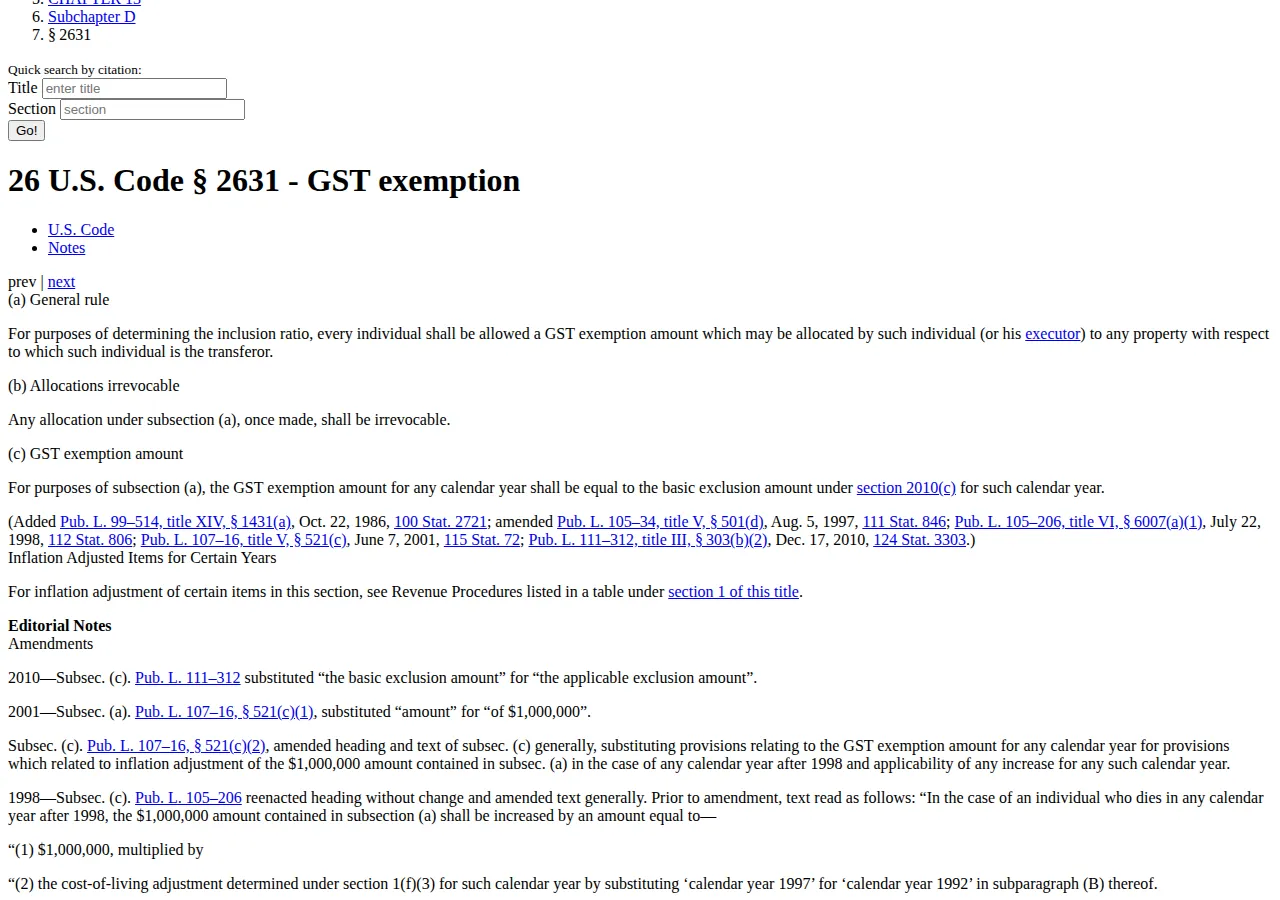
For 2026 that number is $15,000,000 per person: Revenue Procedure 2025-32, section 2.14, states that section 70106 of the One Big Beautiful Bill Act raised the basic exclusion amount to $15,000,000 for 2026 and that the GST exemption under section 2631(c) equals $15,000,000, with inflation adjustments resuming after 2026. The 2025 figure was $13,990,000.
It is per person, not per transfer: one $15,000,000 lifetime pool covers every direct skip and trust allocation you ever make. It is not portable — the estate exclusion can pass unused amounts to a surviving spouse, but the GST exemption has no such provision in section 2631, so a spouse who dies with GST exemption unused loses it. A couple can still shelter $30,000,000, $15,000,000 each, but only if each spouse uses their own. And it is separate from the estate and gift exclusion even though the dollar figure matches: the two pools share a number, not a balance.
The inclusion ratio: the only formula that matters
Section 2642(a) defines the inclusion ratio as 1 minus the applicable fraction: the GST exemption allocated to the trust — or, for a direct skip, to the property — divided by the value of the property transferred, less death taxes recovered and any charitable deduction.
Allocate the full value and the ratio is 0 — no GST tax, forever, on every later distribution from that property, however much it grows. Allocate half and every future distribution bears 20 percent; allocate nothing and every distribution bears the full 40 percent.
Worked examples
Example: Helen gives Maya $2,000,000 outright in 2026 with her full exemption unused. Under section 2632(b), her unused exemption is allocated automatically.
Her remaining exemption is $13,000,000. Scale it up: a $20,000,000 direct skip leaves a 0.25 ratio and $2,000,000 of GST tax on the exposed $5,000,000.
Worked example: Helen funds a trust with $4,000,000 and allocates only $1,000,000 of exemption, saving the rest for later. The trust's inclusion ratio is fixed at 0.75.
A later $400,000 distribution to a grandchild bears:
Every distribution from this trust carries the same 30 percent effective rate until more exemption is allocated.
Case study: Helen gives $19,000 directly to each of four grandchildren every year — the 2026 annual exclusion under section 2503(b), per Revenue Procedure 2025-32, section 4.42(1). A direct skip that qualifies as a nontaxable gift carries an inclusion ratio of zero under section 2642(c), so no exemption is used.
Ten years of annual gifts move $760,000 to the next generation with no gift tax, no GST tax, and no exemption spent — provided each gift is a present interest made directly to the skip person. A gift to a trust qualifies only under section 2642(c)'s narrow single-beneficiary conditions.
How the exemption gets allocated
Allocation runs through three mechanisms, and using the wrong one is the most common GST error after not allocating at all. Section 2632(b) governs direct skips: a lifetime direct skip draws an automatic allocation of unused exemption, to the extent needed for a zero inclusion ratio. You can elect out under section 2632(b)(3) by attaching a statement to Form 709, or by reporting the direct skip on a timely filed Form 709 and paying the GST tax — usually to save exemption for a faster-growing trust.
Section 2632(c) governs indirect skips — transfers to a GST trust, generally any trust that could eventually benefit skip persons. The allocation is automatic here too, with an election out available. The trap runs the other way: a transfer to a trust you intended as a non-GST trust can draw an allocation you never meant to make.
Elective allocation covers the rest: a transfer that is neither a direct skip nor an indirect skip is allocated only if you claim it on Form 709, Schedule D, and the executor makes at-death allocations on Form 706. Timing decides the price — a timely allocation is valued at the transfer date, a late one when the return is filed. Worked example: stock worth $2,000,000 at transfer and $3,000,000 at a late filing costs $3,000,000 of exemption instead of $2,000,000 — $1,000,000 burned by delay.
Schedule D: where the allocation lives
Form 709, due April 15 of the year after the gift, covers lifetime gifts and GST transfers. Schedule A reports the gifts — Part 1 gift-tax-only, Part 2 direct skips, Part 3 indirect skips — and Schedule D computes the GST tax: Part 1 lists the transfers, Part 2 is the GST Exemption Reconciliation under section 2631, and Part 3 computes the tax, whose total flows to line 10.
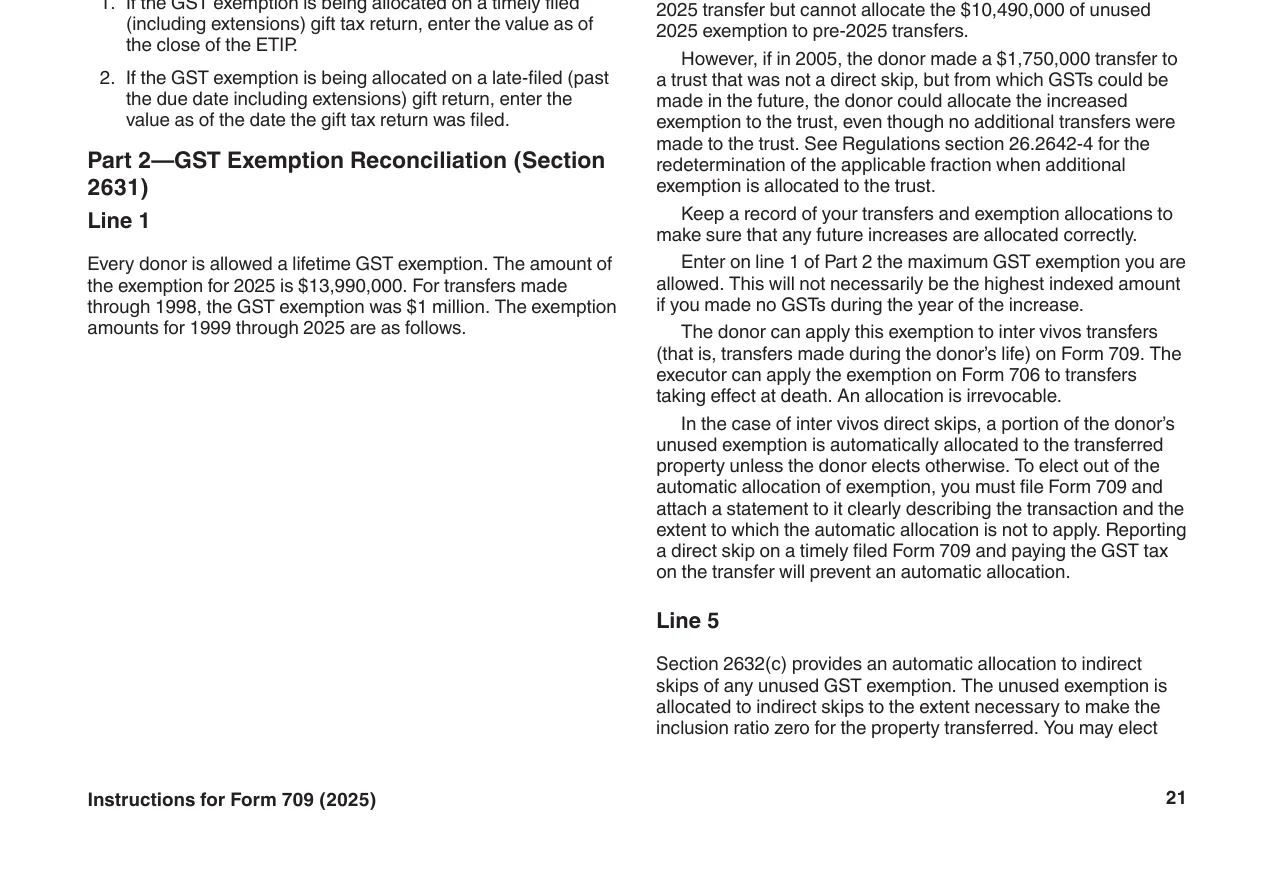
The instructions' example: a donor who made $1,750,000 of direct skips through 2005 and allocated all $1,500,000 then available can allocate $2,000,000 to a $2,000,000 taxable GST in 2025 — but cannot allocate the $10,490,000 of unused 2025 exemption to pre-2025 transfers. Each year's increase reaches only transfers from that year on.
The return carries the acronyms: the donor's SSN or ITIN, the estate's EIN, and — for an entity interest — the LLC operating agreement or the S-Corp or C-Corp share certificates a CPA will ask for. An LLC interest is valued like any other property, starting from the entity's GAAP books. None of this is payroll tax: no FICA or SECA applies to a gift or a GST transfer.
The risk layer
First, the unprotected trust: a dynasty trust funded with $10,000,000 and no exemption allocated has an inclusion ratio of 1, so when the middle generation's interest terminates, the GST tax is $4,000,000 — 40 percent of the full trust value — payable by the trustee. Second, the silent trust: a transfer that draws an automatic allocation under section 2632(c) when the donor meant to save the exemption elsewhere; the allocation is irrevocable, and the exemption is gone. Third, the late return: appreciation between the transfer date and a late filing is taxed in exemption terms. Fourth, the missed Form 709: a direct skip above the annual exclusion requires a return even when no tax is due, because the return is where the allocation is recorded. Fifth, the growth trap in reverse: a $15,000,000 allocation to a dynasty trust growing at 5 percent a year is worth about $64,800,000 after 30 years, every dollar passing with a zero inclusion ratio.
Cross-border and noncitizen-spouse notes
The GST exemption is per individual and not portable, which bites hardest in mixed-status families. The noncitizen spouse gets the larger annual exclusion: Revenue Procedure 2025-32, section 4.42(2), sets the 2026 exclusion for gifts to a spouse who is not a United States citizen at $194,000, against $19,000 for other donees. That exclusion shelters gift tax, not GST tax — a gift routed through that spouse to a grandchild is a separate transfer with its own GST analysis.
The execution checklist
- [x] Identify every skip person — grandchildren and later descendants, and any trust whose interests are all held by skip persons (§ 2613).
- [x] Classify each transfer — direct skip, taxable distribution, or taxable termination (§§ 2611, 2612); check § 2651(e) first.
- [x] Measure the exemption — $15,000,000 per person for 2026, less prior allocations, from Schedule D Part 2; no reliance on portability.
- [x] Choose the allocation — automatic for direct and indirect skips, elective on Schedule D for the rest; decide any election out (§ 2632(b)(3), (c)) before filing.
- [x] Compute the inclusion ratio — exemption over value (§ 2642(a)); confirm 0 on every trust meant to be fully sheltered.
- [x] Price the exposed part — 40% × inclusion ratio × amount (§§ 2641, 2001(c)); confirm who pays (§ 2603(a)).
- [x] File Form 709 by April 15 — Schedule A Parts 2–3, Schedule D Parts 1–3; executor files Form 706 at death.
- [x] Record the allocation — keep the reconciliation current.
Helen's check cost nothing in GST tax because the statute applied her exemption automatically; the same money in a trust funded after her exemption was spent would have cost her grandchildren 40 percent of every distribution for a generation. The difference was never the amount — it was the allocation, made on time, on the right return, to the right property. Run the estate tax exemption and portability playbook for the death side of the same $15,000,000, the gift tax and Form 709 playbook for the annual exclusion and gift-splitting mechanics, and the revocable versus irrevocable trust playbook before choosing the trust that will hold the allocation. For a rough sense of what a tax bill does to cash flow, the tax estimator models federal tax on self-employment income.