The form that decides what a sole proprietor keeps
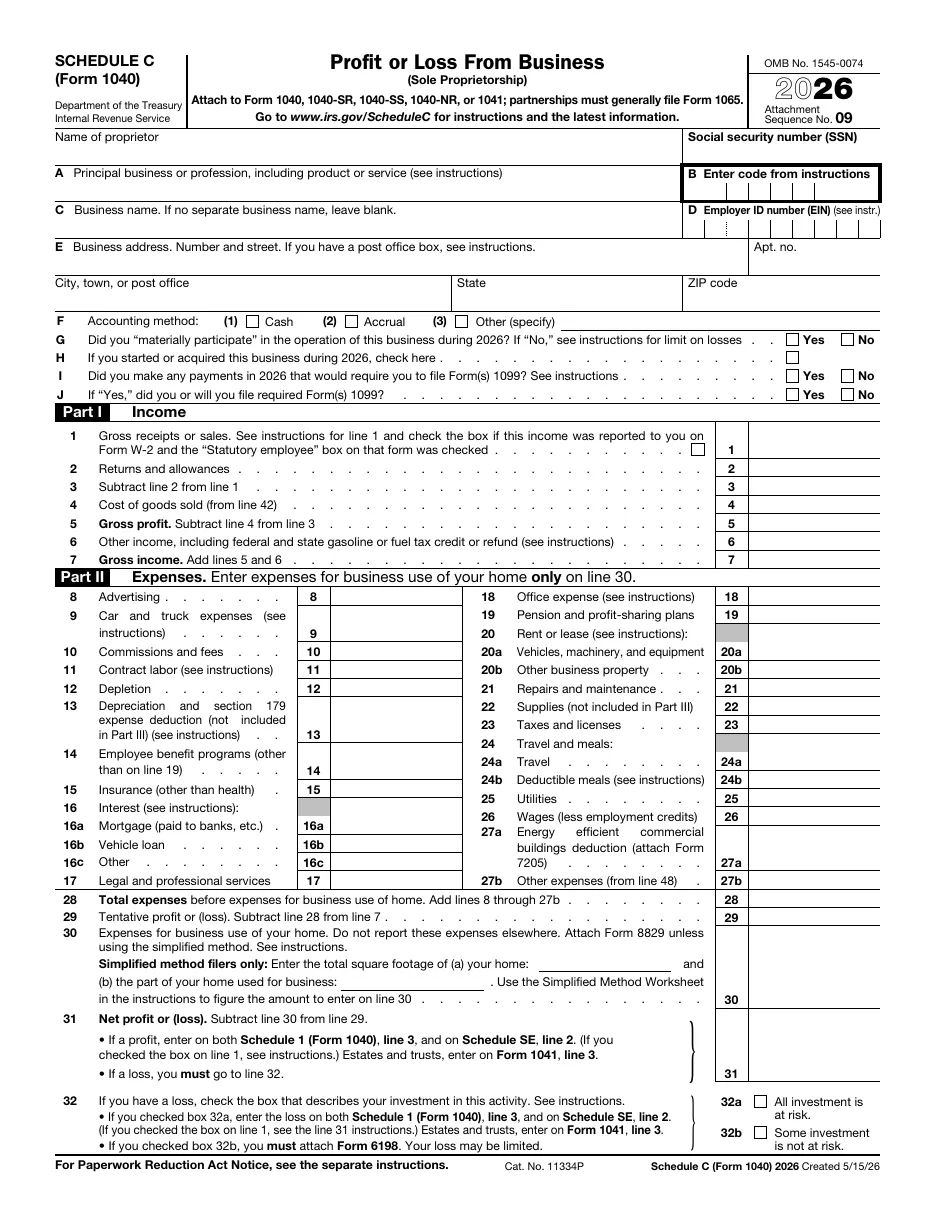
Schedule C is the one-page return inside the individual return where a sole proprietor's year is decided. Every dollar of business revenue enters on line 1, every deductible cost leaves through Part II, and line 31 flows to Schedule 1 and then to Form 1040. An operator who files Schedule C wrong does not misstate a deduction; they misstate the income tax, the self-employment tax, the estimated-tax safe harbor, and the retirement contribution room that all derive from line 31.
The worked return in this guide is an illustrative scenario, not a client file. It follows one freelancer through the whole form on the same numbers: $96,000 of gross receipts, $1,200 of returns, $8,000 of cost of goods sold, $29,140 of expenses, and a $56,660 net profit that produces $8,006 of self-employment tax. The same seller appears in the companion Form 1099-K playbook: $24,300 of the $96,000 arrived through payment platforms, and the 1099-K reconciliation there is the first step of the Schedule C that follows here.
Who files Schedule C, and who must not
Schedule C is for a sole proprietor — one person carrying on a trade or business — and for a single-member LLC that has not elected corporate treatment, which the tax law disregards and treats as a sole proprietorship. The identifier on the form is the taxpayer identification number: a sole proprietor files under their SSN, an LLC files under its EIN, and a nonresident alien sole proprietor files under an ITIN. A statutory employee also files it, reporting wages that are subject to income tax but not to FICA withholding. A partnership files Form 1065. An S corporation files Form 1120-S. A C corporation files Form 1120. An operator who files Schedule C for an entity that is legally a partnership or a corporation has filed the wrong return entirely.
The line map: what each line is for
| Line | What it holds | Where the number comes from |
|---|---|---|
| Line 1 | Gross receipts or sales | Every 1099-K, 1099-NEC, and direct payment, reconciled to the books |
| Line 2 | Returns and allowances | Refunds and price reductions given |
| Line 3 | Line 1 minus line 2 | Arithmetic |
| Line 4 | Cost of goods sold | Part III, for sellers of goods |
| Line 5 | Gross profit (line 3 minus line 4) | Arithmetic |
| Line 6 | Other income | Interest, recoveries, business income not on line 1 |
| Line 7 | Gross income (lines 5 + 6) | Arithmetic |
| Lines 8–27 | Part II expenses | Advertising, vehicle, contract labor, supplies, professional services, and the rest |
| Line 28 | Total expenses | Sum of Part II |
| Line 29 | Tentative profit (line 7 minus line 28) | Arithmetic |
| Line 30 | Business use of home | Simplified method or Form 8829 |
| Line 31 | Net profit or loss | Line 29 minus line 30, flows to Schedule 1, line 3 |
| Line 32 | At-risk rules | The loss limit for a business financed with nonrecourse debt |
Line 1 is where the 1099-K lands. The form's box 1a is gross, and line 1 is gross receipts — but the two numbers are equal only for a seller with no platform fees, refunds, sales tax collected, or personal payments mixed in. The reconciliation that turns box 1a into line 1 is covered in full in the 1099-K playbook; the short version is that fees come off as an expense on line 10, refunds come off on line 2, and sales tax collected never enters the form at all. A Schedule C whose line 1 is lower than the year's box 1a total, with no reconciliation in the workpapers, is the most common matching-program notice a sole proprietor receives.
The worked return: $96,000 to $56,660
The freelancer's year, line by line. Gross receipts of $96,000 include $24,300 reported on 1099-Ks from two platforms and $71,700 from direct payments and invoiced clients. Returns and allowances of $1,200 are refunds issued to three clients. Cost of goods sold (COGS) of $8,000 is materials resold to clients, tracked through Part III inventory. Gross profit is $86,800.
Expenses, Part II: advertising $2,400 on line 8; vehicle $5,940 on line 9, computed below; supplies $3,600 on line 22; contract labor $12,000 on line 11; legal and professional services $1,800 on line 17; other expenses $2,400 on line 27b. Home office of $1,000 sits on line 30, not in Part II. Total expenses on line 28 are $29,140, tentative profit on line 29 is $57,660, and line 31 is $56,660 after the home office.
The vehicle: a split-year mileage rate
The vehicle line is where the 2026 calendar matters, because 2026 has two standard mileage rates. The IRS set the business rate at 72.5 cents per mile for January 1 through June 30, 2026, in Notice 2026-10, then raised it to 76 cents per mile for July 1 through December 31, 2026, in Announcement 2026-11, citing fuel-price increases. The rate follows the date of the drive, not the date of the filing, so the log has to separate the two halves of the year. The freelancer drove 8,000 business miles: 4,000 in each half.
The same 8,000 miles at the 2025 rate of 70 cents would have been $5,600, so the split-year rate adds $340 — and the log is the evidence. A log that records only a year-end total cannot support the split. The rate carries a second number: the depreciation component, which reduces the car's tax basis. Notice 2026-10 sets it at 35 cents per mile for all of 2026, and Announcement 2026-11 left it untouched. On 8,000 miles the basis reduction is $2,800, and it matters the year the car is sold.
The home office: simplified or regular, never both
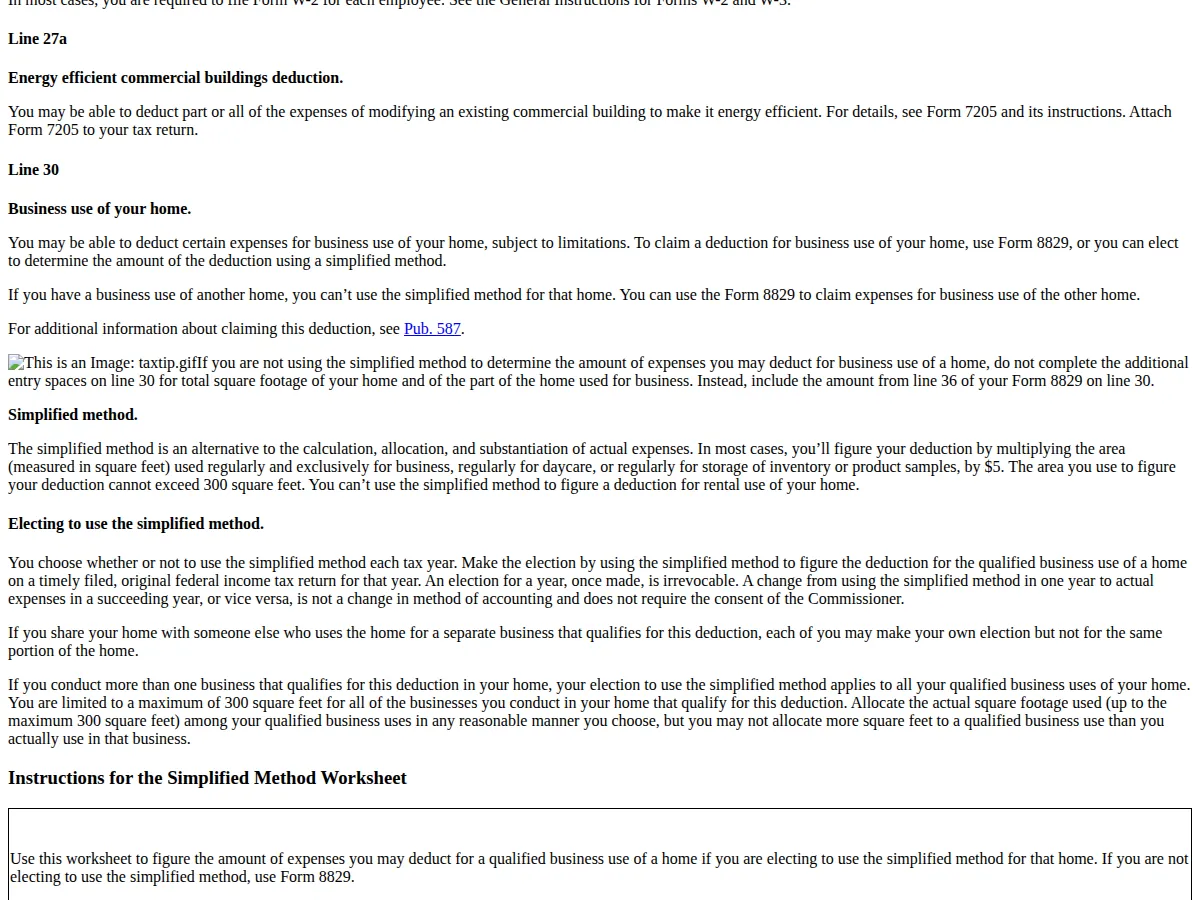
Line 30 holds the business use of the home, and the taxpayer chooses one of two methods each year. The simplified method multiplies the office area by $5 per square foot, up to 300 square feet — a maximum deduction of $1,500 — with no depreciation, no Form 8829, and no allocation of mortgage interest or utilities. The freelancer's office is 200 square feet, so the simplified deduction is $1,000. The regular method, computed on Form 8829, allocates actual expenses — mortgage interest, rent, utilities, insurance, repairs, depreciation — by the percentage of the home used exclusively and regularly for business, and it can exceed $1,500 for a large office with high housing costs. The trade is recordkeeping against dollars: the simplified method costs a one-line calculation, the regular method costs a depreciation schedule and a recapture calculation on sale.
The gate for either method is the same, and it is strict: the space must be used exclusively and regularly for business. A spare room that doubles as a guest room fails the exclusive-use test, and a kitchen table used for invoicing in the evenings fails it too. A taxpayer who claims the room and then uses it for anything else has claimed a deduction the statute does not allow.
From line 31 to self-employment tax
Net profit of $56,660 does not end on Schedule C. It flows to Schedule 1, line 3, and from there to Form 1040, where it is taxed as ordinary income. It also flows to Schedule SE, where the self-employment (SECA) tax is computed. Only $400 of net earnings triggers Schedule SE at all. The tax is 15.3 percent — 12.4 percent for Social Security on the first $184,500 of combined wages, tips, and net earnings for 2026, plus 2.9 percent for Medicare, with an additional 0.9 percent Medicare tax above $200,000 for a single filer — applied to 92.35 percent of net profit.
One half of the self-employment tax — $4,003 — is deductible as an adjustment to income on Schedule 1, line 15. The full picture is $56,660 of net profit, $8,006 of self-employment tax, and $4,003 of adjustment that lowers taxable income before the brackets apply. A sole proprietor who budgets only for income tax and forgets the 15.3 percent is under-reserved by more than eight thousand dollars on a $56,660 year.
The loss year, and when the IRS calls it a hobby
A Schedule C loss is deductible against other income, but only within limits. Line 32, the at-risk rules, caps the loss at the amount the taxpayer has at risk — cash invested plus debt the taxpayer is personally liable for. A larger loss is suspended and carried forward. Beyond that, section 183 treats an activity that loses money year after year as a hobby: the statute presumes a profit motive when the activity shows a profit in three of five consecutive tax years, and an activity that never shows a profit invites the IRS to disallow the losses entirely. The freelancer with a genuine first-year loss and a written business plan is in a different position from the operator with five straight losses and no plan, no separate account, and no records — and the records are what prove which one they are.
Operator boundaries
Do not deduct personal expenses through Schedule C. The commuter drive to a co-working space is not a business mile, the family phone plan is not a business expense except for the business share, and a meal is deductible only for business travel or a business meeting with a documented purpose. Do not claim the home office on a room that is not exclusively business. Do not round expenses: $12,000 of contract labor is a figure with invoices behind it, and $12,000 of "miscellaneous" with nothing behind it is an audit adjustment. Do not skip estimated taxes because the profit felt small — the safe harbor is 100 percent of the prior year's tax, or 110 percent above a $150,000 adjusted gross income, and the underpayment penalty runs from the quarter the payment was missed, not from April 15.
Founder & CEO Insight — Enow A. Jovial
Execution checklist
- [x] Step 1 — Reconcile line 1 first: Match every 1099-K and 1099-NEC against the books, back out fees, refunds, sales tax, and personal payments, and carry the reconciled gross to line 1.
- [x] Step 2 — Price the vehicle by date: Split business miles at June 30, 2026 — 72.5 cents before, 76 cents after — and keep the log with dates, destinations, and purpose for every trip.
- [x] Step 3 — Choose the home-office method: Take the simplified $5 per square foot up to 300 square feet, or run Form 8829 for the regular method, and confirm the space is used exclusively and regularly for business.
- [x] Step 4 — Run the SE tax before filing: Multiply line 31 by 92.35 percent and then by 15.3 percent, and confirm the $400 Schedule SE threshold is met — then deduct half of it on Schedule 1, line 15.
- [x] Step 5 — Check the loss limits: If line 31 is a loss, confirm the at-risk amount on line 32 and the three-of-five profit record under section 183 before deducting it.
- [x] Step 6 — Pay the estimates: Calendar the quarterly estimated payments — April 15, June 15, September 15, January 15 — and test the safe harbor on total tax, income tax plus self-employment tax.
- [x] Step 7 — Keep the workpapers: File the reconciliation, the mileage log, and the expense receipts with the return's workpapers for at least three years.
Run the finished line 31 through the tax estimator to see the combined income-tax and self-employment-tax cost, and read the Form 1099-K playbook for the reconciliation that produces line 1. The quarterly side is in the quarterly estimated tax payments guide, the payroll side is in the Form 941 quarterly filing playbook, and the retirement side is in the Solo 401(k) vs SEP IRA playbook.
Rental income lands on Schedule E, not Schedule C — the Schedule E playbook walks the form line by line.
Capital gains do not belong on Schedule C — the Schedule D playbook nets them and caps the loss at 3,000 dollars.
Farm income belongs on Schedule F — see the Schedule F farm income playbook.
Hiring help at home is Schedule H, not Schedule C — the Schedule H playbook covers the household lane.
Line 30 is the home-office deduction — see our Form 8829 playbook.
The expense lines on Schedule C are decided by section 162: see our Section 162 business expense deduction playbook.