Section 162 Business Expense Deduction: The Complete Playbook
Section 162 is the single sentence that decides whether a business cost comes off taxable income: it allows a deduction for all ordinary and necessary expenses paid or incurred in carrying on a trade or business. Everything else here — the 50 percent meal limit, the home office tests, the travel rules, the substantiation file — is a limit, an exception, or a proof requirement bolted onto that sentence.
1. What section 162(a) actually says
Section 162(a) provides: "There shall be allowed as a deduction all the ordinary and necessary expenses paid or incurred during the taxable year in carrying on any trade or business." The same sentence names three examples: reasonable salaries; travel, including meals and lodging that are not lavish or extravagant, while away from home; and business rentals.
"Paid or incurred" ties the expense to the taxable year under the taxpayer's accounting method. "Carrying on" means the business must be active; costs before it opens fall under section 195, which amortizes them. "Ordinary and necessary" is two gates, not one.

2. The ordinary-and-necessary test: two gates, both mandatory
Ordinary asks whether the expense is common and accepted in your line of work. A consultancy buying cloud hosting passes; the same consultancy buying a racehorse does not. Necessary asks whether the expense is helpful and appropriate, not indispensable. Each gate is independent.
The wall behind the test is section 262(a): except as otherwise expressly provided, no deduction shall be allowed for personal, living, or family expenses. The same dinner is deductible as a client meal and nondeductible as dinner with your family.
| Expense | Ordinary? | Necessary? | Verdict | Authority |
|---|---|---|---|---|
| Cloud hosting for a consultancy | Yes | Yes | Deductible in full | § 162(a) |
| Client dinner, taxpayer present | Yes | Yes | Deductible at 50% | § 162(a); § 274(n)(1) |
| Parking fine on a client visit | Yes | No | Zero — fines barred | § 162(f)(1) |
| Family dinner, no business contact | No | No | Zero — personal | § 262(a) |
3. The denial list inside section 162
Lobbying and politics. Section 162(e)(1) denies any deduction for influencing legislation, campaigning, or swaying the public on elections. Section 162(e)(2)(B) spares in-house lobbying up to 2,000 dollars a year, ignoring allocable overhead; spend 2,001 dollars and the whole amount is out.
Fines and penalties. Section 162(f)(1) denies any deduction otherwise allowable for an amount paid to a government in relation to the violation of any law or the investigation into a potential violation. Harassment settlements with secrecy. Section 162(q) denies any deduction for a settlement or payment related to sexual harassment or sexual abuse if it is subject to a nondisclosure agreement, and for attorney's fees related to such a settlement.
Executive pay. Section 162(m)(1) caps the deduction for employee remuneration at a publicly held corporation at 1,000,000 dollars per covered employee per year.
4. Meals: the 50 percent rule and the five conditions
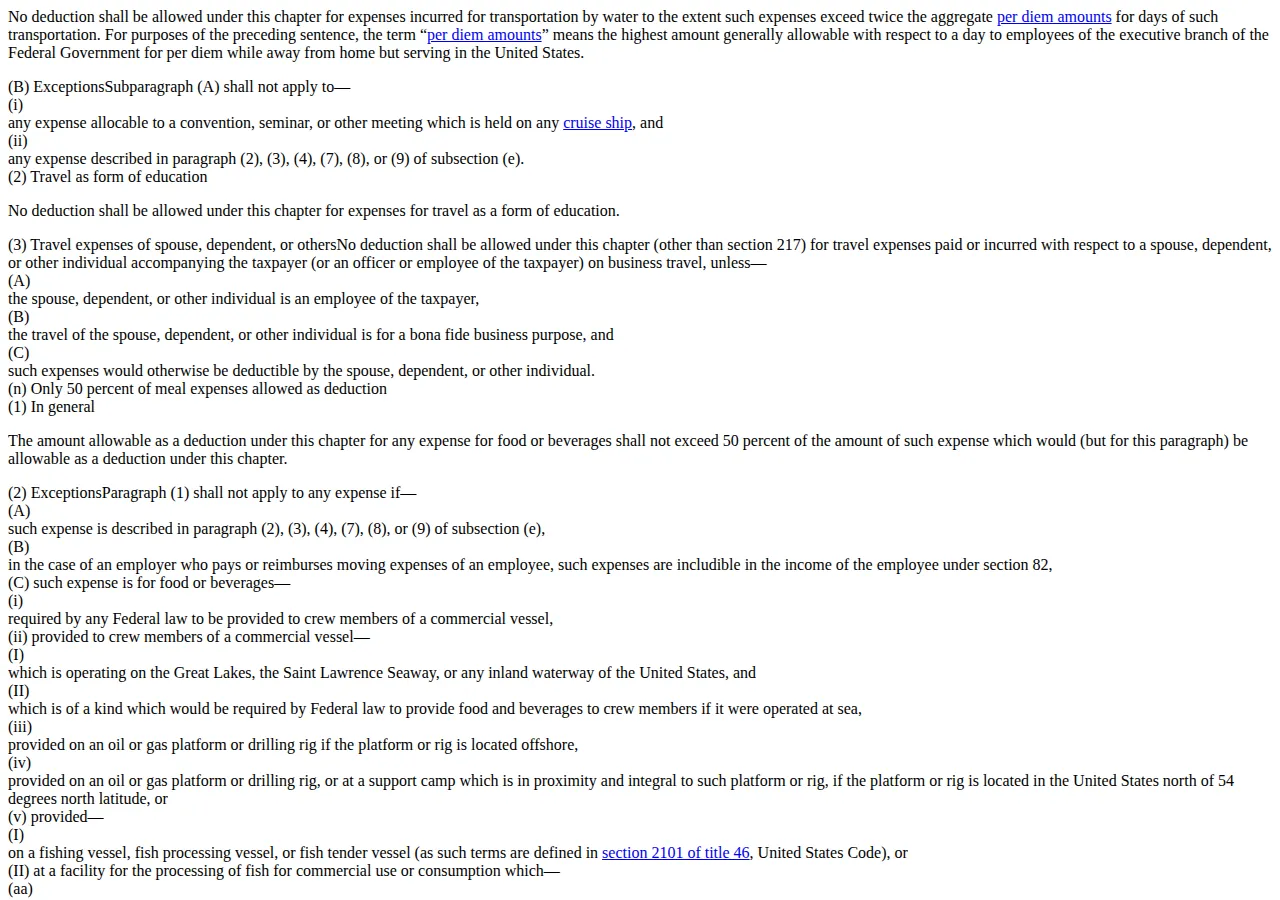
Section 274(n)(1) caps the deduction: the amount allowable for any expense for food or beverages shall not exceed 50 percent of the amount that would otherwise be allowable. A 200-dollar client dinner is a 100-dollar deduction.
Section 274(k) adds two conditions: the meal must not be lavish or extravagant, and the taxpayer or an employee must be present when the food is furnished.
Notice 2018-76 states five conditions for a 50 percent deductible business meal: the expense is ordinary and necessary under section 162(a); it is not lavish or extravagant; the taxpayer or an employee is present; the food and beverages are provided to a current or potential business customer, client, consultant, or similar business contact; and, where the food is provided at an entertainment activity, it is purchased separately from the entertainment, or its cost is stated separately on the bill.
In Example 1, a taxpayer invites a business contact to a baseball game and buys hot dogs and drinks there: the tickets are nondeductible entertainment, and the separately purchased food is 50 percent deductible. In Example 2, the same game in a suite where the invoice bundles food into the ticket price: nothing is deductible. In Example 3, the same suite, but the invoice separately states the food cost: the tickets stay nondeductible and the separately stated food is 50 percent deductible.
5. Entertainment: zero, with no exceptions left to argue
Section 274(a)(1) allows no deduction otherwise allowable for any item with respect to an activity generally considered to constitute entertainment, amusement, or recreation. Before 2018, a taxpayer could save an entertainment expense by showing it was directly related to the active conduct of the business or associated with a substantial business discussion. The Tax Cuts and Jobs Act repealed both exceptions, and Notice 2018-76 confirms the repeal in plain terms: entertainment expenses are no longer deductible.
A theater critic attending a play professionally is not entertained for tax purposes; an appliance distributor running a fashion show for retailers is. None of the nine exceptions in section 274(e) covers taking a client to a game.
6. Travel: away from home, and the four facts you must prove
Section 162(a)(2) deducts traveling expenses, including meals and lodging that are not lavish or extravagant, while away from home on business. Three elements must all hold: business purpose, away from home, and not lavish or extravagant. A day trip across town is not travel away from home, so its meals are client meals under the section 274 rules.
Section 274(m)(3) bars deductions for a spouse or dependent accompanying the taxpayer, unless that person is an employee traveling for a bona fide business purpose and the expenses would otherwise be deductible by that person.
Substantiation is where travel deductions are won or lost. Section 274(d) allows no deduction under section 162 for any traveling expense, including meals and lodging while away from home, unless the taxpayer substantiates by adequate records or by sufficient evidence corroborating the taxpayer's own statement: the amount of the expense, the time and place of the travel, the business purpose of the expense, and the business relationship to the taxpayer of the person receiving the benefit. > [!TIP]
7. Home office: exclusive, regular, and capped by income
Section 280A(c)(1) allows deductions for a portion of the home only if it is exclusively used on a regular basis as the principal place of business, or as a place for meeting patients, clients, or customers. An employee qualifies only if the exclusive use is for the convenience of the employer.
Administrative and management activity also counts as a principal place of business if there is no other fixed location for substantial administrative or management activities.
Revenue Procedure 2013-13 sets a simplified option: 5 dollars per square foot, up to 300 square feet, for a maximum of 1,500 dollars.
The regular method allocates actual home expenses by the business share, and it often beats the simplified figure. Take a 2,000-square-foot home with a 240-square-foot office, a 12 percent share: annual home costs of 27,000 dollars allocate 3,240 dollars to the office, against 1,200 dollars simplified. The regular method wins by 2,040 dollars here, but it demands records for every allocated cost.
Section 280A(c)(5) caps the deduction at the gross income from that business use, minus other allowable deductions; any excess carries to the succeeding taxable year, subject to the same limitation.
8. Education and health insurance
Under Treasury Regulation section 1.162-5, education expenses are ordinary and necessary business expenses when the education maintains or improves skills required in the present trade or business, or meets a requirement of the employer or of applicable law. A tax preparer taking the annual update course or a contractor renewing a required license is deductible on that ground.
Two hard lines: education is not deductible if it meets the minimum educational requirements for qualification in the trade or business, or if it qualifies the taxpayer for a new trade or business. A paralegal paying for law school to become a lawyer is buying a new trade, and the tuition is nondeductible.
Section 162(l)(1) gives the self-employed a deduction equal to the amount paid during the taxable year for medical care insurance for the taxpayer, spouse, dependents, and children under 27. For a sole proprietor this is an adjustment to income, not a Schedule C expense, and it is the full amount paid. For the retirement plan that sits on top of this income, see our Solo 401(k) vs SEP IRA self-employed retirement playbook.
Regulation section 1.162-17 limits an employee's expenses to those directly attributable to the business: an employee who accounts to the employer and is reimbursed exactly need not report the expenses; reimbursement in excess of expenses is income; and an employee claiming a deduction for the excess must submit a statement of amounts received and expenses by category — transportation, meals and lodging away from home overnight, entertainment, and other business expenses. The contractor side of the same workforce is covered in our IRS Form 1099-NEC contractor reporting playbook.
9. Worked example: Maya, sole proprietor, full year
Maya runs a sole proprietorship consultancy from a home office, with gross receipts of 180,000 dollars. Every figure is a stated assumption; every computation is shown.
| Cost | Spent | Deductible | Authority |
|---|---|---|---|
| Software and subscriptions | 4,800 | 4,800 | § 162(a) |
| Office rent | 12,000 | 12,000 | § 162(a)(3) |
| Contract labor | 18,000 | 18,000 | § 162(a)(1) |
| Travel, airfare and lodging | 6,400 | 6,400 | § 162(a)(2) |
| Business meals (50 percent limit) | 3,600 | 1,800 | § 274(n)(1) |
| Client baseball tickets (entertainment) | 1,200 | 0 | § 274(a)(1) |
| Home office, simplified, 240 sq ft | — | 1,200 | Rev. Proc. 2013-13 |
| Education, skills course | 2,400 | 2,400 | Reg. § 1.162-5(a) |
| Supplies | 3,000 | 3,000 | § 162(a) |
| Parking fine on a client visit | 450 | 0 | § 162(f)(1) |
| Total | 51,850 | 49,600 |
The 1,200-dollar home office deduction is not a cash cost.
Maya also pays 7,200 dollars for health insurance, deductible in full under section 162(l) as an adjustment to income. Her taxable income therefore falls by 49,600 dollars plus 7,200 dollars, or 56,800 dollars in total. The Schedule C profit of 130,400 dollars flows to the Schedule C self-employed profit and loss playbook. To price the result on your own figures, run them through our tax estimator.
10. Section 162 versus section 199A: the boundary
Both reduce the tax on business income. Section 162 deducts the cost of running the business: salaries, rent, travel, meals at 50 percent, the home office. Section 199A deducts up to 20 percent of qualified business income for pass-through owners. Section 162 is claimed as the expenses are incurred; section 199A is computed after net business income is fixed. A sole proprietor claims both: section 162 first, then section 199A on the net profit. For the pass-through side, see our Section 199A QBI deduction SSTB phaseout playbook.
Founder & CEO Insight — Enow A. Jovial
>
11. Who this playbook is for, and the execution checklist
This playbook is for sole proprietors, single-member LLC owners, partners, and S corporation owners reporting business costs on Schedule C or the business return — not for employees, not for a business that has not yet opened, and not for personal costs with a business label.
The filer behind the deduction: a sole proprietor files under an SSN, a single-member LLC under its EIN, and a nonresident alien sole proprietor under an ITIN. An S-Corp owner takes salary subject to FICA while pass-through profit escapes SECA; a C-Corp deducts salaries under section 162(a)(1) subject to the section 162(m) cap. Have a CPA tie the Schedule C lines to the COGS schedule before filing.
- Separate the accounts first: pay every business cost from the business account.
- Run the two-gate test on each cost: ordinary in your trade, and necessary for your business.
- Split meals from entertainment at the point of sale: ask for the itemized receipt.
- Apply the 50 percent rule to every meal: record the gross amount and the deductible half.
- Prove travel with four facts: amount, time and place, business purpose, and business relationship, recorded the same day.
- Price the home office both ways: the simplified 5-dollar method and the regular allocation method, and claim the larger.
- Check the denial list before filing: lobbying over 2,000 dollars, fines, NDA settlements, entertainment, and personal costs all come out.
- File the accountable-plan statement if you are an employee: account in writing, by category, and claim only the excess over reimbursement.