Robinhood vs Fidelity vs Schwab: The Brokerage Pricing Playbook
All three of the largest retail brokers charge $0 commission on online stock and ETF trades — a headline that tells you almost nothing about what your account will cost. The real price sits in four places the headline never mentions: margin interest, options contract fees, the yield on idle cash, and the fee charged when you leave. On those four lines, the three are different pricing machines, and the cheapest depends on how you use the account.
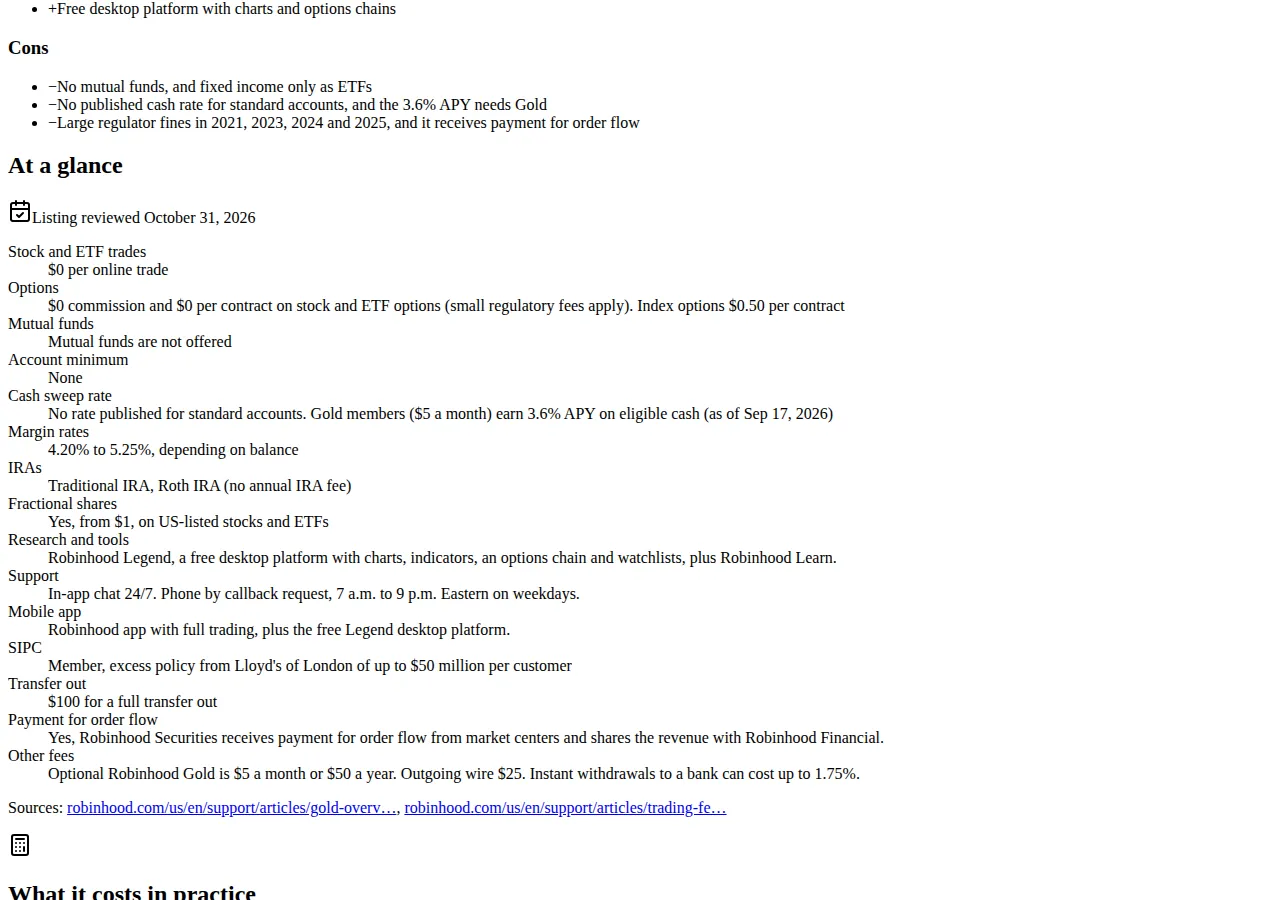
One disclosure first. Robinhood's own pricing and support pages returned errors to every direct read attempted on 9 November 2026, so every Robinhood figure below is corroborated-secondary — confirmed across at least two independent 2026 reads. Fidelity and Schwab figures come from their own pages, read the same day.
Founder & CEO Insight — Enow A. Jovial
The headline price: identical, and nearly free
Online trades in US-listed stocks and ETFs cost $0 at all three brokers, with no account minimum and no annual fee — the whole story for a buy-and-hold investor who never borrows or trades options and keeps cash fully invested.
| Price line | Robinhood | Fidelity | Schwab | Authority |
|---|---|---|---|---|
| Online US stock and ETF trades | $0 | $0 | $0 | Each broker's pricing page |
| Options, per contract (stock and ETF) | $0 | $0.65 | $0.65 | Fidelity; Schwab; RH corroborated |
| Index options, per contract | $0.50 ($0.35 with Gold) | $0.65 | $0.65 | RH corroborated; Fidelity; Schwab |
| Transfer of assets out (ACATS) | $100, full or partial | $0 per transfer | $50 full, $0 partial | Fidelity; Schwab Pricing Guide; RH corroborated |
| Fractional shares, minimum | $1 | $1 | $1 | MoneyVerge, October 2026 |
Two rows matter most. Options: Robinhood charges no per-contract fee on stock and ETF options, while Fidelity and Schwab charge $0.65 — $65 against $0 at 100 contracts a year.
Margin rates: Robinhood charges about half, Fidelity and Schwab charge the same
Margin is where the three brokers split hardest. Fidelity's base margin rate is 10.825%, effective since 18 September 2026; Schwab's base rate is 10.25%, last changed the same day. The base rates differ, but the spreads each adds produce the same effective rate at every tier — 12.075% on the smallest balances, falling to 10.325% at $250,000 to $499,999.
| Debit balance | Robinhood | Fidelity | Schwab |
|---|---|---|---|
| Up to $24,999 | 5.25% | 12.075% | 12.075% |
| $25,000–$49,999 | 5.25% | 11.575% | 11.575% |
| $50,000–$99,999 | 5.05% | 10.625% | 10.625% |
| $100,000–$249,999 | 4.75% | 10.575% | 10.575% |
| $250,000–$499,999 | 4.75% | 10.325% | 10.325% |
| $500,000 and above | 4.75% to 4.20% | Call for rate | Call for rate |
Sources: Fidelity; Schwab; RH corroborated. Gold members borrow the first $1,000 interest-free. Schwab charges no interest below a $100 debit balance, and for balances of $500,000 and above both legacy brokers ask you to call for a rate.
The math below prices a $10,000 average debit balance held for six months — the smallest tier at all three brokers.
Six months of a $10,000 margin balance costs $262.50 at Robinhood and $603.75 at Fidelity or Schwab. Held for a full year, the same $10,000 costs $525.00 against $1,207.50 — a $682.50 annual difference.
Cash sweep: the quiet line that costs Schwab holders $890 a year
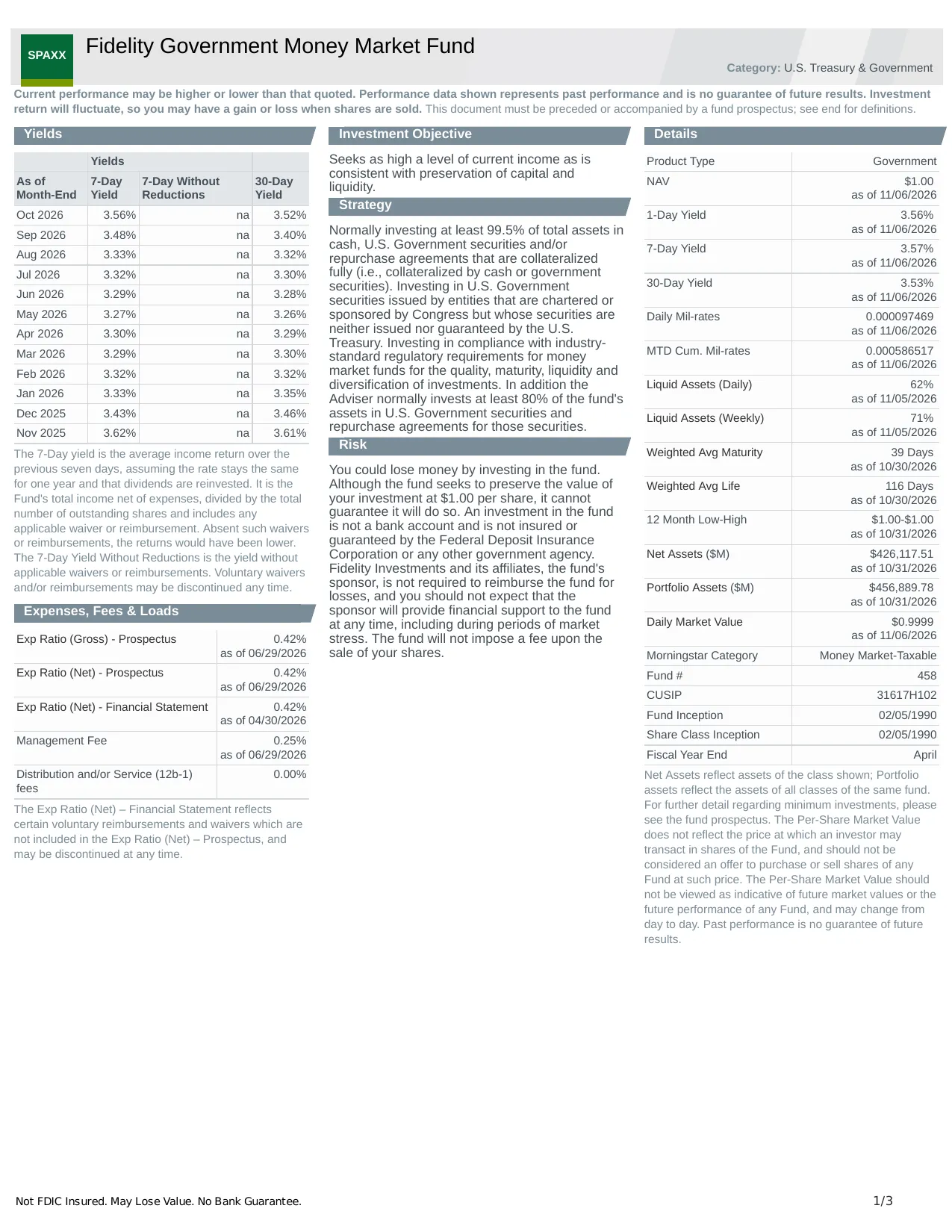
Uninvested cash does not sit still. At Fidelity it lands by default in the Fidelity Government Money Market Fund (SPAXX), whose 7-day yield is 3.57% as of 6 November 2026 per Fidelity's own fact sheet. At Robinhood, swept cash earns 3.6% APY for Gold members and 0% for standard accounts — no published cash rate without the $5 subscription. At Schwab it lands by default in the Bank Sweep program at Schwab Bank, which pays 0.01% a year; Schwab's own money-market page states it has eliminated sweep money market funds as a cash feature for most accounts. The fund that used to do the job, the Schwab Government Money Fund — Sweep Shares (SWGXX), yields 3.36% as of 6 November 2026, but you have to buy it yourself.
The gap below prices $25,000 of average idle cash for one year at each broker's default.
On $25,000 of idle cash, Fidelity pays $892.50 a year and Schwab pays $2.50 — an $890 annual gap that never appears on a statement as a charge. A Schwab holder who buys SWVXX or SNVXX by hand (3.77% and 3.63% as of 6 November 2026) closes most of the gap — by doing after every deposit what Fidelity does automatically.
Robinhood Gold: $5 a month, and a break-even you can compute
Gold costs $5 a month, or $50 a year. For that it buys three pricing benefits: 3.6% APY on eligible swept cash, the first $1,000 of margin borrowing interest-free, and index options at $0.35 per contract instead of $0.50. The subscription pays for itself on cash alone at a precise balance:
Hold more than $1,666.67 in average swept cash and Gold pays for itself on yield alone. Below that it needs margin or options savings: borrowing $10,000 saves $52.50 a year on the free first $1,000 at 5.25%, and 100 index-option contracts a year saves $15.00 on the $0.15 discount. Add your own three numbers — cash yield, margin saving, options discount — and compare the total with $60.
Options: $0.65 a contract is small until you count contracts
Fidelity and Schwab charge $0.65 per contract on stock and ETF options, with a $0 base commission online. Robinhood charges $0 on stock and ETF options, and $0.50 per contract on index options — $0.35 with Gold — plus a $0.04 regulatory pass-through. Fidelity's page also notes an Options Regulatory Fee on both buy and sell transactions. One hundred contracts a year costs $65.00 at Fidelity or Schwab and $0 at Robinhood; 500 contracts costs $325.00 against $0. An index-options trader at Robinhood pays $50.00 per 100 contracts without Gold and $35.00 with Gold, before the pass-through.
The worked example: one investor, priced at all three brokers
One profile, priced everywhere: a $50,000 account, $25,000 average idle cash, a $10,000 margin debit held six months, and 100 stock-option contracts in the year. Net annual cost equals margin interest plus options fees plus subscription, minus sweep interest earned.
| Annual line | Robinhood | Robinhood Gold | Fidelity | Schwab |
|---|---|---|---|---|
| Margin interest, $10,000 for 6 months | $262.50 | $236.25 | $603.75 | $603.75 |
| Options, 100 contracts | $0.00 | $0.00 | $65.00 | $65.00 |
| Subscription | $0.00 | $60.00 | $0.00 | $0.00 |
| Sweep interest earned, $25,000 cash | −$0.00 | −$900.00 | −$892.50 | −$2.50 |
| Net annual cost | $262.50 | −$603.75 | −$223.75 | $666.25 |
A negative net cost means the account pays you. Robinhood Gold comes out $603.75 ahead, Fidelity $223.75 ahead, plain Robinhood costs $262.50, and Schwab costs $666.25. The ranking turns on two facts — Robinhood's cheaper margin and Fidelity's automatic sweep — and it reverses fast if the profile changes. Remove the borrowing and the options, and Schwab's cost falls to a $2.50 sweep against Fidelity's $892.50 earned. For idle cash outside a brokerage account, see the cash parking playbook. For retirement accounts, the solo 401(k) versus SEP IRA playbook. For the tax on this profile, use the estimator.
Leaving costs and the fractional-share trap
The cheapest broker to join is not always the cheapest to leave. Fidelity lists transfer of assets at $0 per transfer. Schwab's April 2026 Pricing Guide lists $50 per account for a full transfer out and $0 for a partial one. Robinhood charges $100 for partial and full ACATS transfers out — 0.20% of a $50,000 account, 2.00% of a $5,000 one. The fee is charged by the firm you leave, not the one you join. Fractional shares add a second exit cost: they cannot transfer through ACATS, so a full transfer sells every fractional position and sends the cash. In a taxable account, that sale can realise a gain in the transfer year. Under FINRA Rule 11870, the old firm has one business day to validate an ACATS request and three more to complete it. Check the tax on any fractional-share sale with the tax-loss harvesting playbook first.
Risk layer: margin calls, order flow, sweep drag, exit fees
Four risks sit underneath the pricing here. Margin calls: the loan is callable — if holdings fall, the broker can demand cash or sell positions without asking, and Fidelity charges $32.95 per margin liquidation. Borrow only against money you can repay from outside the account. Payment for order flow: Robinhood charges $0 on options and earns revenue through payment for order flow, priced into execution rather than charged as a fee. Sweep drag: a 0.01% default sweep is a 3.56-point annual drag against a money-market yield on every idle dollar. Exit fees: a $100 ACATS fee is a rounding error on $500,000 and a 2% haircut on $5,000.
Who each broker fits — and who should avoid it
Robinhood fits the active trader who borrows modestly, trades options often, and keeps cash swept under Gold: its margin rate is about half the legacy rate, its options are free, and Gold pays 3.6% APY. It fits poorly the investor who plans to leave — the $100 exit fee and the forced sale of fractional shares make switching expensive, and the standard account pays 0% on cash. Fidelity fits the investor who wants the account to manage itself: the SPAXX default pays a money-market yield with no action, the exit fee is $0, and fractional trading starts at $1. It fits poorly the heavy margin borrower and the frequent options trader, for whom 12.075% and $0.65 a contract are the highest rates here. Schwab fits the investor who values the branch network and banking integration and will buy a money-market fund by hand after every deposit. It fits poorly the cash-heavy investor who will not do that chore: the 0.01% default sweep is the worst of the three.
Execution checklist
- List your own numbers first: average idle cash, average margin debit and months carried, options contracts per year, and your odds of transferring out within two years.
- Price the sweep before anything else if your cash balance is above $10,000 — the sweep gap is usually larger than every fee combined.
- If you choose Schwab, buy SWVXX or SNVXX after every deposit.
- If you choose Robinhood, decide on Gold with the break-even: $1,666.67 in average swept cash, or margin and index-options savings adding to $60 a year.
- If you trade options, count your contracts for the year and multiply by $0.65 before choosing Fidelity or Schwab.
- If you borrow, write down the rate, the monthly interest in dollars, and the price at which a margin call would hit — before the first trade.
- Before opening the account, read the exit fee and the fractional-share rule, so the cost of leaving is a decision, not a surprise.
The brokerages compared here all offer Roth and traditional IRAs: the Roth IRA vs Traditional IRA 2026 limits playbook runs the contribution limits, phase-outs, and backdoor math.