Treasury Bills vs Money Market Funds: The Cash-Parking Playbook
Cash between decisions still has a job: earn a short-term return without market risk or a lock-up. Two vehicles do it — Treasury bills bought at auction, and money market funds holding short-term government and bank paper. The bill pays a fixed auction rate, and its interest escapes state and local tax by statute. The fund pays a floating 7-day yield and charges an expense ratio.
1. What cash parking is
Cash parking means holding money you will need in weeks or months — a tax reserve, a payroll buffer, sale proceeds waiting to be deployed — where it pays interest and returns on demand or on a known date. It is not investing or a retirement account; money earmarked for retirement belongs in a retirement vehicle, such as the accounts in our Solo 401(k) vs SEP IRA self-employed retirement playbook.
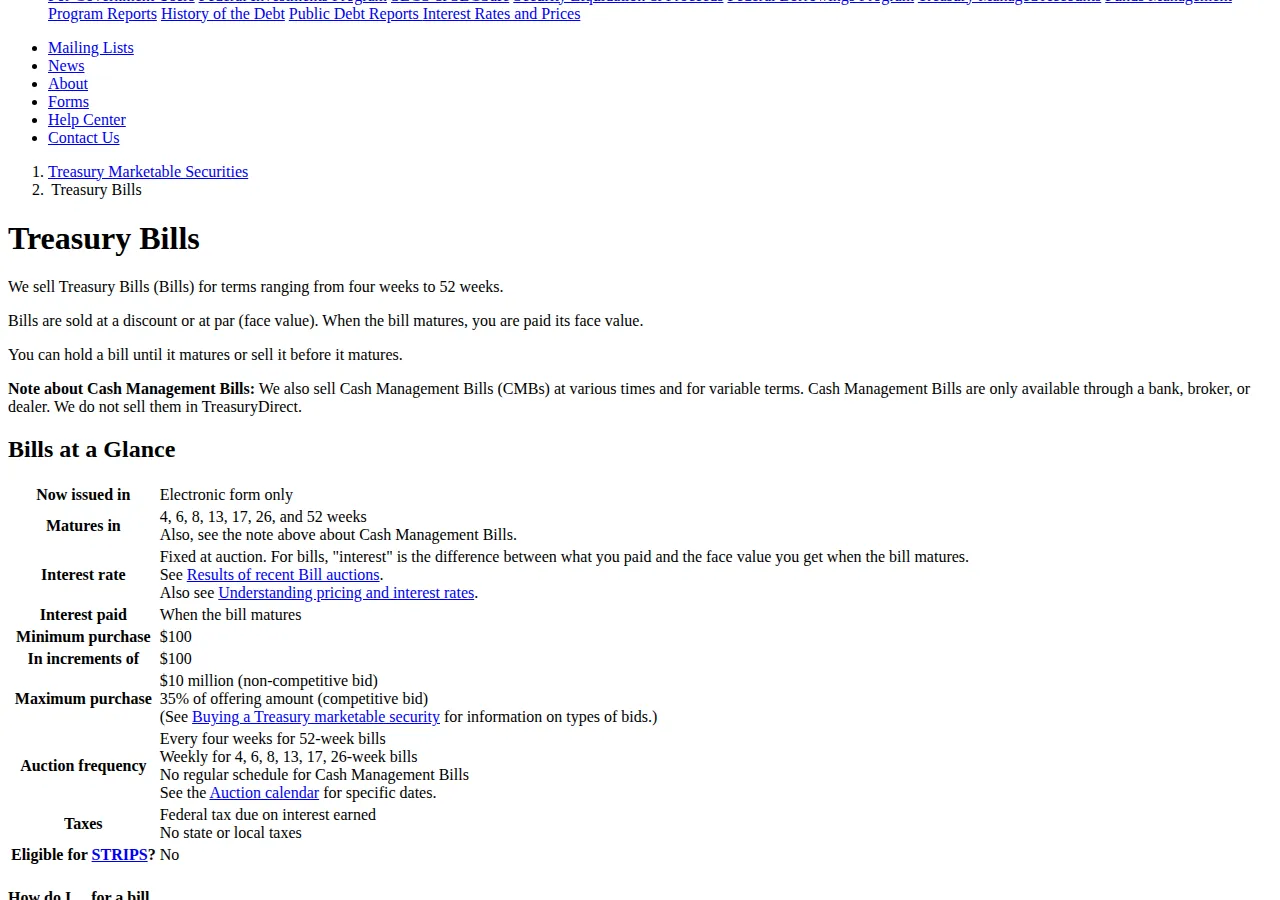
A bill is a direct obligation of the United States: you lend to the Treasury for 4 to 52 weeks and get the face value back at maturity. A fund is a mutual fund owning short-term debt and selling shares at $1.00; you own fund shares, not the underlying paper. The bill's rate is fixed at auction for its term; the fund's 7-day yield floats daily. The bill's interest is exempt from state and local tax under 31 U.S.C. § 3124; the fund's distributions are state-taxable except for the share of its income from United States government obligations.
2. How a Treasury bill works
A bill is sold at a discount: you pay less than face value today and receive the full face value at maturity; the difference is the interest. TreasuryDirect sells bills in terms of 4, 6, 8, 13, 17, 26, and 52 weeks, electronic form only, with a $100 minimum in $100 increments and a $10 million maximum for a non-competitive bid. Auctions for 4- through 26-week bills run weekly; 52-week bills auction every four weeks. Non-competitive bids close at 11:00 AM Eastern; competitive bids close at 11:30 AM Eastern. Interest is paid at maturity.
Two rates describe every bill: the high rate is the discount rate on a 360-day basis; the investment rate is the bond-equivalent yield on a 365-day basis, the number that compares directly with a fund's 7-day yield.
Auction record for the week of November 2, 2026, from TreasuryDirect's own securities search.
| Term | High discount rate | Investment rate | Price per $100 | Issue date | Maturity | CUSIP |
|---|---|---|---|---|---|---|
| 4-week | 3.910% | 3.976% | 99.695889 | Nov 3, 2026 | Dec 1, 2026 | 912797VZ7 |
| 8-week | 4.020% | 4.101% | 99.374667 | Nov 3, 2026 | Dec 29, 2026 | 912797WH6 |
| 13-week | 4.040% | 4.138% | 98.978778 | Nov 5, 2026 | Feb 4, 2027 | 912797VV6 |
| 26-week | 4.150% | 4.298% | 97.901944 | Nov 5, 2026 | May 6, 2027 | 912797WX1 |
| 52-week | 4.290% | 4.496% | 95.662333 | Oct 29, 2026 | Oct 28, 2027 | 912797WT0 |
Check the 13-week row by hand: 0.04040 × 91 / 360 = 0.0102122, so the price is 100 × (1 − 0.0102122) = 98.97878, matching the auction price of 98.978778; the investment rate is (100 − 98.978778) / 98.978778 × 365 / 91 = 0.0103176 × 4.010989 = 0.041384, or 4.138%. A $100,000 face 13-week bill costs $98,978.78 and pays $1,021.22 at maturity on February 4, 2027.
3. How a money market fund works
A money market fund pools cash and buys short-term debt — Treasury bills, agency paper, repurchase agreements, and, in prime funds, bank certificates of deposit and commercial paper. The fund holds its share price at $1.00 using amortized-cost and penny-rounding methods under 17 CFR 270.2a-7, and quotes a 7-day SEC yield: the last seven days' income, annualized and net of fees. The expense ratio is already subtracted before the yield is quoted — but the ratio still matters, because it explains why two funds holding similar paper pay different yields.
| Fund | Type | 7-day yield | Expense ratio | Minimum | State-tax character |
|---|---|---|---|---|---|
| Vanguard Federal Money Market (VMFXX) | Government | 3.89% (Nov 6, 2026) | 0.11% | $3,000 | Mostly Treasury-derived |
| Fidelity Government Money Market (SPAXX) | Government | 3.57% (Nov 6–8, 2026) | 0.42% (secondary) | $0 (core) | Mostly Treasury-derived |
| Schwab Prime Advantage (SWVXX) | Retail prime | 3.77% (Nov 6, 2026) | 0.34% net (secondary) | $0 | Mostly bank/corporate |
The expense ratios for SPAXX and SWVXX are marked secondary: Fidelity's and Schwab's own fund pages would not render figures from this network on November 9, 2026, so those ratios come from independent fund-data listings. The yields are primary reads — SPAXX's 3.57% from Fidelity's own daily-pricing document, SWVXX's 3.77% from Schwab's own money-market-funds page. SWVXX was renamed from the Schwab Value Advantage Money Fund to the Schwab Prime Advantage Money Fund.
VMFXX held $375.3 billion in net assets as of October 31, 2026, its portfolio 36.65% Treasury bills, 38.81% United States government obligations, and 24.54% repurchase agreements as of September 30, 2026 — which is why its income is mostly Treasury-derived.
4. The state-tax exemption: 31 U.S.C. § 3124
Section 3124(a) of Title 31 provides:
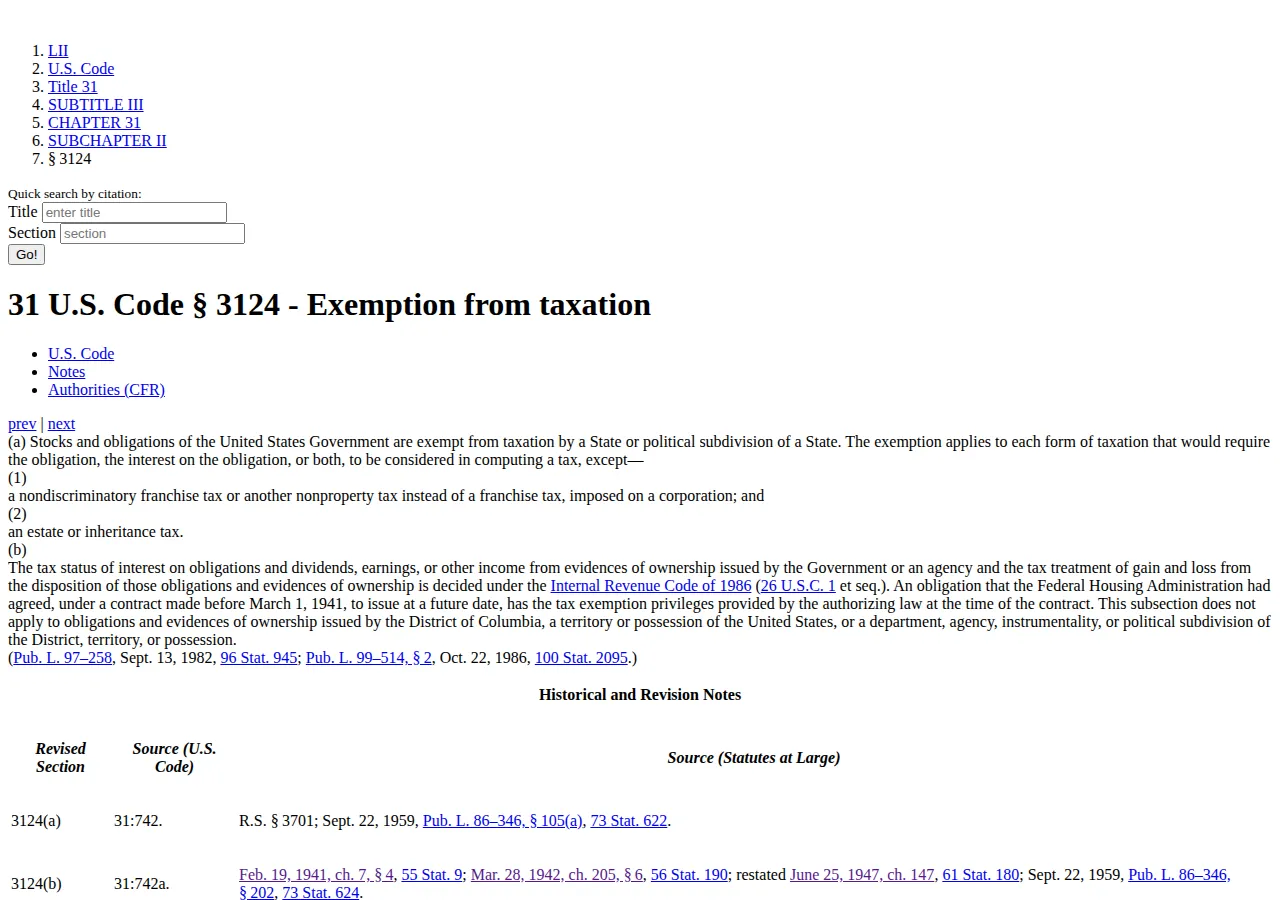
The fund side works differently. A fund's distributions are taxable by your state except for the share of its income from United States government obligations — not the holdings percentage, but the income share, published yearly in each fund's tax supplement. A government fund such as VMFXX has a large Treasury-derived share; a prime fund such as SWVXX has only a small one. The worked example below assumes 50% for the two government funds and 0% for the prime fund.
5. The after-tax math
Assumptions: a 24% federal marginal rate, a 9% state rate, a 50% Treasury-derived income share for VMFXX and SPAXX, and 0% for SWVXX. Rates are the November 6, 2026 readings, held constant for one year for illustration only — real yields move daily.
For the 13-week bill:
For VMFXX:
For SPAXX:
For SWVXX:
| Vehicle | Pre-tax yield | After-tax yield | Per $100,000/year |
|---|---|---|---|
| 13-week T-bill | 4.138% | 3.14% | $3,145 |
| VMFXX | 3.89% | 2.78% | $2,781 |
| SPAXX | 3.57% | 2.55% | $2,553 |
| SWVXX | 3.77% | 2.53% | $2,526 |
The bill leads VMFXX by $364 a year per $100,000. The exemption alone is worth 4.138% × 9% = 0.372 percentage points, or $372 a year per $100,000. The bill would still win with no state tax at all: at a 0% state rate VMFXX keeps 3.89% × 0.76 = 2.956%, below the bill's 3.145%. The exemption widens a lead the bill already holds; it does not create it. If fund yields rise above bill investment rates, rerun this table before you move money.
6. Liquidity and backing
A money market fund redeems at $1.00 per share, normally the next business day. At Fidelity the fund is the core position; at Schwab you must buy SWVXX yourself, since the default sweep pays a fraction of a percent; at Vanguard the fund is the settlement fund. A bill returns money on its maturity date, or earlier only by selling through a broker — TreasuryDirect offers no sell button for bills held there.
Backing is the second divide. A bill is a direct obligation of the United States. A money market fund is not FDIC-insured — the FDIC insures deposits to at least $250,000 at each FDIC-insured bank, and a fund share is not a deposit. Fund shares at a brokerage are protected as securities by SIPC. Under Rule 2a-7, fund boards may charge a discretionary liquidity fee of up to 2% on redemptions, and funds that are neither government nor retail must charge one when a day's net redemptions exceed 5% of net assets.
| Attribute | Treasury bill | Government money fund | Prime money fund |
|---|---|---|---|
| Backing | Full faith and credit | Government paper (≥99.5%); not FDIC-insured | Bank/corporate paper; not FDIC-insured |
| Access | At maturity; early sale via broker | Next business day | Next business day |
| Rate | Fixed at auction for the term | Floats daily | Floats daily |
| State tax | Exempt under § 3124 | Partially exempt | Mostly taxable |
| Liquidity fee | None | Board discretionary up to 2% | Board discretionary up to 2% |
| Authority | 31 U.S.C. § 3124; TreasuryDirect | 17 CFR 270.2a-7 | 17 CFR 270.2a-7 |
7. Build the 13-week ladder
The ladder removes the bill's one weakness — the fixed calendar — by staggering maturities so money frees up every few weeks. Split $100,000 into four rungs of $25,000 face value: buy the first now, the second in three weeks, the third in six, and the fourth in nine, reinvesting each rung as it matures. After thirteen weeks the ladder is fully built, one rung maturing every three weeks.
The rung arithmetic, from the November 5, 2026 auction: one $25,000 face 13-week bill costs 25,000 × 98.978778 / 100 = $24,744.69 and pays $255.31 in 91 days. Four rungs cost $98,978.78. Each rung rolls four times a year, so the ladder pays $4,084.88 a year on $98,978.78 invested, about 4.13% on cost. After tax, the ladder keeps about $3,104 a year: 4,084.88 × 0.76 = $3,104.51.
- Open TreasuryDirect and link the bank account: the link takes days to verify, so do this before the money is needed.
- Place the first non-competitive bid: $25,000 face of the 13-week bill, before 11:00 AM Eastern on auction day.
- Calendar the next three rungs: three, six, and nine weeks out.
- Turn on reinvestment: schedule each maturing rung to buy the same term again.
- Hold one rung in the fund instead: keep the first $25,000 in VMFXX or SPAXX until the ladder is built, so an unexpected bill in week two does not force a sale.
For operating cash, the same logic applies to the float: our cash conversion cycle DSO reduction playbook shows how to shorten the cycle so the float grows. For a software business sitting on collected cash it has not yet earned, see our deferred revenue SaaS balance sheet recognition playbook.
8. The decision table
| Situation | Choose | Authority |
|---|---|---|
| Money needed on a known date | T-bill matched to the date | TreasuryDirect auction schedule |
| Unknown date, state rate above 5% | T-bill ladder | 31 U.S.C. § 3124 |
| Unknown date, state rate 0% | Whichever pre-tax yield is higher | Auction rate vs 7-day yield |
| Operating float that moves weekly | Money market fund | 17 CFR 270.2a-7 |
| Money needed in under a week | Fund, not a bill | Fund next-day redemption |
Founder & CEO Insight — Enow A. Jovial
>
9. Who this playbook is not for
This playbook is for United States taxpayers holding dollars they will need within a year — founders, operators, and households with a tax reserve or a deployment fund. It is not for money needed this week, which belongs in a checking account or a money fund. It is not for anyone chasing yield above the risk-free rate: the bill's 4.138% is the ceiling for zero-credit-risk cash.
10. Execution checklists
Buy the bill:
- Open a TreasuryDirect account and link the bank account; allow days for verification.
- Check the auction schedule for the next 13-week auction.
- Submit a non-competitive bid before 11:00 AM Eastern on auction day.
- Confirm the issue and record the CUSIP, price, and investment rate.
- Turn on reinvestment, or calendar the maturity.
- At tax time, report the interest as federal income only.
Buy the fund:
- Confirm which fund is the settlement or core position.
- Read the 7-day yield and expense ratio on the fund's own page, and date both.
- Buy the fund; for Schwab, buy SWVXX explicitly, not the default sweep.
- Download the fund's annual tax supplement and record the Treasury-income percentage.
- At tax time, apply that percentage to the year's distributions.
Compare the brokers before parking cash: see our Robinhood vs Fidelity vs Schwab brokerage pricing playbook.