A married couple in New Jersey pays $18,000 in property tax and $34,000 in New Jersey income tax in 2025 — $52,000 of state and local tax in a single year. For eight years, the federal return let them deduct only $10,000 of it. For 2025, the same couple deducts $40,000. That is the whole story of the SALT cap change in one household: a $30,000 larger deduction, worth $7,200 a year at a 24 percent marginal rate, delivered by a single section of the One Big Beautiful Bill Act. But the cap is not flat: it phases down above $500,000 of modified adjusted gross income, reverts to $10,000 in 2030, and is worth nothing to a taxpayer who takes the standard deduction or pays the alternative minimum tax. This guide runs the statute, the phase-down math, the itemized-versus-standard decision, and the pass-through-entity workaround.
What the SALT cap is, in one paragraph
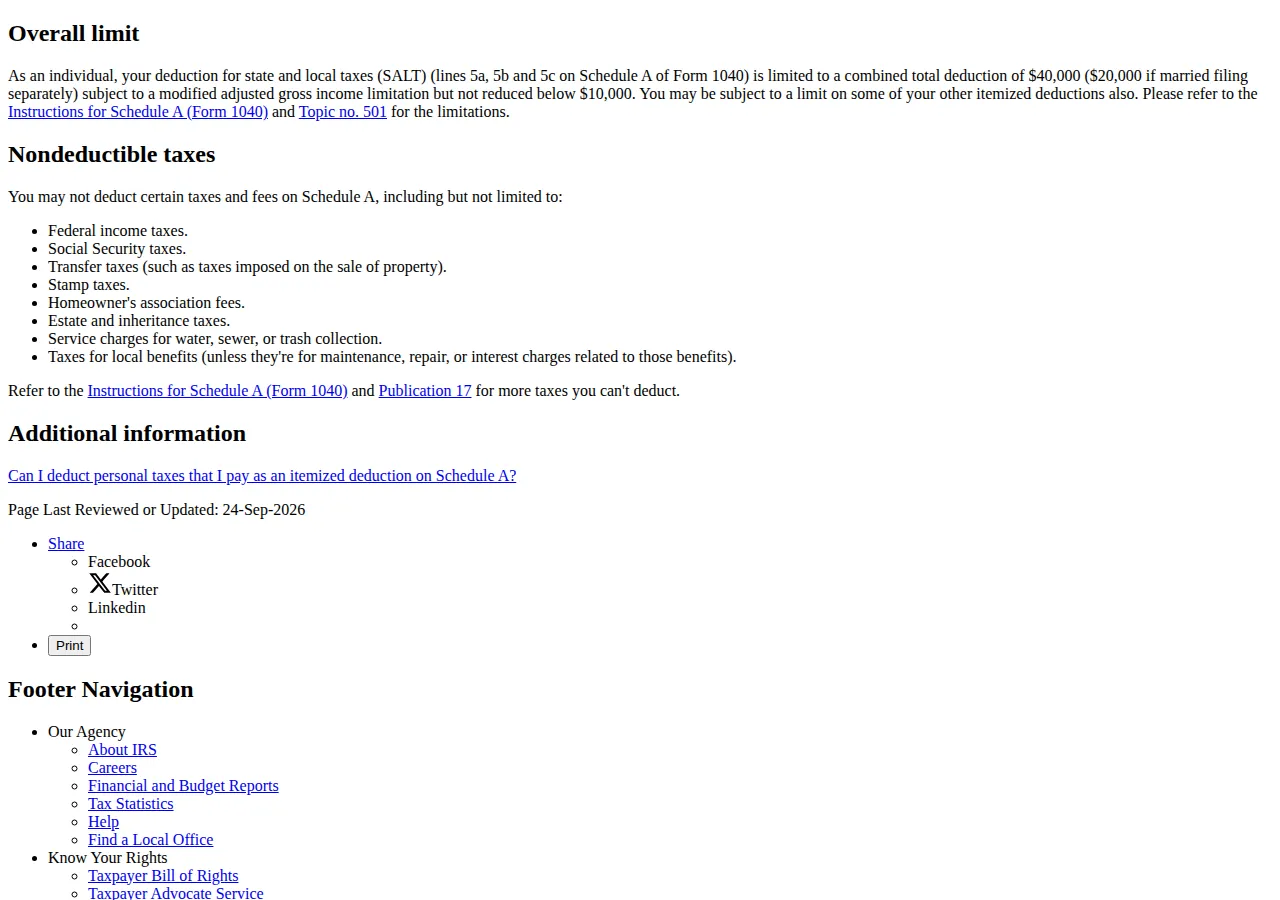
The state and local tax deduction lives on Schedule A of Form 1040, lines 5a through 5c: state and local income taxes (or general sales taxes, if you elect them instead), real property taxes, and personal property taxes. Section 164(b)(6) of the Internal Revenue Code caps the combined total an individual may deduct. The Tax Cuts and Jobs Act set that cap at $10,000 for tax years 2018 through 2025. Section 70120 of the One Big Beautiful Bill Act, Public Law 119-21, replaced the flat $10,000 with an applicable limitation amount defined in new section 164(b)(7): $40,000 for 2025, $40,400 for 2026, rising 1 percent a year through 2029, then $10,000 again from 2030. Married filing separately gets half of each figure. The IRS confirmed the $40,000 figure in Topic No. 503, updated September 24, 2026: a combined total deduction of $40,000, $20,000 if married filing separately, subject to a modified adjusted gross income limitation but not reduced below $10,000.
Why it matters
The cap decides whether itemizing is worth the paperwork. For 2025 the standard deduction is $31,500 for a married couple filing jointly and $15,750 for a single filer; for 2026 it is $32,200 and $16,100 under Revenue Procedure 2025-32. A household whose only itemized deductions are state and local taxes needs SALT above those lines before itemizing pays at all. Under the old $10,000 cap, almost nobody in a high-tax state cleared the bar on SALT alone. Under the $40,000 cap, a couple with $40,000 of SALT and $12,000 of mortgage interest itemizes $52,000 against a $31,500 standard deduction — a $20,500 advantage worth $4,920 at a 24 percent marginal rate. The same couple under the old cap itemized $22,000 and took the standard deduction instead. The cap change does not merely raise a deduction; it moves millions of households across the itemize-or-standard line, and the move is worth thousands of dollars a year to each of them.
Founder & CEO Insight — Enow A. Jovial
The cap, year by year
Section 164(b)(7) writes the schedule into the statute. The cap rises 1 percent a year, the phase-down threshold rises 1 percent a year, and both die at the end of 2029:
| Tax year | Cap (MFJ / single) | Cap (MFS) | Phase-down threshold (MAGI) |
|---|---|---|---|
| 2025 | $40,000 | $20,000 | $500,000 |
| 2026 | $40,400 | $20,200 | $505,000 |
| 2027 | $40,804 | $20,402 | $510,050 |
| 2028 | $41,212 | $20,606 | $515,151 |
| 2029 | $41,624 | $20,812 | $520,302 |
| 2030 | $10,000 | $5,000 | None |
| Authority | 26 U.S.C. section 164(b)(7)(A) | 26 U.S.C. section 164(b)(6) | 26 U.S.C. section 164(b)(7)(B) |
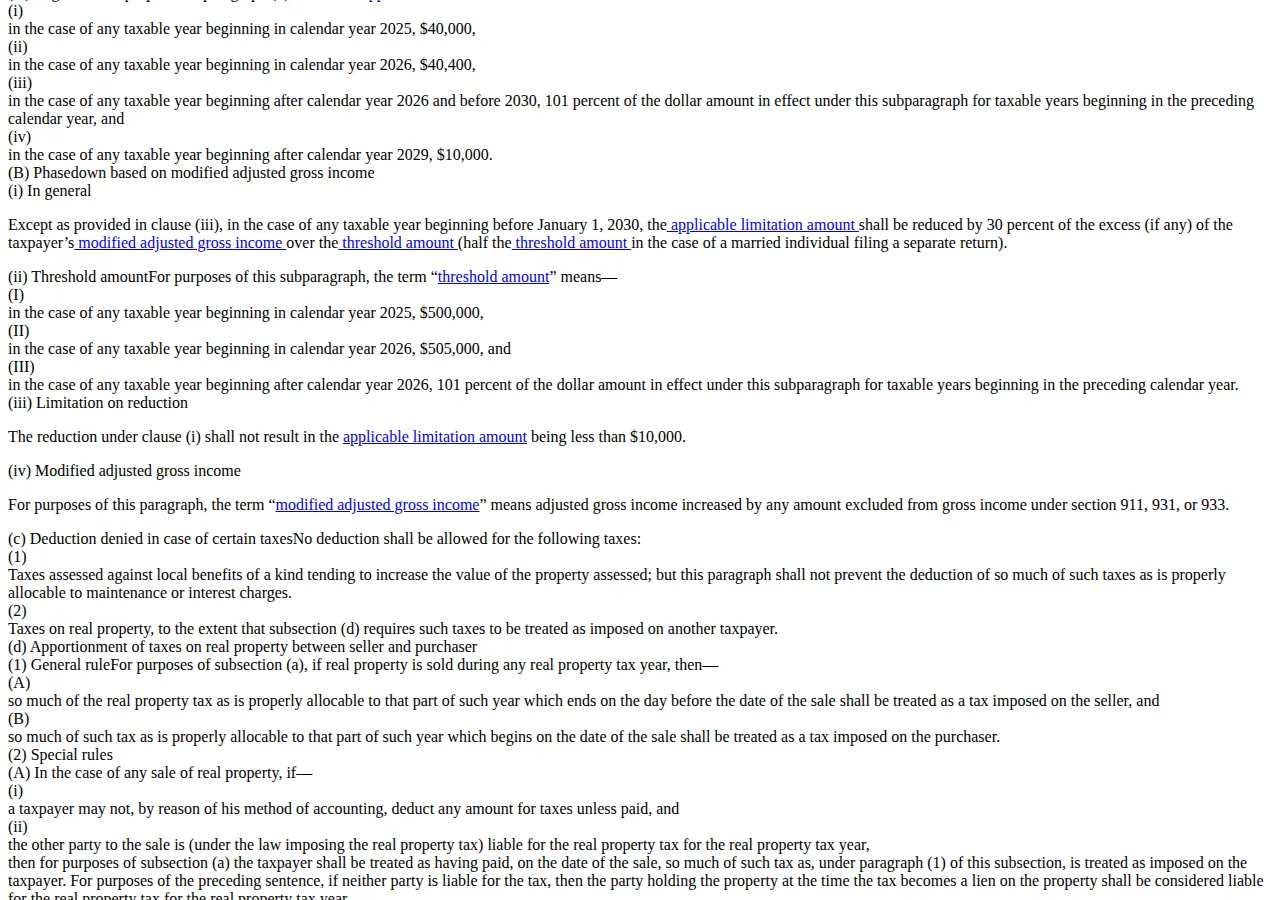
The 2027 through 2029 figures are the statute's own arithmetic at 101 percent of the prior year: the 2028 cap is $41,212.04 and the 2029 cap is $41,624.16; the table rounds to whole dollars.
The phase-down: 30 cents per dollar over the threshold
Above the threshold, the cap falls by 30 percent of the excess of modified adjusted gross income over the threshold, and the reduction can never take the cap below $10,000 ($5,000 for married filing separately). The formula, straight from section 164(b)(7)(B):
Three worked cases for 2025, all married filing jointly:
| MAGI | Excess over $500,000 | Reduction (30 percent) | Cap |
|---|---|---|---|
| $420,000 | $0 | $0 | $40,000 |
| $550,000 | $50,000 | $15,000 | $25,000 |
| $600,000 | $100,000 | $30,000 | $10,000 (floor) |
| Authority | 26 U.S.C. section 164(b)(7)(B)(ii) | 26 U.S.C. section 164(b)(7)(B)(i) | 26 U.S.C. section 164(b)(7)(B)(iii) |
The floor is reached when the excess equals the cap minus $10,000, divided by 0.30. For 2025 that is $500,000 plus $100,000 — a MAGI of $600,000. For 2026 it is $505,000 plus $30,400 divided by 0.30, which is $101,333.33 — a MAGI of $606,333.33. Every dollar of MAGI between the threshold and the floor costs 30 cents of cap, so a taxpayer at $550,000 in 2026 keeps a $26,900 cap ($40,400 minus 30 percent of $45,000), and at $600,000 keeps $11,900 ($40,400 minus 30 percent of $95,000). The phase-down is the single most expensive planning mistake in this guide: a $10,000 year-end bonus that pushes MAGI $10,000 further past the threshold costs $3,000 of SALT deduction.
The worked return: a New Jersey couple
Take the couple from the opening paragraph. Married filing jointly, 2025, MAGI $420,000, New Jersey property tax $18,000, New Jersey income tax $34,000, mortgage interest $9,000, charitable gifts $3,000:
Against the old $10,000 cap, the same $30,000 of extra deduction is $7,200 a year at 24 percent, and $9,600 at 32 percent.
Under the old cap the same couple itemized $22,000 and took the standard deduction instead. The change moves millions of households across the itemize-or-standard line.
A single filer, 2025, MAGI $180,000, SALT paid $22,000, mortgage interest $6,000: deductible SALT is $22,000, under the cap. Itemized total is $28,000 against a $15,750 standard deduction — a $12,250 advantage worth $2,695 at a 22 percent marginal rate. Under the old cap the same filer itemized $16,000 and took the standard deduction.
The pass-through-entity workaround still beats the cap
The $40,000 cap applies to individuals. It does not apply to a partnership or an S corporation that pays state income tax at the entity level. IRS Notice 2020-75 announced that specified income tax payments made by a partnership or S corporation are deductible in computing the entity's income and are not subject to the individual SALT cap. As of May 2023, 36 states and New York City had adopted pass-through-entity tax regimes, and more have followed. The mechanics: the entity elects into the state regime, pays the state tax itself, deducts the payment as a business expense on the federal return, and the owners receive a credit on their personal state returns so the income is not taxed twice at the state level.
The worked case: an S corporation with $300,000 of pass-through income in a state with a 5 percent income tax. The entity pays $15,000 of state tax at the entity level. Federal taxable income falls $15,000, and at a 24 percent marginal rate the owner saves $3,600 of federal tax. If the same owner paid the $15,000 personally, and already had $25,000 of property tax, total personal SALT would be $40,000 — exactly at the cap — and the $15,000 of income tax would buy zero additional federal deduction. The workaround is worth $3,600 a year on these facts, every year, and the OBBBA cap increase did not change it: Notice 2020-75 is untouched by section 70120, and the cap increase only narrows the gap for owners whose personal SALT already fits under $40,000. The boundary: the election adds a state return and estimated payments, and it reduces qualified business income for the section 199A deduction, so the net benefit needs a CPA. The section 199A QBI deduction playbook runs the QBI side of that trade-off, and the Schedule C profit and loss playbook shows how the entity's income reaches the owner's return in the first place.
The traps: prepayment, AMT, and the 2030 cliff
A taxpayer in the 28 percent AMT bracket with $40,000 of SALT gets no federal benefit from any of it — the AMT computation adds the full amount back. Bunching works when the tax is assessed and the payment is made in the same year, and fails when the payment runs ahead of the assessment. And any multi-year decision that prices in $40,000 of SALT relief in 2031 is pricing in a law that does not exist yet.
The decision table
| Operator shape | SALT paid | MAGI | Best move | Authority |
|---|---|---|---|---|
| MFJ, high-tax state, itemizes | $52,000 | $420,000 | Itemize; full $40,000 cap | 26 U.S.C. section 164(b)(7) |
| MFJ, high-tax state, high income | $52,000 | $550,000 | Itemize; cap is $25,000 | 26 U.S.C. section 164(b)(7)(B) |
| MFJ, MAGI above $600,000 | Any | $600,000+ | Cap is $10,000; PTET is the lever | Notice 2020-75 |
| Single, moderate SALT | $22,000 | $180,000 | Itemize; SALT under cap | Rev. Proc. 2025-32 |
| Standard-deduction filer | Any | Any | No benefit; cap is irrelevant | 26 U.S.C. section 63(c) |
| AMT payer | $40,000 | Any | No benefit; SALT added back | 26 U.S.C. section 56(b)(1)(A) |
| S-corp / partnership owner | $15,000 state tax | Any | Elect PTET; deduct at entity level | Notice 2020-75 |
Who should NOT chase the cap
Not everyone benefits, and chasing it costs time and fees. Do not build a plan around the $40,000 cap if your modified adjusted gross income is above $606,333 in 2026 — you are at the $10,000 floor and the cap is already gone. Do not itemize if your total itemized deductions stay below the standard deduction: $32,200 for a married couple in 2026, $16,100 single. Do not prepay property tax that has not been assessed yet. Do not assume the cap survives 2029. And do not elect a pass-through-entity tax without a CPA running the QBI interaction — the federal saving can be smaller than the compliance cost on a small entity. The 1099-NEC contractor reporting playbook covers the reporting side for owners who pay contractors through the same entity, and the tax estimator runs the itemized-versus-standard comparison on your own numbers before you commit to a strategy.
The execution checklist
- [x] Step 1: Total your SALT. Add property tax, state income tax, and local tax paid in the year. Compare the total to the cap for your filing status and year.
- [x] Step 2: Compute your MAGI. Adjusted gross income plus foreign earned income exclusions under sections 911, 931, and 933. Compare it to the $500,000 threshold for 2025 or $505,000 for 2026.
- [x] Step 3: Apply the phase-down. Cap minus 30 percent of the MAGI excess over the threshold, floored at $10,000. Write the number down before any planning.
- [x] Step 4: Run itemized versus standard. Add the capped SALT to mortgage interest, charitable gifts, and other itemized deductions. Itemize only if the total beats $31,500 (MFJ, 2025) or $32,200 (MFJ, 2026).
- [x] Step 5: Check AMT. If the alternative minimum tax applies, the SALT deduction adds back in full — confirm the benefit survives before relying on it.
- [x] Step 6: Price the PTET election. If you own a pass-through entity in a PTET state, have your CPA compare the entity-level deduction against the personal cap, including the QBI effect.
- [x] Step 7: Calendar the cliff. The cap reverts to $10,000 in 2030. Re-run this checklist in late 2029; do not let a five-year plan quietly expire.
The estate tax exemption $15 million playbook runs the other side of the same household balance sheet: the $15,000,000 exclusion, the portability election, and the Form 706 deadline.
Capital gains add to taxable income and can push a filer into the 15 or 20 percent band, so the tax-loss harvesting playbook shows how a harvested loss lowers the bill before the cap bites.
Rental losses and the section 469 allowance change the itemized total — see the Schedule E rental income playbook.
Gifts also move state tax — the gift tax playbook runs the 2026 exclusion and Form 709 math.