IRS Form 1040 Schedule 1: Additional Income & Adjustments — The Operator's Playbook
Form 1040 is a summary page with room for wages, interest, and dividends — and then it stops. Everything else a taxpayer earns, and every adjustment that lowers income before the standard deduction, lives on Schedule 1. If your return has a side business, unemployment, gambling winnings, a state refund, an HSA, or an IRA, Schedule 1 is where it is decided.
One dating note first. Line structure follows the 2025 Schedule 1 form and instructions, current when researched on November 6, 2026; the 2026 form was not yet posted, so all 2026 dollars come from Rev. Proc. 2025-32, Rev. Proc. 2025-19, IR-2025-107, IR-2025-111, and the December 2026 instructions.
Who this is for — and who should stop here
This guide is for the filer whose income does not fit on the face of Form 1040: the freelancer with Schedule C profit, the landlord with Schedule E income, the worker who collected unemployment, the teacher buying classroom supplies. It is also for the preparer explaining a $4,500 casino win that raised a client's tax when they lost $3,000 the same night.
Stop here if your return is wages and bank interest only — you do not file Schedule 1. Get professional help for a net operating loss carryforward, a § 461(l) excess business loss, foreign earned income, or cancellation of debt tied to bankruptcy or insolvency: the elections are easy to get wrong and expensive to fix.
Schedule 1 carries the same identification as Form 1040: your Social Security number (SSN), or an Individual Taxpayer Identification Number (ITIN) if you are not eligible for an SSN. A sole proprietor reports on Schedule C under the owner's SSN; a partnership or S corporation files under its own Employer Identification Number (EIN) and passes its result on a Schedule K-1 to line 5. An LLC is not a tax classification: a single-member LLC reports on Schedule C, an LLC electing S-Corp treatment passes income through on a K-1, and a C-Corp pays its own tax. Employees pay FICA tax through withholding; the self-employed pay SECA tax on Schedule SE, and half of that tax is line 15. These are tax-basis numbers, not GAAP — a CPA prepares the return, but the taxpayer signs it.
The authority frame: what Schedule 1 does to AGI
26 U.S.C. § 62(a) defines adjusted gross income as gross income minus the listed deductions, and Schedule 1 is the worksheet: Part I adds income the face of Form 1040 has no room for; Part II subtracts the § 62 adjustments:
Line 10 goes to Form 1040 line 8; line 26 to line 10. AGI on line 11 is line 9 minus line 10, and everything downstream keys off AGI — standard deduction, taxable income, tax table, most credits, the IRA and student-loan phase-outs. An error here reprices the whole return.
Part I: additional income, lines 1–9
Most Part I lines are pass-throughs from another schedule.
| Line | What lands here |
|---|---|
| 1 | State/local tax refunds |
| 2a | Alimony, pre-2019 agreements |
| 3 | Business income or loss (Schedule C) |
| 4 | Other gains/losses (4797/4684) |
| 5 | Rental/royalties/partnerships/S corps |
| 6 | Farm income or loss |
| 7 | Unemployment compensation |
| 8a–8z | Other income (26 sub-lines) |
| 10 | Total additional income |
Line 1: a state refund is taxable only if you itemized in the year you paid the tax; if you took the standard deduction, or deducted state sales taxes, none of it is taxable. Line 2a is narrower than expected: alimony counts only for agreements executed on or before December 31, 2018, unless later changed to expressly exclude it. Under a later agreement it is not income — the same cutoff governs line 19a.
Schedule C profit or loss flows to line 3 (Schedule C playbook). Rental, royalty, partnership, and S corporation income arrive from Schedule E on line 5 (Schedule E playbook). Capital gains do not appear here — they go through Schedule D (Schedule D playbook); only Form 4797 and Form 4684 gains land on line 4.
Unemployment compensation is fully taxable ordinary income; the code has no exclusion for it. Repaying an overpayment during the year reduces line 7.
Line 8 is the catch-all: 8a net operating loss (negative); 8b gambling winnings in full — losses go on Schedule A if you itemize; 8c cancellation of debt; 8i prizes and awards; 8m Olympic medals/USOC prizes; 8p the § 461(l) adjustment; 8z the residual. Line 9 totals 8a–8z; line 10 adds lines 1–7 and line 9.
Where 1099-K and 1099-NEC amounts land
Two information returns cause most Schedule 1 routing errors, and both changed for 2026: a 1099-K reports payments settled through a third-party network, and a 1099-NEC reports nonemployee compensation. Neither decides whether the money is taxable — both only report that it was paid.
| Situation | 2026 reporting test | Where it lands | Authority |
|---|---|---|---|
| 1099-K, payment app/marketplace | Over $20,000 AND over 200 transactions | Schedule C or capital-gain reporting | IR-2025-107 |
| 1099-K, amount in error or personal items at a loss | No threshold | Top-of-form entry | Schedule 1 form |
| 1099-NEC, contractor work | $2,000 for 2026; $600 for 2025 | Schedule C, then Schedule 1 line 3 | Instructions, 12/2026 |
The One, Big, Beautiful Bill retroactively reinstated the pre-2021 test: a third-party settlement organization need not file unless reportable payments to a payee exceed $20,000 and transactions exceed 200, per platform, per year (IR-2025-107). A seller with $24,000 across 260 transactions gets a 1099-K; one with $25,000 across 150 does not. The threshold governs reporting, not taxability: amounts reported in error, or for personal items sold at a loss, go at the top of Schedule 1, out of income.
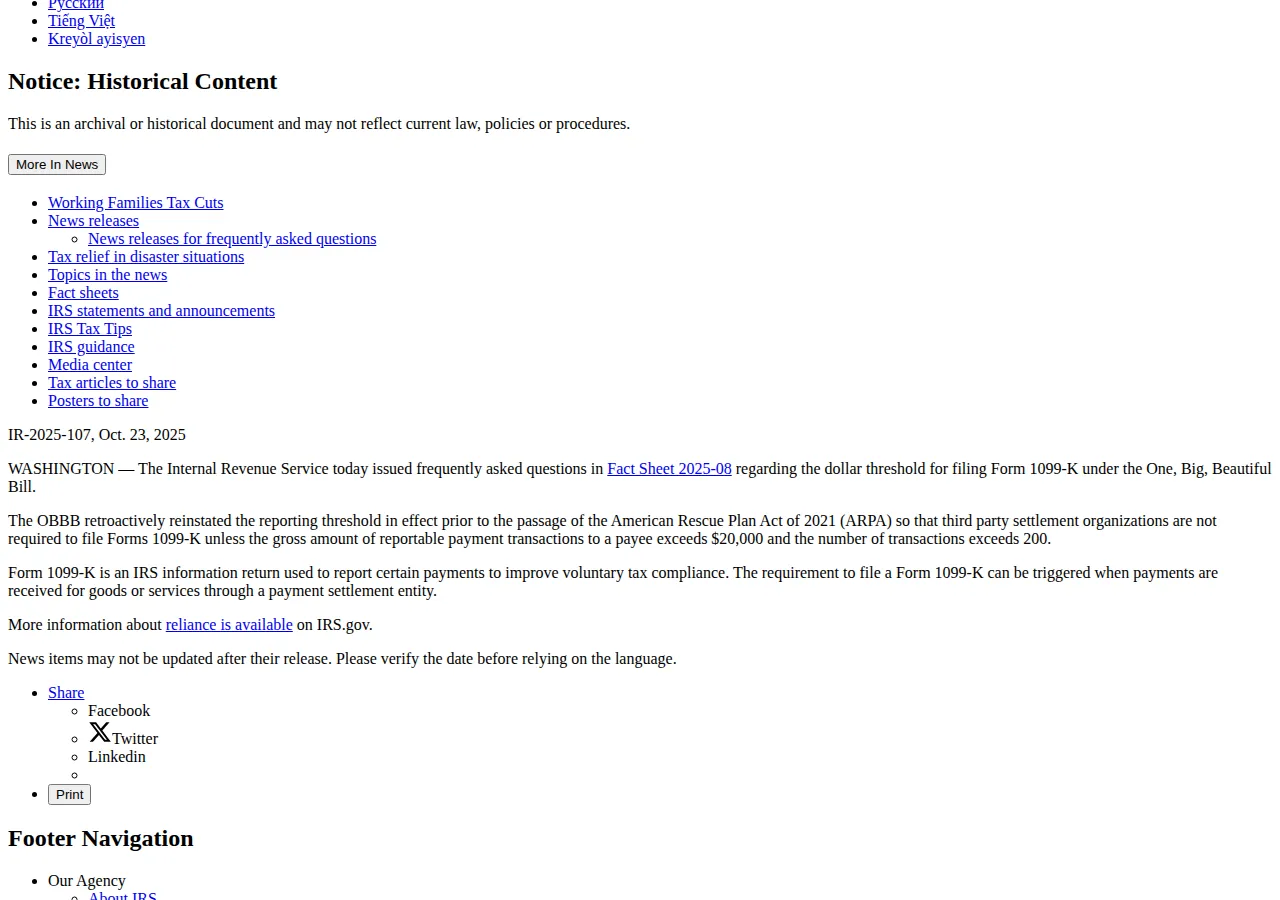
The 1099-NEC threshold moved the other way: the December 2026 instructions raise the minimum to $2,000 for tax years beginning after 2025, adjustable for inflation from 2027. A client who paid a contractor $1,500 in 2026 need not issue a 1099-NEC — but the contractor still reports it. The 1099-NEC playbook covers the payer side.
Part II: adjustments to income, lines 11–26
Part II is the valuable half. These adjustments reduce AGI dollar for dollar, help whether or not you itemize, and lower the AGI other phase-outs are measured against.
| Line | Adjustment | 2026 limit |
|---|---|---|
| 11 | Educator expenses | $350 |
| 12 | Reservists/performers/fee-basis | Actual expenses |
| 13 | HSA | $4,400 self-only; $8,750 family |
| 14 | Moving, Armed Forces only | Actual expenses |
| 15 | Half of SE tax | One-half of SE tax |
| 16 | SEP/SIMPLE plans | Plan limits |
| 17 | SE health insurance | Premiums paid |
| 18 | Early-withdrawal penalty | Amount forfeited |
| 19a | Alimony paid, pre-2019 | Amount paid |
| 20 | IRA deduction | $7,500; $8,600 at 50+ |
| 21 | Student loan interest | $2,500 maximum |
| 26 | Total adjustments | Lines 11–23 + 25 |
Line 11 is capped at $350 for 2026 — books, supplies, and classroom materials for eligible educators. Line 13, the HSA deduction, is capped by Rev. Proc. 2025-19: $4,400 self-only and $8,750 family under a high deductible health plan, with minimum deductibles of $1,700 and $3,400 and out-of-pocket maximums of $8,500 and $17,000. Employer contributions count toward it.
Line 15 trips up self-employed filers most. Schedule SE multiplies net earnings by 92.35%, applies 12.4% Social Security tax up to the 2026 wage base of $184,500 and 2.9% Medicare tax, and its line 13 lands on Schedule 1 line 15. Section 164(f) allows exactly one-half of the § 1401 tax.
Line 20, the IRA deduction, for 2026 (IR-2025-111): the limit is $7,500, up from $7,000, plus $1,100 at 50 and over. Deductibility is separate: a single filer covered by a workplace plan phases out between $81,000 and $91,000 of modified AGI; a covered joint filer, between $129,000 and $149,000. No workplace plan means no income test. Line 21, student loan interest, caps at $2,500 and phases out above $85,000 single and $175,000 joint, ending at $100,000 and $205,000. At modified AGI of $92,500 with $2,400 of interest paid, a single filer keeps half:
The § 461(l) excess business loss limitation
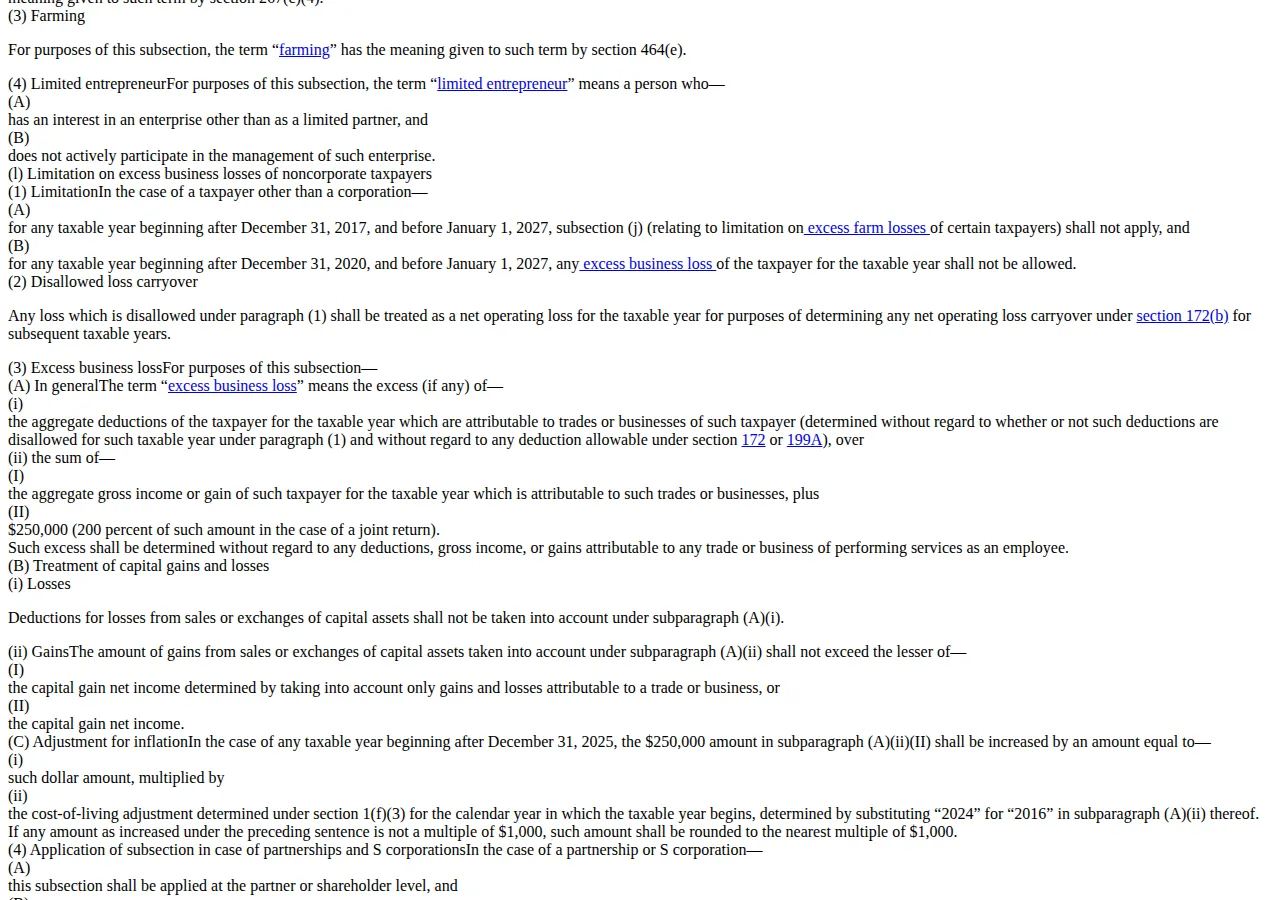
Section 461(l) caps the business loss a noncorporate taxpayer can use in one year — which is why line 8p exists. Under § 461(l)(3), the excess business loss is aggregate trade-or-business deductions over aggregate trade-or-business gross income plus a threshold — $250,000 in the statute ($500,000 joint) — inflation-adjusted after 2025. Rev. Proc. 2025-32 sets the 2026 threshold at $256,000, or $512,000 for joint returns. The disallowed loss is not lost: § 461(l)(2) treats it as a net operating loss carryover. The limit applies after § 469, at the partner or shareholder level. The One, Big, Beautiful Bill made it permanent (Pub. L. 119–21 § 70601).
Worked: a single filer has Schedule C gross income of $210,000 and deductions of $640,000 — a net loss of $430,000. The excess is $640,000 minus ($210,000 + $256,000), or $174,000, disallowed for 2026, entered on line 8p, and carried forward as a net operating loss. The loss allowed is $430,000 minus $174,000, or $256,000 — exactly the threshold.
Worked example: one return, start to finish
Maya, 34, single, with no workplace plan, earned $92,000 in wages, ran a side business, collected unemployment for two months, and won $4,500 at a casino while losing $3,000:
| Schedule 1 line | Item | Amount |
|---|---|---|
| 1 | State tax refund | $1,800 |
| 3 | Schedule C income | $18,400 |
| 7 | Unemployment | $6,200 |
| 8b | Gambling winnings | $4,500 |
| 8i | Prizes and awards | $1,200 |
| 9 | Total other income | $5,700 |
| 10 | Additional income | $32,100 |
| 11 | Educator expenses | $350 |
| 13 | HSA deduction | $4,400 |
| 15 | SE tax, half | $1,300 |
| 20 | IRA deduction | $7,500 |
| 26 | Total adjustments | $13,550 |
Line 10: $1,800 + $18,400 + $6,200 + $5,700 = $32,100. Line 26: $350 + $4,400 + $1,300 + $7,500 = $13,550. Total income: $92,000 + $32,100 = $124,100. AGI: $124,100 − $13,550 = $110,550.
Schedule C profit is $18,400; Schedule SE multiplies by 92.35% for net earnings of $16,992.40, then applies 15.3% for tax of $2,599.84, rounded to $2,600. One-half is $1,300. Had she been covered by a workplace plan, her IRA deduction would be zero — her AGI exceeds the $81,000–$91,000 phase-out.
The 2026 single standard deduction is $16,100, so taxable income is $110,550 minus $16,100, or $94,450. Under the 2026 single tax table, the tax is $5,800 plus 22% of $44,050, or $15,491. Her $3,000 of gambling losses appear nowhere here: she takes the standard deduction, so she cannot itemize them; even itemizing, § 165(d) caps the deduction at 90%. Break-even is now taxable: $10,000 won against $10,000 lost leaves a $9,000 deduction and $1,000 of taxable winnings. Test a different income mix with the profit calculator.
Founder & CEO Insight — Enow A. Jovial
The five-step filing sequence
- Gather every information return — W-2, 1099-NEC, 1099-K, 1099-G, 1099-R, K-1 — and match each to a Schedule 1 line first.
- Complete Schedules C, D, E, and F before touching Schedule 1; lines 3, 5, and 6 are pass-throughs.
- Enter Part I top to bottom, then add lines 9 and 10, re-adding by hand.
- Enter Part II, then check each phase-out: IRA coverage, student-loan MAGI, the HSA ceiling.
- Post lines 10 and 26 to Form 1040 lines 8 and 10 and verify the footings: total income minus adjustments equals AGI, and AGI minus the standard deduction equals taxable income.
Execution checklist
- Route every 1099-K amount by the nature of the transaction; erroneous or personal-items-at-a-loss amounts go at the top of Schedule 1.
- Check the HSA ceiling against employer contributions.
- Confirm the IRA coverage test before claiming line 20: covered single filers phase out at $81,000–$91,000 for 2026.
- Recompute Schedule SE line 13 by hand.
- If business losses approach $256,000 single or $512,000 joint, run § 461(l) before year-end and enter any excess on line 8p.
- Re-add lines 9, 10, 25, and 26, and confirm Form 1040 lines 8, 10, and 11.
What Schedule 1 cannot do
Schedule 1 cannot fix a missing information return, or convert a nondeductible item into a deduction by relabelling it. Gambling losses stay on Schedule A. A state refund stays nontaxable only if you did not itemize the year you paid the tax. A civilian move is not deductible. The schedule's totals are only as honest as the source schedules: a Schedule C with invented expenses produces a line 3 no Schedule 1 arithmetic can rescue. the return is a single document, and Schedule 1 is where the filer proves they understand what they earned and what the law allows them to subtract.
A disallowed EITC is reclaimed on Form 8862 — see our IRS Form 8862 playbook.