Section 465 At-Risk Rules: The Playbook for Deducting Only What You Can Actually Lose
Founder & CEO Insight — Enow A. Jovial
Daniel is a partner in an LLC that leases construction equipment, one of the five activities Section 465(c)(1) names. In 2026 the LLC allocates a $150,000 loss to Daniel. He contributed $40,000 in cash and equipment with a $25,000 adjusted basis. His share of the recourse bank loan is $60,000; his share of the nonrecourse loan, secured only by the equipment, is $40,000. Daniel claims the full $150,000. The correct deduction is $125,000; the $25,000 difference is suspended, not lost.
The decision in one table
| Your position | The move | Tax result | Authority |
|---|---|---|---|
| Cash and property contributed | Count it | Raises the deductible loss | IRC § 465(b)(1)(A) |
| Recourse debt you are personally liable to repay | Count your share | Raises the deductible loss | IRC § 465(b)(2)(A) |
| Nonrecourse debt secured only by activity property | Do not count it | No increase in the deductible loss | IRC § 465(b)(4) |
| Qualified nonrecourse financing on real property | Count it, even with no personal liability | Raises the deductible loss | IRC § 465(b)(6) |
The Section 465(a) limit, in one sentence
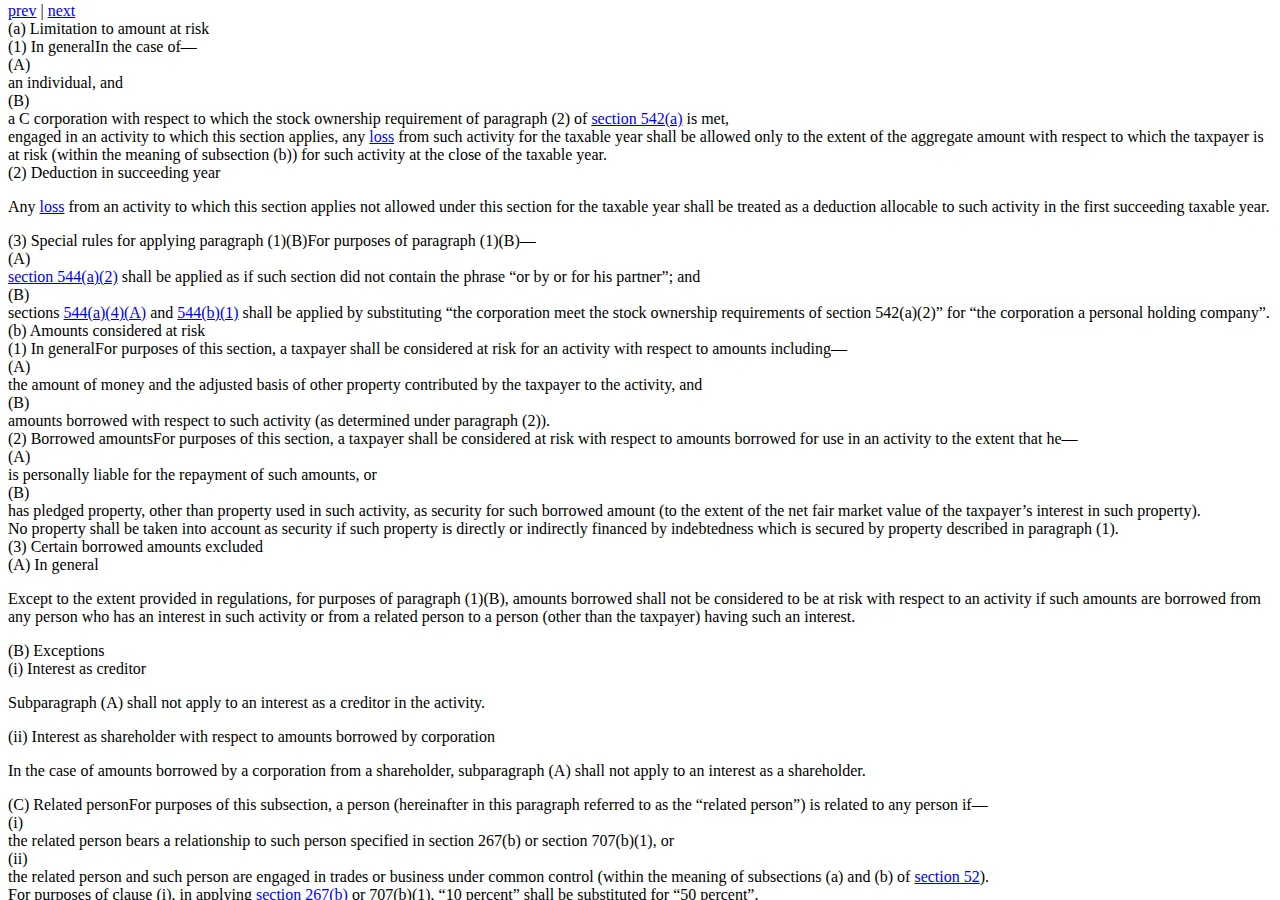
Section 465(a)(1) caps the loss from an activity at "the aggregate amount with respect to which the taxpayer is at risk" for that activity at the close of the year, and it applies to individuals and to C corporations meeting the Section 542(a)(2) stock-ownership test. Partners and S corporation shareholders apply the limit at the owner level. A widely held C corporation is outside the rule; a closely held one described in Section 465(a)(1)(B) is inside it. Section 465(a)(2) carries the disallowed loss forward to the same activity in the first succeeding taxable year.
The three gates, in order
No loss reaches your return without passing three gates in order: basis first, then at-risk, then passive. Publication 925 states that the at-risk rules must be applied before the passive activity rules.
Gate 1 is basis. Under Section 704(d)(1), a partner's loss is allowed only up to the adjusted basis of the partnership interest at the end of the partnership year, with the excess carried over under Section 704(d)(2).
Gate 2 is at-risk. Daniel's at-risk amount is $125,000, so $25,000 of his $150,000 loss stops here and carries forward under Section 465(a)(2).
Gate 3 is passive. Section 469(a)(1) disallows the passive activity loss of individuals, estates, trusts, closely held C corporations, and personal service corporations, and Section 469(b) carries it to the next year. A passive activity is a trade or business in which the taxpayer does not materially participate under Section 469(c)(1); rental activity is passive by definition under Section 469(c)(2). Daniel materially participates, so his $125,000 clears gate 3. As a silent investor, the same $125,000 would stop at gate 3 and wait for passive income. Each gate suspends only what survived the gate before it.
What counts toward your at-risk amount
Section 465(b)(1) counts money and the adjusted basis of contributed property, plus amounts borrowed for the activity. Borrowed amounts count under Section 465(b)(2) only to the extent the taxpayer "is personally liable for the repayment of such amounts," or has pledged property outside the activity as security, up to its net fair market value. Cash counts. Property counts at adjusted basis, not fair market value — Daniel's equipment counts at $25,000. A loan counts when the lender can reach beyond the activity's own assets.
Section 465(b)(5) keeps the figure honest: an allowed loss reduces the at-risk amount for later years, so a large year-one deduction can leave it at zero in year two.
What does not count
Three exclusions strip amounts out.
First, Section 465(b)(3)(A): borrowed amounts are not at risk if borrowed from a person with an interest in the activity, or from a related person of someone with such an interest. Two narrow exceptions survive — an interest held only as a creditor, and, for a corporation borrowing from a shareholder, one held only as a shareholder.
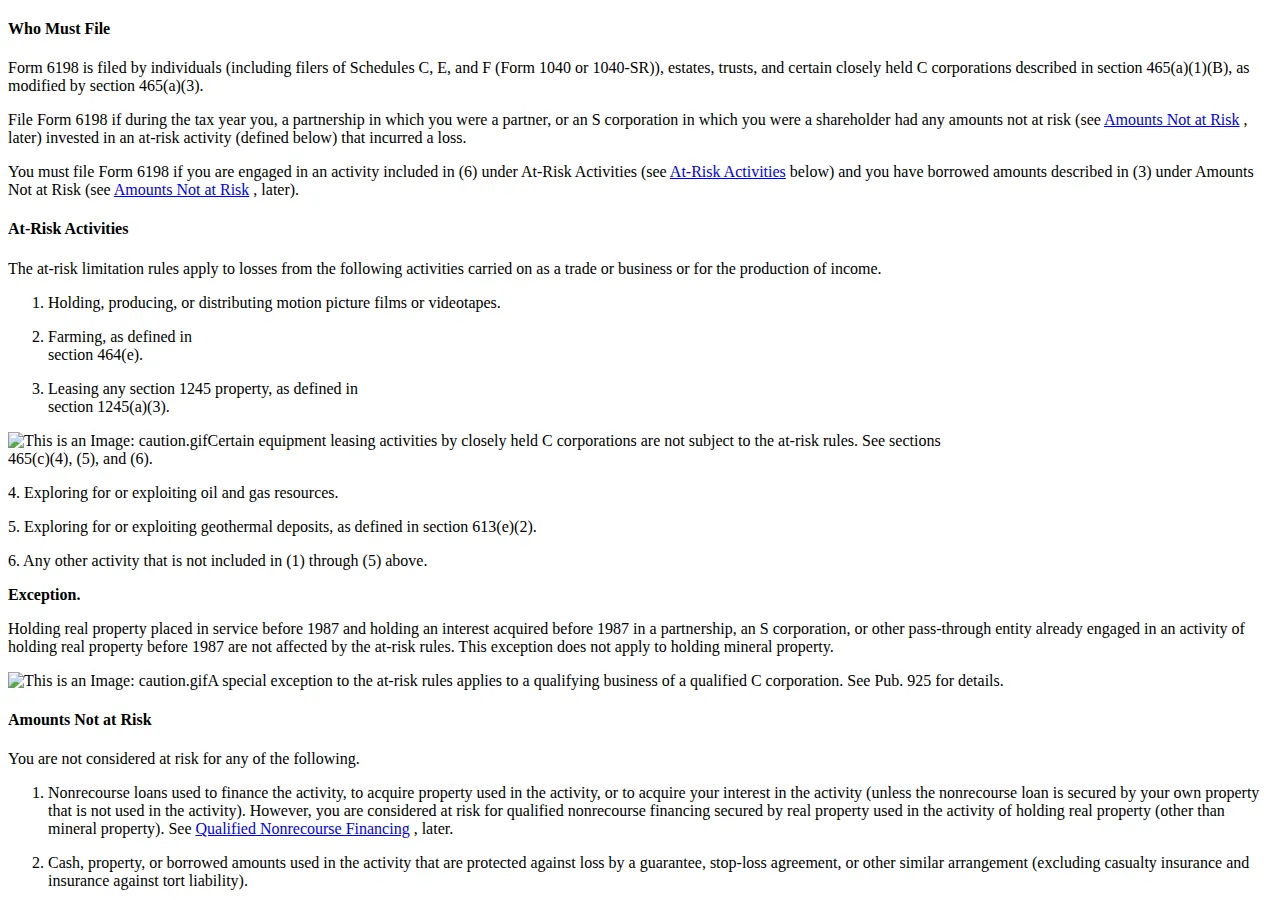
Second, Section 465(b)(4): "a taxpayer shall not be considered at risk with respect to amounts protected against loss through nonrecourse financing, guarantees, stop loss agreements, or other similar arrangements." If a general partner promises to make you whole, or a stop-loss agreement caps your downside, the protected dollars are not at risk even if the borrowing is recourse.
Qualified nonrecourse financing: the real-estate exception
Real property gets one broad exception: under Section 465(b)(6)(A), a taxpayer is considered at risk for their share of qualified nonrecourse financing secured by real property used in the activity. Qualified nonrecourse financing under Section 465(b)(6)(B) must be borrowed for holding real property, from a qualified person or a Federal, State, or local government (or guaranteed by one), with no person personally liable, and not convertible debt. A commercial mortgage on a rental building from an unrelated bank is the standard case: no partner is personally liable, yet every partner counts their share under Section 465(b)(6)(C) and Section 752. Related-person financing can still qualify if commercially reasonable and on substantially the same terms as unrelated loans, under Section 465(b)(6)(D)(ii).
Worked example 1 — Daniel's recourse loan counts, and the nonrecourse loan does not
Daniel's at-risk amount at the close of the year is:
The $40,000 nonrecourse share is left out: the lender's only remedy is the equipment. His $150,000 loss first passes the basis gate — outside basis $165,000 — and then meets the at-risk gate at $125,000.
Daniel deducts $125,000 this year. The $25,000 is treated as a deduction allocable to the leasing activity in the first succeeding taxable year under Section 465(a)(2), tested again against that year's at-risk amount. Another $25,000 of cash or recourse debt next year frees it, if the basis and passive gates still clear. If he does nothing, it waits.
Worked example 2 — Priya's stop-loss agreement erases $60,000 of at-risk amount
Priya is a partner in a film-production partnership — another activity Section 465(c)(1) names — and contributes $50,000 cash. The partnership borrows $200,000 from a bank; Priya's share is $100,000, recourse, with Priya personally liable. On those facts alone her at-risk amount would be $150,000. But the general partner signed a stop-loss agreement covering the first $60,000 of loss on her share of the borrowing. Section 465(b)(4) removes protected amounts from the computation, so her at-risk amount is $90,000.
The partnership allocates Priya a $120,000 loss. Her outside basis is $150,000, so gate 1 clears. Gate 2 allows $90,000 and suspends $30,000. The $60,000 the general partner promised to cover is the amount Priya cannot deduct, because it is the amount she cannot lose. Had the stop-loss covered the full $100,000, her at-risk amount would be $50,000 — her cash alone — and $70,000 would be suspended.
Worked example 3 — Marcus uses qualified nonrecourse financing, then triggers recapture
Marcus joins a rental real estate LLC with $80,000 cash. The LLC borrows $400,000 from a commercial bank, secured by the rental building, with no partner personally liable — qualified nonrecourse financing under Section 465(b)(6) — and Marcus's share is $200,000. The LLC also borrows $120,000 from the seller, a related person, on non-commercial terms; Marcus's $60,000 share does not count. His at-risk amount is $280,000; his outside basis is $340,000, which includes the $60,000 seller-financing share. The lower one governs.
In year one the LLC allocates Marcus a $255,000 loss. It clears the basis gate at $340,000 and the at-risk gate at $280,000, so the full $255,000 is deductible if the passive gate clears. His at-risk amount falls to $25,000 under Section 465(b)(5) and his basis to $85,000. In year two the LLC distributes $40,000 in cash to Marcus. The distribution is within his $85,000 basis, so it produces no gain — but it cuts his at-risk amount to negative $15,000.
Under Section 465(e)(1), if the at-risk amount is below zero at year end, the taxpayer includes the excess in gross income as income from the activity. Marcus reports $15,000 of recapture income in year two, and the same $15,000 is treated as a deduction allocable to the activity in the first succeeding year under Section 465(e)(1)(B). The Instructions for Form 6198 state the same trigger: a current-year profit can still produce recapture income if a distribution cut the at-risk amount below zero.
Form 6198: the four parts
The Instructions for Form 6198 (11/2025) say who must file it: individuals, including filers of Schedules C, E, and F, estates, trusts, and certain closely held C corporations described in Section 465(a)(1)(B). File one Form 6198 for each activity. Partners and S corporation shareholders file at the owner level, starting from their Schedule K-1.
Part I computes the current-year profit or loss, including prior-year nondeductible amounts. Part II is the simplified computation of the amount at risk — opening basis, plus increases, minus decreases — and Part III is the detailed computation for activities that predate the effective-date rules. Part IV computes the deductible loss. The instructions flag the recapture check on line 5: a profit can still produce recapture income if a distribution cut the at-risk amount below zero. Publication 925 covers the recapture rules and the passive-rule coordination.
The execution checklist
- Identify each activity separately. Section 465(c)(2) treats each film, farm, leased section 1245 property, oil and gas property, and geothermal property separately.
- [x] List every activity, and never net one activity's at-risk amount against another's loss.
- Compute the basis gate first. Apply Section 704(d) for a partnership interest or Section 1366(d) for S corporation stock and debt.
- [x] Record the basis at year end before touching Section 465.
- Build the at-risk amount from the statute: cash plus adjusted basis of contributed property plus recourse debt, minus protected amounts.
- [x] Attach the loan documents proving personal liability, and flag every guarantee and stop-loss agreement.
- Test every borrowing against Section 465(b)(3) and (b)(4). A loan from a person with an interest in the activity, and any amount protected by a guarantee, comes out.
- [x] Record lender, borrower, and any related-person link for each loan.
- Check the real-estate exception before excluding nonrecourse debt. Qualified nonrecourse financing under Section 465(b)(6) counts for holding real property.
- [x] Confirm a qualified-person or government lender, no personal liability, and non-convertible debt.
- Run the passive gate last. What survives basis and at-risk is tested under Section 469.
- [x] Record material participation, activity by activity, on the same worksheet.
- File Form 6198 and keep the worksheet. One form per activity, with the Part II computation and the suspended-loss carryforward.
- [x] Carry the suspended loss and closing at-risk amount into next year's opening figures, and have your CPA review the worksheet.
Who should NOT rely on this playbook
This playbook does not cover the excess business loss limitation or the net operating loss rules. It does not cover a widely held C corporation, which Section 465(a)(1) leaves outside the rule, or the equipment-leasing exclusion for certain closely held corporations under Section 465(c)(4). It is not a substitute for advice on whether a financing is qualified nonrecourse financing — that turns on the lender's documents. Use this playbook to compute the number; use a CPA to defend it.
The records that prove the number
The at-risk amount is only as strong as the paper behind it. Your CPA will ask for the LLC's EIN and operating agreement, the S-Corp election and stock ledger, and the C-Corp charter. Keep the loan agreements showing who is personally liable, the guarantee and stop-loss documents Section 465(b)(4) strips out, and the bank statements proving the cash contributions. GAAP books should reconcile capital accounts to tax basis, and payroll records should separate FICA wages from SECA income. Form 6198 is filed under your SSN or ITIN, and the K-1 figures must tie to the partnership return. A worksheet without source documents is an opinion; a worksheet with them is a position.
Section 465 is exact arithmetic: deduct only what you can lose, carry forward the rest. Daniel deducts $125,000 because $25,000 of his loss was never at risk. Priya deducts $90,000 because $60,000 of her borrowing was protected. Marcus deducts $255,000 in year one and reports $15,000 of recapture income in year two because a $40,000 distribution pushed his at-risk amount below zero. Work the three gates in order, file Form 6198 per activity, keep the loan documents. For the gate that follows this one, read our Section 469 playbook; for the return behind these examples, read our Form 1065 playbook; for the sole proprietor's version, read our Schedule C playbook; and run the numbers through our tax estimator before you file.